

Top DeFi vaults, onchain quant strategies, curator rankings and more
Joined October 2021
- Tweets3.2K
- Following2.3K
- Followers5.3K
- Likes2.7K







Trading Strategy retweeted

For anyone interested in learning more about Growi and our trading strategy, this is a great place to start! 👇
Thank you so much! @TradingProtocol It was a real pleasure joining you guys! 🙌

Listen to our Trading Strategy Podcast episode #14 with Growi Finance (@GrowiFinance) and learn how a research-driven, mid-frequency mean-reversion strategy became one of the top-performing vaults on Hyperliquid, and why risk-by-design matters more than chasing yield.
In this episode, Nertila (@theblue_panda) from Trading Strategy discusses with Valentin and Miguel from Growi Finance. Growi Finance is a quantitative asset-management firm building on-chain yield products to institutional standards. It describes itself as the allocation layer for digital asset yield, serving both retail investors and professional allocators.
👉 View Growi Finance vault data on Trading Strategy tradingstrategy.ai/vaults/cu…
👉 Listen to the podcast on Spotify open.spotify.com/episode/009…
👉 Listen to the podcast on YouTube youtu.be/w7X9P1eYV40
Trading Strategy retweeted

The cautious excitement when you're sitting on a new product that might be the best thing you've done in your career.
I think we might have something soon that is going to be a game changer in DeFi
Trading Strategy retweeted

Frankencoin Shares (FCS) are live and tradable. Get them on @Uniswap.
To celebrate the occasion we are releasing a limited version of the FCS T-Shirt.
Share this post.
Claim it for free.
Only for 24hrs.
While supply lasts.
merch.frankencoin.com/discou…

Trading Strategy retweeted
See you in Seoul! 🇰🇷

Also taking the stage: 🎤
5) Peter Chung — Head of Research, @Presto_Labs
6) Sean Kim — APAC Growth, @Tangem
7) Valentin Garcia — CEO & CIO, @GrowiFinance
8) Nova Wong — Co-Founder, @Vishwa_lab
See you in Seoul. 🇰🇷

Trading Strategy retweeted

US 2y pays 4.9%. 10y just hit 5.13%.
Aave USDC pays 3.72%.
most DeFi yields now pay you less than the US government - for more risk.
If you're going onchain, the spread is the only number that matters.
eEARN on @EmberProtocol is running ~10%.

Trading Strategy retweeted

Zero-day remote code execution vulnerability in iPhone Safari. Click a link, and your crypto, passwords and everything else on your iPhone are gone.
Exploited in the wild by "DarkSword" malware.
"The DarkSword attack program has leaked, with its core capability being: extracting forensic-level data from iOS devices via HTTP interfaces. In actual attacks, attackers can combine social engineering or watering hole attacks to lure users into falling victim, thereby stealing data from iPhone / iPad devices and uploading it to servers controlled by the attackers."
Update iPhones immediately. Apple originally patched this, but rumours suggest even the latest versions are vulnerable, “pending confirmation,” across a wider range than the original 18.4–18.7 window.
From a Chinese security researcher, SlowMist CISO, @im23pds
xitter.cf/im23pds/status/2101265…

Urgent security advisory for iOS users!
Install the latest iOS update immediately. Security researchers report that financially motivated attackers are now using a complete, in-the-wild exploit chain that can quietly steal cryptocurrency private keys and mnemonic seed phrases from iPhones.
The reported attack begins when a target is socially engineered into opening a malicious page in Safari. That page is said to abuse a memory-corruption flaw in WebKit / JavaScriptCore to gain arbitrary read/write access from JavaScript, then bypass Pointer Authentication Codes (PAC) to run native code, break out of the WebContent sandbox, and escalate to kernel/root privileges.
With that access, attackers can pull data from the device Keychain and from local crypto wallet apps.
The claimed impact range is iOS 13 through iOS 26.5; that range has not been independently confirmed in full. Until more is known, treat any unpatched device as potentially exposed and update as soon as a newer build is available. Also avoid untrusted links in Safari, especially if you keep wallet keys or seed phrases on the phone.
Trading Strategy retweeted

The major dynamic to watch for re btc strength is saylor reentering the market, or a strong debasement narrative forming. Without either, I don't think it's going to outperform unless the market draws down.
I think both catalysts have >33% probabilities over the next few weeks.
1. Saylor has almost repegged strc and bought back part of the pref stack, has raised significant cash, and the mstr mnav premium is expanding rapidly
2. treasury yields are rising rapidly. If they continue to increase, people will seek out the debasement narrative imo. The scenario where they start to fall is also somewhat positive btc and gold given the inverse correlation to real yields


Trading Strategy retweeted

🎙️ New podcast with @TradingProtocol on Atoma and why points on perp DEXs should come on top of profit, not at the cost of your capital.

Sat down with @theblue_panda from @TradingProtocol to talk about the thing most perp DEX users get backwards.
Points are supposed to be a bonus on top of profit. For most people they are a reward for slowly bleeding capital on oversized positions.
The way we run it at @atoma_fi:
> Long and short across perp DEXs at the same time, price exposure neutralized
> Yield comes from the funding-rate spread, not from directional bets
> Points come on top of that, never as the reason to size up
Trading Strategy retweeted

Sat down with @theblue_panda from @TradingProtocol to talk about the thing most perp DEX users get backwards.
Points are supposed to be a bonus on top of profit. For most people they are a reward for slowly bleeding capital on oversized positions.
The way we run it at @atoma_fi:
> Long and short across perp DEXs at the same time, price exposure neutralized
> Yield comes from the funding-rate spread, not from directional bets
> Points come on top of that, never as the reason to size up
Listen to our Trading Strategy Podcast episode #12 with Atoma (@atoma_fi) and learn why points on perp DEXs should come on top of profit, not at the cost of bleeding your capital.
In this episode, Nertila (@theblue_panda) from Trading Strategy discusses with Anton (@T0nyCrypt0) from Atoma. Atoma is a delta-neutral USDC yield vault that opens long and short positions across perpetual DEXs at the same time, neutralizing price exposure while capturing funding-rate spreads.
👉 View Atoma vault data on Trading Strategy tradingstrategy.ai/vaults/cu…
👉 Listen to the podcast on Spotify open.spotify.com/episode/7C2…
👉 Listen to the podcast on YouTube youtu.be/PWNJyuylDv8


Trading Strategy retweeted

Mainnet day 🫡
Proud to be supporting liquidity for @ekidenfi as the first CLOB-based derivatives exchange goes live on @CantonNetwork.
Time to make some markets 🤝

Ekiden Mainnet is LIVE at app.ekiden.fi
After months of building and thousands of traders putting Ekiden through its paces on Testnet, we’re officially live on Canton Mainnet.
A huge thank you to our community, partners, market makers, and everyone who traded, tested, gave feedback, and helped us get here.
Today, Ekiden becomes the first CLOB-based derivatives exchange on @CantonNetwork bringing a new piece of trading infrastructure to the network. We’re incredibly proud of what our team has built.
Mainnet launches with controlled access. The Top 100 traders from our Testnet leaderboard will be the first to trade. You’ll receive your access code and Mainnet link directly.
More traders will be onboarded in waves, with access expanding across the community soon.

Trading Strategy retweeted

The vibe at crypto-only HFT firms


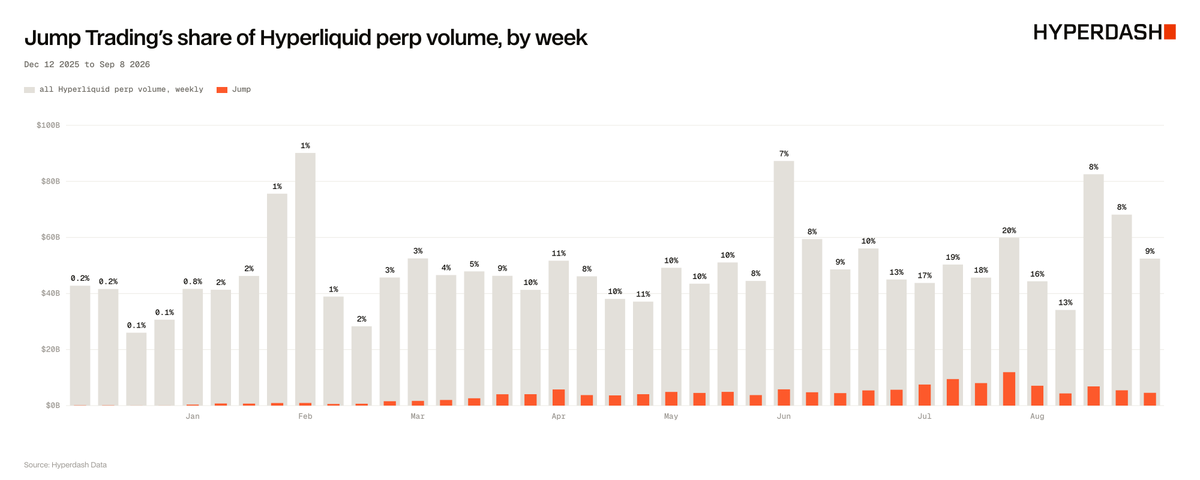
We mapped Jump Trading's entire Hyperliquid operation.
Since onboarding in December 2025, they have traded nearly $150bn and account for almost 8% of all exchange activity and 20% of all XYZ market activity.
Full report below.
Trading Strategy retweeted

No key was stolen from Liquid.
We checked the witness data: all 83 inputs of the peg-out carry exactly 11 valid signatures on the federation's 11-of-15 branch. It signed normally.
A glitch allowed invalid L-BTC to pass the peg-out validation path. 3,996 BTC out, 3,400 returned so far.
1delta.io/blog/tuesday-brief…

Trading Strategy retweeted

2026 Trade[XYZ] Q2 Report
Today, we're excited to release Trade[XYZ]'s 2026 Q2 Report.
While three of its HIP-3 rivals, Felix, Ventuals, and Dreamcash, shut down entirely this quarter, Trade[XYZ] pulled further ahead. Its share of HIP-3 volume climbed from 84.5% to 95.1%.
Quarterly volume rose 79.2% to $202.36B.
More importantly, this was the quarter Trade[XYZ] stopped competing for the category and started defining it.
Pre-IPO Perpetuals launched in May, and Cerebras, SpaceX, and Quantinuum all ran the whole way through to their public listing and converted cleanly into standard equity perpetuals, the first real evidence that a permissionless, onchain market can price a private company's opening trade with remarkable accuracy.
Equity volume grew 377% to $58.9B, the fastest-growing segment of the quarter, and the CFTC's approval of the first US-regulated perpetual futures contract gave the clearest regulatory validation Hyperliquid has had to date, a landmark Trump has since built on, saying CFTC Chairman Mike Selig is working to bring Hyperliquid into the US.
Enjoy the read. Some excerpts below, with the link to the full PDF.
Hyperliquid.


Trading Strategy retweeted
@MoonwellDeFi lost $8.7M. @TectonicFi ~$74M. Same trade: a token with thin liquidity taken as collateral, backed by $376k & $186k pools.
@aave has spent the year delisting exactly this asset class - CRV, UNI, 1INCH, ENS, SNX and 45 more reserves, plus six L2 deployments.
Next to the high risk, @aave's justification was also that these reserves earn near zero against what they cost to maintain.
1delta.io/blog/tuesday-brief…

Trading Strategy retweeted

In defence of Morpho:
There’s still a widespread misconception in crypto that nobody should ever lose money lending, and that if they do, the protocol or curator must have failed and somebody else should make them whole.
But the interest lenders earn is compensation for taking risk. Risk means losses will sometimes happen. Over a long enough period, lending against almost any collateral will eventually produce losses, regardless of oracle design, LTVs or other parameters.
If there were literally no risk of loss, there would be little reason for borrowers to pay meaningful interest. Higher yields generally exist because somebody is taking more risk.
There’s also no universally “safest” lending design, because protections for lenders and borrowers are often in tension. Every design makes trade-offs.
A fixed oracle can protect borrowers from short-term volatility and manipulation, but transfers more risk to lenders. Lenders should demand more interest for bearing that risk.
A market oracle gives lenders more responsive pricing and can protect them better as collateral deteriorates, but exposes borrowers to volatility, liquidity shocks and manipulation. Borrowers should therefore be more conservative.
No protocol design can protect lenders if the collateral itself goes sour or if there’s a hack somewhere else in the system.
Morpho has more blow-ups than Aave largely because it permits a much broader spectrum of markets and risk. Anyone can create a market, so naturally some markets will be much riskier than anything Aave would list. That isn’t evidence that the model is broken.

How does @Morpho keep ending up in the middle of DeFi’s strangest blowups?
I'm talking about incidents like:
1⃣ @Paxos PAXG oracle misconfiguration
A decimal error massively overvalued PAXG collateral, letting one borrower take ~$230K USDC against roughly $350 of PAXG.
The funds were later reportedly repaid.
2⃣ @usualmoney USD0++ repricing
Usual suddenly lowered USD0++’s early-redemption floor to $0.87 while some Morpho markets still priced it at $1.
The result was a wave of forced deleveraging and liquidations.
3⃣ @StreamDefi xUSD collapse
Stream disclosed a $93M loss as xUSD collapsed.
Morpho markets still valued xUSD near $1, which prevented liquidations from clearing properly and left lenders exposed.
4⃣ @ResolvLabs USR exploit
An attacker minted ~80M unbacked USR from roughly $200K.
Morpho’s oracle kept valuing the collateral near $1 as the market price collapsed, leaving millions in bad debt.
5⃣ @re PT-reUSD liquidation cascade
A ~$320K trade moved PT-reUSD down only ~3%.
That was enough to wipe out ~$36.4M of highly leveraged Morpho positions today.
Morpho’s protocol was not hacked or exploited in any of these five cases.
It just keeps catching strays.
Trading Strategy retweeted
tldr; met with suits that decide the rules for LTV
Had a catch-up with ISDA today specifically on the topic of DeFi clearing and Standardised Initial Margin Model (SIMM).
ISDA defines how over-the-counter (OTC) trades are executed, margined, valued, and settled, as well as how defaults and close-outs are handled.
You might be familiar with ISDA from the movie "the big short" where Charlie & Jamie of Brownfield Fund go to JP Morgan attempting to get an ISDA master agreement to trade long term options, falling $1.47 billion short of the supposed $1.5 billion requirement.
1) "DeFi as Repo"
ISDA drew parallels between DeFi and repo markets. They said that BoE are looking at applying ISDA for gilt repo markets and that similar conversations and points were being raised around SIMM. They are receptive to a model whereby DeFi would publish a "SIMM" haircut on lending markets. The comments from the repo desks was that SIMM is often very aggressive and bilateral parties might decide to do lower haircuts. The prosposed suggestion from us is that one would do:
Haircut(1 - LTV) = SIMM + Adjustment
where Adjustment can be +ve or -ve but at least that way there is transparency that all parties did some homework.
2) Private Credit/Equity Funds/MMFS etc
Someone asked me to raise the question about funds being treated the most punitively (equity bucket 11, unknown equity risk). ISDA commented that if you can get look-through sensitivities that's generally acceptable. We pointed out that delta-neutral funds would see zero-charge incorrectly, so probably needs to be taken into account in the "Adjustment". They said where funds are private credit/private equity it may be harder to justify not puting them in Eq bucket 11. Our suggestion was to take proxy indices and benchmarks e.g. MSCI that can be used for sensitivities although acknowledging that this incurs some discretion on the sensitivities and duration when you can't see the underlying book. The tacit agreement was that this is much better than proprietary black-box models, finger-in-the-air or historical returns fitting
3) Overnight equities clearing
Someone else asked me to raise the point of overnight tokenised equities and what that would mean for ISDA's SIMM model as we increasingly saw equities trading in tokenised format out of hours. They suggested that this wouldn't change much unless there was a breach. Although you've technically got as much as 10.5 days instead of 10 days of liquidity horizon it's not materially different from exchanges being open/closed on different daycounts whilst they trade on less liquid venues.
4) Self-Regulation
There is interest in monitoring how the industry comes together to create frameworks and an appetite to engage and educate ISDA members if we can present a coherent solution in the DeFi community for margining. There have been discussions internally in ISDA around crypto but not yet DeFi per-se as they treat crypto as commodity in the SIMM model. They were interested to learn more about how decentralised contracts differed from CCP models particularly around the risks and sensitivities to an increasingly large retail cohort via PSPs, Exchanges and Neobanks.
Trading Strategy retweeted
A huge amount of work on this from @tydrohq and @inkonchain - thrilled to be a core part of this

Trading Strategy retweeted

Live on GMX: QQQ/USD and SPY/USD perps, wave 1 of the TradFi expansion.
24/7 trading of the Invesco QQQ Trust and SPDR S&P 500 ETF, even outside US market hours.
Backed by the GLV: [WETH-USDC] liquidity vault on @Arbitrum; priced by low-latency @Chainlink Data Streams.
1/2 ⬇️
🤖 Made with AI