

I’m a Christian because Jesus saved me. I’m also a husband to a beautiful wife and the father of two amazing children.
Joined February 2011
- Tweets5.5K
- Following142
- Followers211
- Likes7.8K




David retweeted

⚠️Full resolution!⚠️
This graphic has been widely popular, and many asked for the full resolution of these graphics. Here you go: 🔗
Please share!
tinyurl.com/37vrbxr4
tinyurl.com/yh3smkrz


David retweeted
Many well-meaning Christians affirm that 'context is king' when interpreting Scripture. But too often what we see is 'context is systematic,' smuggling in presuppositions foreign to the passage. We need to constantly check our own understanding.
Israel not only is presented in Scripture as "another Adam" who, as the son (Ex. 4:22-23), takes on Adam's role in the world; Israel also anticipates the coming of the true Son, the true Israel, the true servant, the true vine, namely, Christ (see, e.g., Isa. 5:1-7; Hos. 11:1; Matt. 2:15; John 15:1-17). Furthermore, since types find their fulfillment first in Christ and not in us, we as God's people participate in the typological pattern only by virtue of our relationship to Christ. Thus, in the case of Israel, Christ is first its fulfillment and we, as the church, are viewed as the "Israel of God" only because of our relation to Christ. We, as the church, are not the antitypical fulfillment of Israel in the first sense; Christ alone fills that role. Yet in union with Christ, we are the beneficiaries of his work. In relationship to Christ, the true Son/Israel, we become adopted sons (Gal. 3:26 4:7), the "Israel of God" (6:16), Abraham's spiritual offspring (3:29), restored to what God created us to be (Eph. 4:20-24). It is in this way that the new covenant promise given to the "house of Israel/Judah" (Jer. 31:31) is applied to the church. Christ, as the antitypical fulfillment of Israel, takes on the role of Israel, and by our faith union in him, his work becomes ours as his new covenant people.
~ Gentry/Wellum
1
1
148
[Biblical theology] is the hermeneutical discipline that seeks to do justice to what Scripture claims to be and what it actually is. In regard to its claim, Scripture claims to be God's Word written, and as such, it is a unified revelation of his gracious plan of redemption. In regard to what Scripture actually is, it is a progressive unfolding of God's plan, rooted in history and developed along a specific storyline primarily demarcated by the biblical covenants. Biblical theology as a hermeneutical discipline attempts to exegete texts in their own context and then, in light of the entire Canon, to examine the unfolding nature of God's plan and carefully think through the relationship between before and after in that plan, which culminates in Christ.
~ Gentry/Wellum
3
129

David retweeted
I've been told that circumcision was replaced by water baptism according to Paul in Colossians 2. But is that the conclusion we should draw from the context of what Paul said? I don't think so...

David retweeted
Doesn't βαπτίζω (baptizo) always involve water? That's what many think. But when you read more carefully you'll discover the word appears constantly without it.

David retweeted
Someone once asked me, "How does one gain membership into the Church?" It's a loaded question, and once you see why, you'll spot the problem too.

David retweeted
I call it the Noun Smuggle. It's the sleight of hand behind almost every 'baptizo doesn't really mean immerse' argument — and once you see it, you can't unsee it.

And from there he arose and went away to the region of Tyre and Sidon. And he entered a house and did not want anyone to know, yet he could not be hidden. But immediately a woman whose little daughter had an unclean spirit heard of him and came and fell down at his feet. Now the woman was a Gentile, a Syrophoenician by birth. And she begged him to cast the demon out of her daughter. And he said to her, “Let the children be fed first, for it is not right to take the children’s bread and throw it to the dogs.” But she answered him, “Yes, Lord; yet even the dogs under the table eat the children’s crumbs.” And he said to her, “For this statement you may go your way; the demon has left your daughter.” And she went home and found the child lying in bed and the demon gone.
(Mark 7:24-30 ESV)
1
84
David retweeted

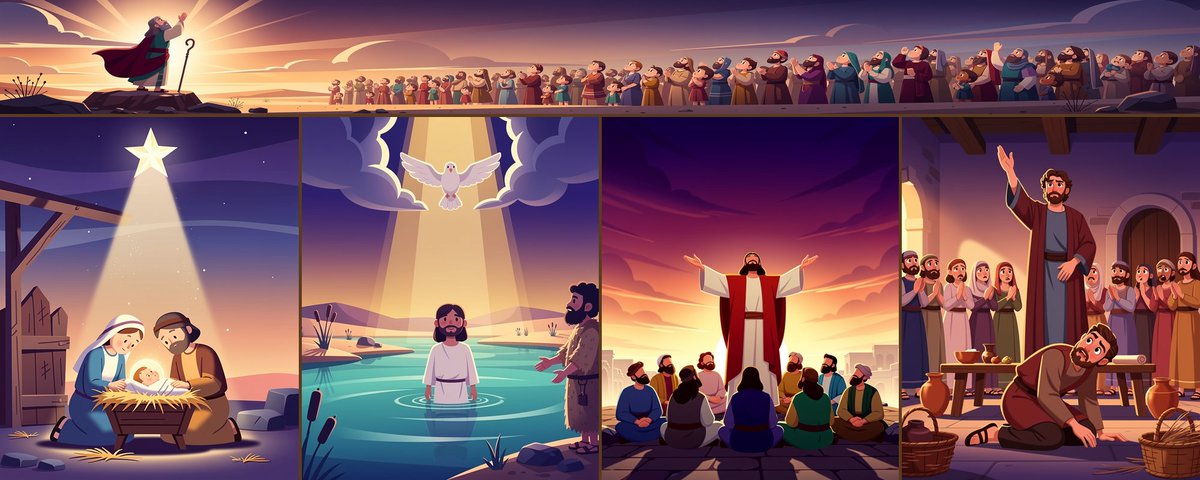
Thankful for those who stood on God’s Word in the face of much opposition 🙏
🤖 Made with AI

Many well-meaning Christians affirm that 'context is king' when interpreting Scripture. But too often what we see is 'context is systematic,' smuggling in presuppositions foreign to the passage. We need to constantly check our own understanding.
So the big flex is “we fast more than Jesus” because people skip lunch for a month and then demolish a buffet every night? That’s not a 40 day 40 night fast. That’s intermittent dieting with extra steps and a victory lap.

2
217
David retweeted

An atheist tells you, “If God wants me to believe in Him, why doesn’t He just give me some solid evidence?”
What's your response?
Jesus immerses with or in the Holy Spirit (Mt. 3:11; Jn 1:33; 1 Cor. 12:13), and this immersion is an ekcheo out of the Holy Spirit (Acts 2:33; Rom 5:5) as the fulfillment of the New Covenant promise (Is. 59:21; Ez. 36:26).
This should be the definitive argument on the primary meaning of the words ekcheo and rhantizo with respect to modes of washing. While those words regularly mean “pour” and “sprinkle,” the Scripture’s own interpretation must be prioritized.

Jesus baptizes with or in the Holy Spirit (Mt. 3:11; Jn 1:33; 1 Cor. 12:13), and this baptism is a "pouring" out of the Holy Spirit (Acts 2:33; Rom 5:5) as the fulfillment of the New Covenant promise (Is. 59:21; Ez. 36:26).
This should be the definitive argument on the primary meaning of the word "baptize" with respect to modes of washing. While the word regularly means "immerse," the Scripture's own interpretation must be prioritized.
1
3
796
Systematic theology arises from the entire canon of Scripture, but not merely as isolated texts that may be organized in a variety of ways. Instead, theology arises out of the Bible's own presentation and covenantal framework, which is why theology must be intratextual and not extratextual. By the former, I mean that theology must be true to the Bibles own structures and categories and thus function as our authoritative "lens" by which we look at the world. This is in contrast to extratextual theologies that function as "authoritative" grids imposed on Scripture, thus reinterpreting the Bible according to an external framework outside of Scripture and not vice versa. This extratextual "method of correlation" is destructive of orthodox theology and must be rejected in order to be faithful to the Bible's own theological framework. Scripture, precisely because it is God's first-order authoritative word, presents its own God-given worldview, which must serve as the spectacles by which we draw theological conclusions and interpret the world. Otherwise, the Bible becomes merely a "wax nose" beholden to the latest conceptual scheme, which sadly we have repeatedly witnessed in theologies from the Enlightenment until today that have departed from historic Christianity.
~ Stephen J Wellum
1
2
144
Context is king

Personal beef I have: when people make ancient Greek (koine or Classical) into being more complex than it really is.
The problem seems to happen when comparing isolated linguistic features across languages without considering how meaning actually functions. Many (though I think well meaning) inadvertently foster an unrealistic picture of language by pushing the view that Greek is exceptionally rich and precise, with writers exploiting subtle semantic distinctions and grammatical variations for the end result of maximum clarity. But I find this then confuses the potential of a linguistic system with its actual use.
Case in point: there are at least three words in Greek (eros, philia, and agape) that can be translated simply as "love" in English. But, the number of vocabulary items in a language reflects the interests and needs of a particular society, not an inherent quality of the language itself. English speakers discussing love today deploy context, modifiers, and description to achieve the same precision that Greek vocabulary once provided. The apparent advantage disappears when you recognize that what can be said in one language can be approximated in any other.
The mythology of Greek complexity rests largely on comparing isolated linguistic features across languages without considering how meaning actually functions.
The real problem is that Greek’s tense structure has often been described as conforming to rigid time categories (past, present, future), even though current research shows verbal aspect, the speaker’s description of action, is the predominant category. This imprecision creates a language sophistication which may or may not actually be there. When you understand Greek as it actually functioned, where words mean what they mean within context, where grammatical forms served practical communicative purposes rather than expressing abstract nuances, then the language becomes far more approachable. Don't get me wrong, Greek is complex, but no more so than any natural language used by real people for real communication.
When push comes to shove eros, philia, agape, and philanthropia could be used synonymous (though not always and context does merit usage). But Greek is neither magic nor unnecessarily convoluted, and we should stop making it such.

3
198
I've been told that circumcision was replaced by water baptism according to Paul in Colossians 2. But is that the conclusion we should draw from the context of what Paul said? I don't think so...
