

Research, conviction & capital as catalyst. Σ DeFi-native yield fund.
Joined October 2021
- Tweets1.2K
- Following77
- Followers2.2K
- Likes1K
Papertrade's LP started at $0 and hit its $5M cap in 65 minutes.
In its first 7 days, @papertrade_xyz traded $1.25T and traders lost $56M net. The LP has stayed close to its cap since, and $51.2M has already been paid to $PAPER stakers.
That cap doubles to $10M today (18:45 UTC), so the LP will keep up to $10M before paying excess to stakers.
The launch rush also front-loaded the token. Two thirds of the 8.46B $PAPER supply was minted in the first 24 hours, when minting cost far less than it does today.
Trading has held up after most launch deposits left. But with 94% of volume from the top 10% of wallets, it's hard to say how much of it will last.
Mechanically, the Martingaler LP has performed as intended. The real test comes once $PAPER is transferable.

ALT Papertrade's first week at a glance, after 7 days of trading, 10 Oct to 17 Oct 2026. Traders: $1.25T traded, 1,166,085 positions opened, 16,126 wallets traded, 21,660 deposited, TVL $67.5M (peak $137.9M). Traders lost $56M net to the LP, which held a median $4.96M at its $5M cap. Above the cap, $51.2M was paid out to $PAPER stakers. 8.46B $PAPER minted, 99.3% staked.
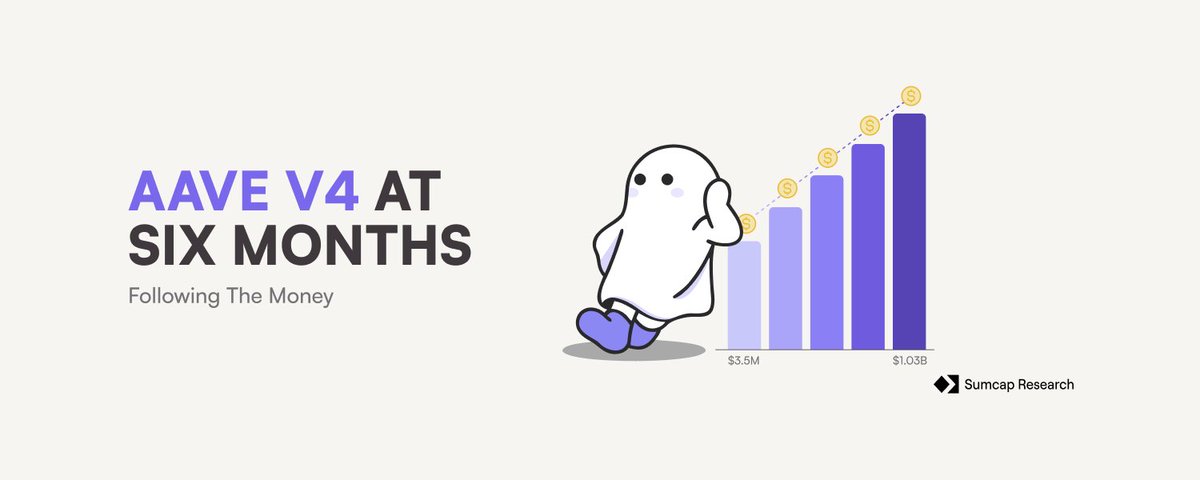
Aave V4 has added $434 million in deposits since Sept. 15, and $292 million of it sits on its Arc hub, live since Circle's mainnet launch.
Core on Ethereum added another $93 million.
xitter.cf/Sumcap/status/21052435…


Ethena Pay has processed $2.67M in card spend, almost 3x the $0.9M it had on 17 September.
• ~1,350 card TXs a day from ~400 daily spenders
• $675K of it in the first week of October alone
@EthenaPay on @avax gives $USDe a new market of users.
The on-chain data agrees.
Card spend crossed $1.5M on 24 Sep.
• $600k of it in the last 7 days, ~750 card txs a day
• 475 of 604 card spenders paid in the last 7 days
Live: dune.com/sumcap/ethena-pay

Token Forecaster is a tool that predicts LLM output length while you type, then shows whether the reply is running long as it comes in. It lives in the terminal, the Mac menu bar, and the browser.
Underneath, it groups replies by model and thinking mode, backs off when data is thin, then adjusts from agent-loop state: depth, prior calls, whether a file was already written.
The setting that mattered most was thinking mode: it moved the tail 2.5×. On 4,146 held-out calls from unseen sessions, the 9-in-10 line held 90.6%.
So yes, output length is forecastable. In our data, most of the useful signal came from the model, the thinking mode, and what the agent had already done, more than from the prompt itself.


Ethena Pay went from 528 accounts to 9k in the two weeks since the app went live, still behind a waitlist.
• $738k of card spend across 10k txs, $415k of it since 1 September.
• $4.3M of $USDe held in app accounts, 75% of all $USDe on @avax.
• 523 accounts ever funded, 353 of them card spenders.
• $25k of $AVAX cashback paid out, running at 3.6% of spend last week.
289 of those 353 spenders used the @EthenaPay card in the last 7 days.

Plasma One passed 155k registered cardholders.
• $57.5M of card spend across 403k txs.
• $20.9M of TVL across Earn and Checkings.
• 82.8M $XPL locked for card tiers against 16.6M $XPL paid out as cashback.
That is 5x more $XPL locked into @Plasma than the cashback programme has spent acquiring those cardholders.
Every number live: dune.com/sumcap/plasma-one

Duration risk can land in three places, and a buffer is one of them. It pays redemptions instantly up to a cap, with depositors earning a spread for the gap.
MSL is @MidasRWA's shared build, one module serving many mTokens, cheaper because uncorrelated flows rarely peak together.
The trade is resilience: a siloed buffer can't be drained by a neighbouring run, but sits idle in calm markets.


We break it all down: yield sources, waterfalls, redemption design, incident response, and composability.
Full piece: sumcap.xyz/blog/tranching-in…


The sector splits in two.
Tranching as a Product: the protocol runs the strategy and the tranches. @ResolvLabs, @avantprotocol, @YuzuMoneyX, @3janexyz, @mezzanine_fi.
Tranching as a Service: infrastructure to tranche external yield. @strata_markets, @roycoprotocol, @Centrifuge.

