

News from the PhD Program on History, Anthropology, and Science, Technology & Society @MIT. A student-run account. Cover art by @bachwards
- Tweets141
- Following100
- Followers307
- Likes167

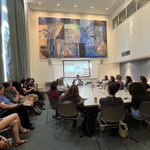






ALT A woman presenting in front of a screen.

ALT Tim presenting on his laptop to a full room.

ALT Three men and a woman standing in front of a projector screen, on which two women from an ongoing Zoom call are projected. Everyone is smiling.


ALT Photograph of warmly-coloured (yellow-to-red) electric circuit boards arranged abstractly as separate flat round and square-shaped parts set on a black background. By Dan Cristian Pădureț under a free License: https://bit.ly/3WzNxqX.


ALT Screenshot from a Zoom call, people are sitting around a table looking at a screen, including Aja who is standing behind them.

ALT Screenshot of a presentation slide with the dissertation title and translation into English (A Hawaiian Nation Through The Restoration Of ʻĀina Momona: Stories Of Unity– Among Ourselves, That Which Feeds, Community, And Spirit–On The Island Of Oʻahu), as well as members of the dissertation committee. There is a picture of a vegetable in the garden on the right.


ALT “Ambivalent Insects” as Tools and Targets Lisa Onaga, Max Planck Institute for the History of Science Luísa Reis-Castro, University of Southern California Abstract: The binary categories of harm and benefit have often shaped how historians frame discussions of insects. Scientists also leverage the binary framing of insects as tools and targets to carry out their work, especially in the development of biological technolo- gies for pest control. This essay emphasizes how binaries function in scientific practice. Two case studies spanning from the twentieth century to the recent past illustrate the shift away from chemicals in pest management and, in doing so, show the instability of binary categories over the longue durée. Noticing “ambivalent insects” affords a way to widen nar- rative options and identify new opportunities for investigating insect histories.