

Actionable technical trading ideas. Not investment advice. Also, links to thought provoking articles.
Joined November 2012
- Tweets4.5K
- Following336
- Followers3.1K
- Likes4.8K








Jim Furey retweeted

this California wealth tax thing is just incredible.
so in October 2025, a California healthcare union proposed a "one time" 5% tax on any billionaire's wealth. the ballot measure will be voted on next month. In early December 2025, California announced that it would be a retroactive tax if passed, applying to anyone with CA residency as of Jan 1, 2026. The objective is to pay for Medi-Cal, California's incredibly dysfunctional healthcare system. (which also functions as a glorified welfare apparatus, but that's a discussion for another time).
polls reveal that the CA electorate is split around 50/50 on the tax, but prediction markets only give Prop 40 a ~23% chance of passing (there are competing measures on the ballet that would nullify it).
there are 200 billionaires in CA, worth collectively somewhere between $2.3 and $2.6 trillion. 5% of that is around $100b, accounting for a small amount of attrition. proponents of the tax forecasted a significant windfall, assuming only a 10% departure rate.
supporters thought they were being clever with the retroactive concept. no billionares would leave CA in the few short months between the tax being proposed and the residency cutoff date, without the tax even having passed yet, right?
well as it turns out, they did.
a new paper [1] from two academics at Stanford called "The Net Present Value of the California Billionaire Tax Act", argues that not only did more billionaires leave due to the proposed tax than its proponents expected, but that the value of the tax, if it does pass, is actually negative.
proponents of the tax only assumed 10% avoidance, that is, only 10% of the taxable base of targeted billionaires would leave CA within the very short Oct-Dec 2025 window. Jaros and Rauh, the Stanford academics, find that a lower bound of 28.6% of the taxable base managed to leave.
just based on known departures, those departures total $577b in net worth, or $28.8b in potential tax lost. this of course does not capture everyone (many left without announcing their departure), so the authors normalize to departure rates estimated from other wealth tax events, and apply other discounts for litigation, arriving arrive at a figure of only $28-$36b in forecasted tax revenues.
but this isn't all! all of the income taxes paid by the departed billionaires are also forsaken. the authors estimate that CA billionaires pay $3.3- 5.8b in annual income taxes. they assume a midpoint of $2b lost in annual collections from departed billionaires. the net present value of that lost income stream is -$68.9 billion.
so when you add it all up you get:
+ $30b one-time tax windfall (estimated)
- $69b in present value of lost future income taxes
= - 38.9b overall net present value of the tax
of course, this analysis is highly estimate driven. the authors simulate the parameters 100k times and find a negative NPV of the implemented tax 85 percent of the time.
and if the tax doesn't pass, which it's not looking like it will, California still ended up losing at least $577b in departed net worth, and they have permanently poisoned the well with entrepreneurs who will now worry about future wealth taxes.
[1]: nber.org/system/files/workin…


Read this please, 👇


In a normal functioning ecosystem, when the price of tokens drops below the cost of production, the quantity of tokens declines to normalize with pricing. In this case, nothing in AI has any unit economics and you don’t see normalization because everyone is still going full-speed ahead with external funding. (Sort of like shale oil in 2016-2019). Meanwhile, compute prices are based on LT contracts that were signed at above market prices, and are now capital destructive. They’ll eventually catch down to token prices in free-fall.
What we’re seeing here is spot price negatively diverging from term pricing. Usually, when this happens in a cyclical industry, it’s INCREDIBLY BEARISH. Especially when there are take-or-pay contracts that make it difficult to ration supply at prices below cost. What we’re witnessing is a world where losses will accelerate, just as more supply comes online….


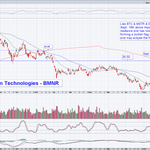
Like BTC & MSTR & ETH, gapped higher Sept. 19th above important horizontal resitance and has now filled the gap by forming a bullish flag continuation pattern and may eclipse the flag's leading edge.

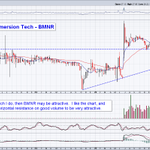
If you like Ethereum, which I do, then BMNR may be attractive. I like the chart, and view the move above horizontal resistance on good volume to be very attractive.


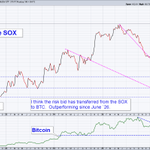
In late '25 it looked like BTC would continue its relative advance vs the S&P 500. It was in the middle of the relative uptrend and the world expected a pro-BTC Trump administration to provide regulatory momentum to BTC and ETH. Instead, BTC entered a brutal correction, similar to so many in the past, and stocks led by AI beneficiaries ripped higher. The price action left a relative uptrend violation and produced heavy doubt regarding BTC's future relavance. Just as suddenly as the correction started in the fall of '25, BTC began surging in September, just shy of a year since BTC began to correct. There is a good chance that BTC regains entry into its relative uptrend and makes new highs, if our confidence in BTC's future is accurate, i.e. NOT wrong. BTC was awful when stocks surged from Oct. '25 to Sept. '26. Why can't BTC rise vs stocks and gold as our earlier post argued. I like the risk-reward setup.

BTC is once outperforming Gold after brutal rapid underperformance from late '25. The chart shows that it is a winning trade for macro funds to again be long BTC, short gold. There was a lot of money made shorting BTC vs stocks and gold in late '25 and in '26 until its recent turn. All the major players are considering this tradge. Many already have it on. This market LOVES momentum, and especially relative momentum when it matches nominal momentum.

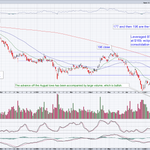
You already know about the massive volume surge accompanying BTC's rise. You may not be as familiar with BTC's repeated megaphone formations. BTC may rise to the current megaphone's leading edge by year end given its rate of ascent. Those are large gains. Overnight BTC is eclipsing the key horiztional resistance that stands between BTC and almost open field running. If you are new to BTC, it is highly likely that you have NOT missed Bitcoin's total advance You have missed the early recovery from a viscous bear market and its now working to return to the all-time highs.


Jim Furey retweeted

Power selects for a specific personality type, and it is not yours.
F.A. Hayek spelled this out in 1944. In a centrally planned system, the people who rise are not the most competent or the most honest. They are the most willing to exercise force against strangers, the most comfortable with contradiction, and the most skilled at coalition-building through favors rather than merit. Government filters for the bad ones from the start.
The mechanism is straightforward. Political power means controlling resources you did not earn. Capturing that control requires outcompeting rivals who have no ethical constraints. A principled candidate refuses to promise contradictory things to different voter blocs. An unprincipled one does it without blinking. The unprincipled one wins. Repeat this selection pressure across hundreds of electoral cycles and you get the U.S. Congress in 2026: a body where the average member has held office for over a decade, raised millions from interested parties, and delivered almost nothing measurable to the people who voted for them.
Bureaucracy compounds the problem. Once entrenched, state agencies attract people who want authority without accountability. You cannot fire most of them. The FDA, the TSA, the Federal Reserve all function this way, staffed by individuals whose career advancement depends on expanding the agency's reach, never on serving you efficiently.

Yes, 👇🏻

The Fed Is Hiking Into a Mirage
What exactly is the Fed tightening against?
The Fed’s shifting standards, cutting 50 basis points before an election with trimmed-mean inflation at 2.81%, then hiking with it at 2.28%, make its reaction function look political rather than principled.
The Fed has raised rates on the premise that growth remains too strong and inflation risks are broadening. But the composition of the economy tells a different story.
The construction boom is overwhelmingly an AI-and-power story. Data centers, grid capacity and related infrastructure are expanding rapidly; outside that complex, residential building, commercial real estate, manufacturing construction and ordinary private investment are weakening. The same is true more broadly: housing, consumer durables, small-business borrowing and credit-sensitive sectors are absorbing the force of restrictive financial conditions, while cash-rich hyperscalers continue to build regardless of a marginal increase in the funds rate.
Meanwhile, the Dallas Fed’s trimmed-mean PCE measure, one of the cleanest gauges of persistent underlying inflation, has declined from 2.81% in August 2024, immediately before Powell’s 50-basis-point cut, to 2.28% today. Inflation expectations remain anchored. There is no persuasive evidence of a wage-price spiral, unanchored expectations, or broad second- and third-order inflation effects.
The Fed cannot lower oil prices, reverse tariffs, create transformers, expand grid capacity, or alter other supply constraints by raising rates. It can only weaken domestic demand and it will do so most aggressively in sectors already under pressure.
The relevant question is therefore not whether headline inflation remains above target. It is whether the Fed is mistaking concentrated, supply-expanding AI investment for generalized excess demand. If so, it is tightening into a negative growth shock, depressing the very rate-sensitive investment needed to broaden productive capacity, while leaving the AI buildout largely untouched.
A central bank should not use broad demand destruction to solve relative-price shocks. The Fed needs to show evidence that inflation is propagating through wages, expectations and broad credit growth, not simply point to aggregate GDP inflated by data centers.

Extremely important. Frontier biz model deteriorating rapidly. Explains the frantic regulatory capture strategy. Anthropic and Open AI are betting on Jevons Paradox. The large cap market and the economy are AI reliant. How this plays out determines the next 25% market move. Up or down is the question. Rapidly evolving dynamics.
