

President & CEO Partnership for NYC | Former 3-term Mayor of Jersey City | U.S. Marine | Former Ironman Triathlete | Husband & Dad
New York, NY
Joined February 2009
- Tweets12.5K
- Following1.8K
- Followers51.4K
- Likes4.7K





Access to cycling is an important part of making NYC more connected and accessible - Did you know the Partnership Fund for New York City (the city’s largest employers), played a key role in helping expand Citi Bike into more neighborhoods across Brooklyn, Queens, and Upper Manhattan?
It’s just one example of how we invest in innovative ideas that strengthen our city, expand opportunity, and focus on improving everyday life in NYC. This was a big idea w/Real impact and ultimately a stronger NYC.


Great to kick off the New York Jobs CEO Council’s conference with Executive Director Kiersten Barnet for a conversation about our shared commitment to expanding opportunities for young New Yorkers and creating stronger pathways into the workforce and meaningful careers. @Partnership4NYC


The housing affordability crisis won’t be solved overnight. Even if we start making the right decisions today, it will take 8-10 years to meaningfully address. The key is recognizing that housing supply has to be the overriding priority. We cannot allow special interests, political considerations, or competing agendas to distort the economics of building housing. If we are serious about affordability, we need to make it easier, faster, and more economically viable to build - and prioritize increasing supply above everything else
October 7 should be a day to remember the victims of Hamas’s horrific attack and stand with their families and survivors.
The Mayor’s decision to use this solemn anniversary to advance divisive political arguments was inappropriate and unnecessarily inflammatory. At a time when heightened antisemitism is a real concern - one the Mayor himself has acknowledged - New York’s elected leaders should be focused on bringing our city together and addressing the urgent challenges facing New Yorkers, not creating further division.

This day is profoundly painful for so many New Yorkers. It marks three years since the horrific war crimes of October 7. On that day, Hamas killed more than 1,100 Israelis and abducted 251 others. We grieve alongside our many friends and neighbors who still carry that unthinkable loss.
The suffering did not begin nor end that day. It instead continued through the Israeli government’s devastating, ongoing genocide in Gaza, in which it has killed more than 74,000 Palestinians—including more than 21,000 children. Even since the so-called ceasefire, more than 1,400 Palestinians have been killed. That suffering has intensified with every Israeli bomb dropped on ambulances waiting outside hospitals, every drone strike targeting a residential building or journalist, and every shipment of food aid turned away at a border crossing. Many New Yorkers are reckoning with this unbearable grief, and we mourn alongside them – all while knowing that our tax dollars fund these war crimes.
Three years later, we must refuse to accept a world in which occupation and apartheid continue, where war crimes are met with impunity, and our federal government continues its complicity with every arms shipment.
To honor the dead, we must fight for a world in which every person can live with freedom, safety, and dignity.
Steven Fulop retweeted

Remarkable to see new Type I/II highrises continue to pencil in Jersey City, even in today's tough financing environment.
We need a deep dive on how Jersey City is (sucessfully?) navigating the new world of higher rates & lower political tolerance for property tax PILOTs


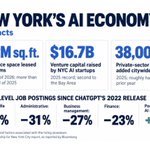
Some key findings from our recent research report on AI’s impact on NYC. You can read the full report at the Partnership’s site.
This graph courtesy CityBiz.

AI is booming in NYC. But the benefits aren’t reaching everyone.
AI firms leased millions of square feet office space in just the first half of 2026, even as entry-level hiring declined sharply across many AI-exposed occupations.
Our new report on what this means for NYC’s competitiveness and workforce:
framerusercontent.com/assets…
An obvious win tor Miami and in many ways at the expense of Chicago and NYC - I think this is obvious, but worth saying: when companies relocate or build major new hubs, the impact goes far beyond employees, taxes and direct economic activity.
Civic investment and philanthropy follow too. Those dollars don’t necessarily double when a company expands elsewhere - they increasingly get shared or redirected.
$2 billion of Ken Griffin’s $3 billion gift will build Carnegie Mellon’s new Miami campus. That is an enormous win for Miami - and a reminder of the broader opportunity cost for places like Chicago and New York when corporate gravity shifts elsewhere.

Today, Carnegie Mellon University and Ken Griffin, founder and CEO of Citadel and founder of Griffin Catalyst, announced a historic $3 billion gift to elevate Carnegie Mellon in Pittsburgh and launch Carnegie Mellon University Miami. #CMUMiami
Learn more: cmu.edu/news/stories/archive…
Steven Fulop retweeted

Jersey City Loew's Wonder Theater to reopen following a $130M renovation - and decades of neglect trib.al/sa7ZDt2

Steven Fulop retweeted

NYC pension funds make $300M affordable housing investment to help solve apartment shortage
gothamist.com/news/nyc-pensi…

Twenty-five years later, 9/11 still shapes who we are, the choices we make, and how we think about service.
I was grateful to share a small part of my story with the @NYDailyNews - and to reflect alongside other New Yorkers on how that day changed our lives and our city forever.
nydailynews.com/2026/09/02/n…

A great example in mass transit of what happens when government and the private sector work together to solve real problems.
What started as a pilot through the Transit Tech Lab, managed by the Partnership Fund for New York City, is now becoming a $10 million deployment across the PATH system- using real-time technology to improve reliability, safety and the rider experience.
This is exactly the model we want to keep scaling: identify innovative companies, give them the opportunity to prove their technology in one of the most complex transit systems in the world, and turn successful pilots into meaningful implementation.
Congrats to Wi-Tronix, PATH, the Port Authority team and everyone at the Transit Tech Lab who helped make this happen.
masstransitmag.com/rail/main…

NYC will always have enormous advantages. But we shouldn’t confuse having advantages with being entitled to the jobs. Companies have choices now, and they’re clearly exercising them. Im quoted in this article because Morgan Stanley is now the fourth major company this year to make a similar announcement, and the pattern deserves a serious conversation.
Post-Covid, employers realized something fundamental: they can maintain a New York address without putting their next 1,000, 5,000 or 10,000 jobs here. They can grow elsewhere.
And every job that goes elsewhere means lost revenue that NYC needs to fund schools, public safety, housing and social services. That creates pressure for higher taxes and more anti-business policies, which only gives employers another reason to put their next jobs somewhere else. It’s a downward spiral unless elected leaders are willing to push back and find a better balance - even when politically difficult - that’s leadership.
What makes this more concerning is the contrast: other states are aggressively rolling out the welcome mat for jobs from NY and investment while NYC itself increasingly vilifies the very success we depend on to fund our priorities.

Morgan Stanley picks Dallas for expansion outside NYC - stepping up Wall Street exodus following Mamdani election: 'Wake-up call' trib.al/1wkXLrA

Supply increase will be the only solution for increased rents
And Jersey City is prob the best example in the country on the supply conversation - the NYT wrote this year in Jan an article - “A Housing Boom Transformed This City. Mamdani Is Taking Notes.” It specifically discusses Jersey City’s pro-development strategy and says rents, after years of increases, began flattening in 2023–24 and may now be falling. It also notes Jersey City has roughly 3% of NJ’s population but about 20% of the state’s new building permits.
thecityreporter.nyc/2026/08/…

From the NYT today - This is true and to elaborate a little further as it is bigger than a video - I’ve spoken with a number of business leaders/prominent CEOs who employ many people who declined the invitation - which tells you something. While I won’t speak for individual conversations, the concerns I’ve heard are fairly consistent:
1) meaningful engagement is important towards solutions, not symbolic participation/soundbites.
2) Many also believe the administration’s rhetoric has consistently made it harder to build trust with the business community as often success is villainized
3) we are at a point where concerns around antisemitism remain significant -
Quite a few have declined

From AI job displacement, to budget strain, to childcare - these aren’t hypotheticals, they’re on the horizon now. I do believe the business community will show up in a big way if City Hall brings a concrete agenda and commits to actually implementing what a public-private advisory board proposes, not just discussing it
Interview from @foxnews today - spoke a little about voter ID and free grocery stores. Nice to join @danaperino
Reasonable question: office leasing is booming while jobs data looks flat. A few reasons the two diverge:
1.AI/tech firms are leasing ahead of headcount - many bets on growth that hasn’t landed yet, which is why these leases skew shorter-term
2.A chunk of “leasing volume” is renewals, not new demand - it inflates the topline without reflecting net new hiring
3.Available inventory is down vs. history as office-to-resi conversions take supply offline
4.Class A demand is rising while new supply stays flat, so quality space stays tight even as jobs growth lags
crainsnewyork.com/real-estat…