

Go-to-market for technical products. Built for the developers, users, and buyers who choose them.
Global
Joined March 2024
- Tweets235
- Following35
- Followers44
- Likes42







You don’t have to build the next Google.
It’s easy for founders to get caught up in the funding rounds, the valuations, and the billion-dollar exit everyone treats like the only real finish line.
But plenty of great companies took a different route. They found a smaller group of people nobody was serving well and built exactly what those people needed.
@PlausibleHQ is a great example (many of our clients use it). People wanted website analytics without tracking their visitors, so @ukutaht and @MarkoSaric built a privacy-first alternative to Google Analytics. No investors, and profitable for years.
Or @KagiHQ , a search engine for people who’d rather pay for search than have their data sold. @vladquant bootstrapped it for 5 years, and it now has 75,000+ paying members.
Neither of them is trying to win over the whole world. They found their people, their people stuck around, and nobody’s telling them what to build.


1
65
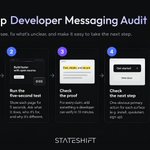
When developers aren’t using your product, it’s easy to blame the channels or the product. But a lot of the time, the problem is your messaging.
Here’s how to check if it’s quietly killing your growth 👇

6
39

5. Check who you’re talking to
Read each page in the shoes of a founder paying for it, then the dev who has to set it up. “Reduce downtime and protect revenue” speaks to the founder but tells the dev nothing. Add a line on what setup actually looks like and you’ve got both covered.
1
4. Check the next step
Each page should make it obvious what to do next. On a README, that’s the install command. On the docs intro, it’s the quickstart. If your homepage has five buttons that all look the same, people won’t know which one to click.
3
3. Check the proof of every claim
Underline every “fast,” “simple” and “scalable” on the page. Next to each one, see if a dev could verify that in 10 minutes, like a command, a benchmark or a public repo. If there’s nothing to write, you should cut the claim.
3
2. Run the five-second test
Show the top of your homepage to three people who don’t work on your product. Give it 5 seconds, then ask what it does, who it’s for and why it’s different. If two of them can’t answer the first question, it fails.
3
1. Put everything in one doc
Paste the headline and first paragraph from your homepage, docs intro, README, pricing page and latest launch post side by side. Most teams find their product is a “platform” on one, a “library” on another and a “toolkit” on the third.
19
5. Check who you’re talking to
Read each page in the shoes of a founder paying for it, then the dev who has to set it up. “Reduce downtime and protect revenue” speaks to the founder but tells the dev nothing. Add a line on what setup actually looks like and you’ve got both covered.
2
4. Check the next step
Each page should make it obvious what to do next. On a README, that’s the install command. On the docs intro, it’s the quickstart. If your homepage has five buttons that all look the same, people won’t know which one to click.
6
3. Check the proof of every claim
Underline every “fast,” “simple” and “scalable” on the page. Next to each one, see if a dev could verify that in 10 minutes, like a command, a benchmark or a public repo. If there’s nothing to write, you should cut the claim.
2
2. Run the five-second test
Show the top of your homepage to three people who don’t work on your product. Give it 5 seconds, then ask what it does, who it’s for and why it’s different. If two of them can’t answer the first question, it fails.
2
1. Put everything in one doc
Paste the headline and first paragraph from your homepage, docs intro, README, pricing page and latest launch post side by side.
Most teams find their product is a “platform” on one, a “library” on another and a “toolkit” on the third.
2
Send this to someone who thinks Open Source is stupid or irrelevant 👇
ft. @linuxfoundation, @CloudNativeFdn, @ThePSF, @OpenSourceOrg, @kubernetesio, @rust_foundation, @llama, @huggingface, @jonobacon, @ubuntu, @Canonical, @PyTorch
Every AI site promises a “revolutionary AI-powered engine.”
Which usually means a thin OpenAI wrapper + a monthly markup...
Developers read landing pages like specs, not brochures. They will spend 30 minutes reading a README...but zero seconds reading a landing page full of marketing slop with vague promises.
These marketing buzzwords seem to be the next best way to get developers off your website.
Which buzzword have you seen that makes you close the tab instantly?
3
52
Stateshift retweeted

GitLab said no, so Lee Faus built it. Git on a causal graph, explained with a hamburger and some cheese, at the Atomic booth at All Things Open 2026. youtu.be/Bey8jR4gjCg #AllThingsOpen
Are you guilty of having a "Claudsession" (Claude + obsession)?
Even the best professionals are now spending 2 hours prompting AI to fix a bug they could've fixed in 30 seconds.
Using AI for everything is like a monkey at a slot machine. "One more prompt, this one's gonna hit."
AI is a great tool, but you also have hands. Use them sometimes.
2
44