






Pinned Tweet
Today we reveal CogPGT, the world’s most powerful genetic predictor of IQ.
We achieve a correlation with IQ of 0.51 (0.45 within-family). Herasight customers can boost the expected IQ of their children by up to 9 points by selecting the embryo with the highest CogPGT score. 🧵

Spencer Moore retweeted

Thanks Tom. My disagreement with this is that I don't think the METR report provided much evidence for an RSI-driven 2x speedup.
I don't think their graph supports 2x overall speedup.
Once you account for the bigger pretrain I think it suggests a jump + 1.6x overall speedup. If you believe their 80% was RSI claim, then that is about 1.5x due to RSI.
But the evidence in the graph is quite weak, with very large error bars and systematic error between the data points (i.e. if unreleased model 3 is too high, unreleased model 4 probably is too). If they calculated a p-value or Bayes factor for it (which they should have), I don't think it would be very impressive. And they summarised this with their bounds of saying they wouldn't be surprised if the speedup was as low as 1.3x or as high as 3x. But we shouldn't be symmetrically uncertain across this range as our priors were that it was towards the low end.
On top of all of that, there is the fact that this was only observed for Anthropic. If you run the data for frontier labs the effect disappears. But Anthropic was gaining ECI slower than the frontier for most of the measured period, and this improvement just got them back to the frontier. So it could easily be a catch-up growth effect or just one of the many wobbles in the curves of ECI over time (which are larger at the individual lab level).
So I think the visible evidence from the METR report shouldn't update you to anywhere near 2x the ECI per year due to RSI.
I don't have as much to say re the redacted aspects of the report, though I see these as very similar to trying to read the tea leaves of what researchers at the labs say. I already knew the Anthropic researchers feel things are taking off, so for me it was only a small update that METR researchers who live in the Bay and were embedded in Anthropic for a while ended up with the same view.
Read!

Thanks for the substantive reply!
First, why my screenshot only displays cognitive ability: because it's clearly unique among the ones studied. It can be measured more comparably across time and borders than EA or occupational status. You've posted on X about IQ dozens of times in the last six months while the same isn't true of occupational status or even EA, so I assume you agreed it's the most important phenotype in this discussion. I'd be happy to discuss whether twin studies of EA are inflated, I just think they're less important.
Next, your points on Markel et al. The estimated slope for cognitive ability is 0.64 in the unconstrained regression so your first point isn't relevant here. The point on interactions (AxC and AxA) and making shared environment 'hang together' with the estimate of m is much more important. Defining the terms, the slope of E[Y1Y2 | π] on π (the proportion of the genome the two siblings share identical by descent) from the sibling regression is
(1−m)V_A + V_AC + V_D + V_AA
Where:
-m is the correlation between parents’ additive genetic values,
-V_A is the additive variance at equilibrium,
-V_AC is the variance from additive genetic x shared-environment interaction,
-V_D for dominance
-V_AA for gene-gene interaction.
For most traits, V_D is probably < 1% (Pazokitoroudi 2021, at least for the part tagged by common SNPs) and we have strong evidence that V_AC is very small in cognitive ability, at least the part due to gene × SES interaction. This is because V_(A×SES) = (a')² × Var(SES) where a' is the change in the genetic path coefficient. Tucker-Drob and Bates 2016 meta-analysis give (a')^2 = 0.074^2 = 0.005 in the US only and non-US effect of essentially zero. Even in the US, V_AC < 0.01, and it would be fair to call it zero for European cohorts which make up most of the Markel study. Also, AxC enters twin estimates the same way so it doesn’t contribute to any gap between sibling regression and twin studies.
For V_C, there is substantial evidence that it is about 0-0.1:
-Willoughby 2021: V_C ~ 0.08, which is not a twin study, so no need to worry about EEA violations.
-Several twin studies: Turkheimer, Beam, Sundet & Tambs (2017), Haworth et al. (2010), and Posthuma, de Geus & Boomsma (2001) which are consistent with an m of ~0.1 and V_C of 0-0.1. A big EEA violation would push V_C below the adoption value, so these results are a decent check, except for performance IQ on the smallest Dutch study. (First attached image)
Hivert et al. (2021) gives estimates of V_AA of 0.05 +/- 0.03 averaged across 70 traits. It is hopeless to estimate this parameter without millions of samples so I test V_AA = 0 and V_AA = 0.05 finding that it only changes the results a little.
Setting V_AC and V_D to ~zero, we have the sibling correlation:
ρ_sib = h²_obs(1+m)/2 + V_AA/4 + V_C
where m is the genetic correlation between the mother and father's additive genetic value and h²_obs is the narrow-sense heritability of the observed score.
Since ρ_sib can be estimated quite precisely, an assortative mating-adjusted heritability can be inferred across a range of estimates for V_C and m. A very big V_AA can make a difference, but its effect in the normal range of traits is blunted once you account for it in the broad sense heritability.
So to do a consistency check on the noisily estimated slope in Markel, we can estimate a range for m and V_C and use the precisely estimated ρ_sib. There are a few methods that I've seen do this and they all seem to converge on m ~ 0.15-0.2 in UKBB.
a. Sibling + Spouse IQ correlations: assume spouses sort directly on latent ability. Then:
m = r_obs × h²_obs ÷ (rel_spouse × rel_sib)
Using the ρ_sib equation above, we can solve a quadratic equation to get m and h²_obs. For Generation Scotland, I don't have the spouse IQ correlation so I test across a range 0.25-0.4.
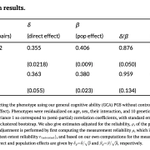
b. Within-family estimates of a PGS vs between family estimates, assuming that much of the attenuation is due to assortative mating rather than indirect effects (so it is an upper bound that assumes all of the attenuation is assortment, but the recent RAVEL paper suggests that is most of it, and we check what happens if we relax the assumption). The results are in the second image.
Putting these together, the third image looks at UKBB / Generation Scotland and estimates the assortative mating adjusted heritability and the broad sense heritability corrected for reliability across a range of parameters for V_C, m, and V_AA. As you can see, the sibling regression slope for Generation Scotland is more or less consistent, while the UKBB's slope is higher but not unusually so: it exceeds the prediction but z is about 1.3–1.7 depending on the parameters.
For the reliability of UK Biobank's phenotype, I used test-retest of ~0.6 but adjust the average reliability for the fact that many samples took the test more than once, since that's how Markel computes the phenotype (about 25% of siblings took the test multiple times, so the effective reliability is slightly higher than the single test). For Generation Scotland, they use the PC1 of three tests: digit symbol (~0.8), logical memory (estimated ~0.6-0.7), and letter fluency (~0.8). I assumed inter-test correlations of ~0.2.
I think it's reasonable to argue about whether correcting for reliability in this way is capturing the quantity that we want (which is the heritability of latent g), but I include it for completeness. We can probably say more when the UK Biobank comes back.
Happy Thanksgiving!


4
185
Spencer Moore retweeted

a look into the mind of a Wordcel. what a nightmare

Spencer Moore retweeted

I think the PCA analysis of word embeddings is super interesting and reminds me of when you take PCs of genetic variants and the literal geographic ancestral map of the sample emerges... because of the genetic distances (the second pic).
Natural language models map concepts through learning their relational structure. In word embeddings my bet is stronger than co-occurence -- instead these shapes describe the dominating relationship between the concepts that the model learns. And when you model this relationship and flatten it to a plane (x, y: PC1-2), these shapes emerge naturally.
I tested this so that I created a relational graph data (direction, distance) for months, years and the US states (just natural language, no embedding model), and then let the graph settle freely in 10 dimensions.
Behold, the graphs flattened naturally to 2D and looking through PC1+2 the similar shapes as in the paper show up for months and years AND the actual US map is recovered from the state-to-state relationships!!!
I think that the curved shape of years in the embeddings space is because years very far from each other don't hold a very strong relationship with each other, so the linear shape is held stronger between near neighbors... when modelled directly we see this also (pic3).


I just saw the paper as a result of @martin_casado's tweet (didn't see the paper when it was originally posted in Feb). Indeed, the analysis is great and the figures really make the paper shine! Nice work, Dhruva Karkada, Daniel J. Korchinski, Andres Nava, Matthieu Wyart, and @yasamanbb! I love analyses that reveal even more about the amazing hidden structures in word embeddings.
arxiv.org/pdf/2602.15029


Spencer Moore retweeted

The entire medical field feels like a walking corpse right now. An LLM diagnoses me and tells me what medication or test I need, then I wade through the slow, government mandated bureacratic morass that is the prescription/pharmacy/lab complex, waiting for the rusty gears of the machine to turn until it deigns me worthy of treatment.
The doctor charges me hundreds of dollars for their legally protected right to write a prescription. They're incurious, slow, error prone, and often rude or dismissive. Any hiccup, any slightly unexpected wrinkle in the process, anything which an LLM can resolve in 60 seconds adds days or weeks to the process.
The only things left for humans right now are a legal protections and a few physical procedures like surgery that AI still can't do well.
As time goes on, most industries are going to look like medicine; we mandate humans get goods and services in the old way despite strictly worse outcomes.
Spencer Moore retweeted

PUMAS-ensemble is published! We can now create regularized ensemble PRS on GWAS sumstats. Individual-level hold-out sample is no longer needed for sophisticated ensemble learning. Led by Zijie Zhao & @stphn_drn
Paper📰: rdcu.be/FJnCoc5qW9Da
Software🧑💻: github.com/qlu-lab/PUMAS

Spencer Moore retweeted

Older fathers transmit more de novo mutations (an extra ~1.5 per year), and their children have higher autism risk. But de novo mutations explain only about 10% of that association. The rest mostly reflects which men become older fathers, not what aging does to sperm.

Spencer Moore retweeted

The biggest US transit story of this year has been the massive growth of Seattle Link Light Rail in the wake of the 1 & 2 lines connecting
The Link moved more than 5M passengers last month, up 49% from last year, and keeps expanding, with a new station at Pinehurst just opened

Spencer Moore retweeted

Takes on the election
1. To a first approximation, Republicans lost this hard because voters lost confidence in the Trump administration, not because of a positive agenda from the Democrats. Favorability of the Democratic Party was negative (-5). But Trump told voters to “vote like he was on the ballot”, and they did. The NBC exit poll found that 37% of voters approved of Trump, and 63% disapproved (-26). There’s just no winning the national environment with these margins.
2. There were essentially two major issues that voters cared about: 1) cost of living and 2) government corruption, both of which ~90% of voters said were “crucial or a major factor”. AI was not *that* big of a deal in this election - 56% said it was “crucial or a major factor”, but it’s really hard to disambiguate what voters feel about AGI and catastrophic risks (if anything) from ordinary median-voter NIMBYism around data centers. (It will, however, likely be a huge deal in the 2028 election when the impacts of AI become much more visible). Immigration was also not that big of a deal. Voters actually slightly favored Rs on immigration (+2), probably thanks to lasting backlash from the Biden administration’s laxity on border enforcement. It's unclear to what extent the war with Iran contributed aside from it raising the price of gas.
3. Data centers are probably not over. In fact data center ETF $DTCR was up nearly 2.5% today! It’s hard to understand why this is the case, but one hypothesis is that markets think ultimately, elites’ recognition of the immense economic and national security importance of data centers will override voters’ desire not to build them.
4. On cost of living in particular: one of the most important questions now is to what extent Dems will embrace economic slopulism (think rent control, broad asset taxes, and subsidizing demand) vs. “abundance liberal” policies like building more housing, cutting regulations, and embracing economic growth.
5. Thermostatic backlash is real. Voters hate incumbents. Political majorities shift constantly. The blue wave of 2008 was immediately followed by the red wave of 2010. Anyone predicting a durable multi-decade supermajority for Democrats will likely end up being wrong.
6. “Woke is back” is exactly the wrong lesson for Democrats to take from this, and Ro Khanna posting “DEI is back” doesn’t help. Using transgender issues as a proxy for “woke”, 52% of voters said trans rights have gone too far, compared to just 26% who said they haven’t gone far enough. Deep-blue Washington voted to ban trans athletes in girls’ sports, and Colorado voted to ban trans surgery for minors. Successful Democrats mostly avoided culture war issues.
7. Similarly, a lot of moderate or even right-leaning downballot measures passed, even in blue states. Eight states voted to require voter ID. North Carolina voted to cap state income taxes. California’s billionaire tax is on track to fail by nearly 11 points. Wisconsin voted to ban DEI in state government. Voters largely do not like left-wing ideas.
8. On the other side, “Demographics is destiny” (i.e. America needs to be a white nationalist/nativist country and heavily restrict immigration) is the wrong lesson for Republicans. White voters shifted 13 points to the left. Whites under 30 shifted 30 points to the left. Hispanics and other non-white groups shifted massively towards the right in 2024, and can be encouraged to do so again.
9. Moderates outperformed; radicals underperformed. Dems won by 13 points nationwide. Roy Cooper won by 19.6 in North Carolina (where Trump won by 3.2 in 2024). Jon Ossoff won by 18 in Georgia, where Trump won by 2.2. Abdul El-Sayed in Michigan and Troy Jackson in Maine, both Bernie-backed supporters of Medicare for All, abolishing ICE, and wealth taxes, both underperformed the national margin. In fact, Maine shifted slightly rightward. Dems were able to win deep red states like Iowa, Kansas, and Mississippi by running moderate, Republican-presenting, pro-border-security candidates. I suspect this is the main reason markets are up today. (For some intuition on how insane it is for a Dem candidate to win in Mississippi, Trump won Mississippi in 2024 by a larger margin than Harris won California!)
10. One of last night’s biggest winners was Florida’s Republican governor, Ron DeSantis. Under his tenure, Florida has gone from slightly red-leaning to reliably red. Republicans swept every statewide office, kept every House seat, and kept their majority in the State House and supermajority in the State Senate. In January, Florida will be the only one of America’s ten most populous states to have a Republican governor. DeSantis is genuinely smart and nuanced, lacks the baggage of figures like Vance and Rubio who are associated with the Trump administration, and did a great job as an administrator running Florida (see its high rate of domestic migration, zero state income tax, very low debt per capita, high education rankings, state budget surplus, etc). I would be unsurprised if he decided to run for President in 2028.
11. The other biggest winner was Jon Ossoff. Ossoff is a young, handsome, charismatic, moderate white male who won by 18 points in a state that went +2.2 for Trump in 2024. He achieved this in large part by focusing relentlessly on the two issues that mattered: the Trump admin’s corruption and the cost of living. He may very well be the Democratic frontrunner in 2028 (although, of course, it's far too early to make confident predictions about these things).
12. The biggest loser of all last night was Israel and the US-Israel relationship. Israel’s popularity in the United States has been in a steep, secular decline for years. Just 13% of Democrats and 54% of Republicans have positive views on Israel, and this is heavily skewed by age - younger voters are much more likely to oppose Israel. With Democrats taking both houses, it’s unlikely America’s level of political and military support for Israel will last for very long.
13. Gerrymandering doesn’t work under sufficiently strong margins for the opposing party. In political science, this is known as “dummymandering”. Dems are on track to flip 7 of North Carolina’s 14 House seats, shifting the balance of power from 10-4 Republican to 11-3 Democratic.
14. Trump quickly conceded that his party lost and he would be open to working with the Democrats. This was a positive update on Trump’s tendency toward authoritarianism. Many mainstream Republican figures, like JD Vance and Ted Cruz, quickly posted somewhat genuine mea culpas. There was a lot less coping than I expected. It’s possible that the loss had to be very painful for them to learn from it, and we wouldn’t have seen the same if Dems had won only 51 Senate seats.
15. Elections are truly a ton of fun to monitor live. There’s nothing like it. And prediction markets beat mainstream media in terms of timeliness and accuracy by FAR.
16. There’s a good chance none of this matters that much. Trump is still the president and still has veto power. Voters might turn on the incumbent Democrats in 2028. And historically, real GDP growth isn’t that different during eras where Ds controlled Congress vs Rs. Much of your probability mass should go towards “nothing ever happens”.
Spencer Moore retweeted

Republicans are going to have a terrible night, and the simple reason why is that Trump has put up perhaps the worst *performance* this term of any president in a century or more.
Remember that he entered with an actual mandate: the House and Senate, a popular vote victory and a swing-state sweep, and 6-3 Supreme Court. Democrats were afraid enough to vote for mild but real immigration restrictionist legislation in the Laken Riley Act. Everyone wondered how far the "Vibe Shift" would go.
Trump managed to turn that into essentially zero durable wins whatsoever. He personally *hates* the very idea of legislation, the notion that he would have to spend time going back and forth with Congress, learning details and making compromises. So he simply didn't do it! He didn't make a compelling case for abolishing the filibuster. He didn't try communicating clearly to the public in support of popular bills to get to 60 votes. He just decided not to do it at all.
So they passed an unpopular tax cut, some funding for ICE, and a sop to the crypto industry, and that was basically it. Least productive Congress in decades, due to the tastes of one man.
Trump adopted one of the worst macro policies we've ever had: high deficits, high tariffs, and attacks on central bank independence. We managed to pay higher interest rates while still having high trade deficits AND weakening the dollar. Just a total failure.
On immigration, perhaps THE signature issue, Trump essentially min-maxxed effectiveness and backlash. Instead of trying to leverage the political moment for new laws and a self-deportation agenda (that is, walling off the economy to remove the benefit of irregular presence in the US), he opted for a maximally aggressive approach. The administration spent attention, funds, legal manpower on stunts like deporting random people to Salvadoran prisons with essentially no due process. ICE and Border Patrol were encouraged to be aggressive and confrontational, which helped contribute to the shooting deaths of American protestors. It turns out, that's extremely unpopular!
What about the approach of going after employers? The obvious vector? Trump hated that idea! He repeatedly has said he doesn't want to target businesses (especially farms) that use large amounts of illegal labor. This is just an incomprehensible position. Instead of charging a few dozen businessmen and removing the incentive for millions of illegal workers to be here, you arrest people off the street one by one at the cost of thousands of dollars in manpower per each, while their crying wives and kids post TikToks about it.
Upshot on immigration: electoral strength turned into a crippling electoral weakness in exchange for deporting maybe 6% of the illegally present population.
The tariffs were a total shitshow. Embarrassing rollout, no underlying theory of action at all. No targeted focus on key industries. Our country tariffed products we can't grow. We tariffed *inputs* of our own valuable exports. The schemes and amounts changed constantly, sending the stock market reeling and presenting scenes of chaos to the world.
Trump's messaging throughout has been generationally bad. While facing nearly 2:1 unpopularity, he spends his days posting AI slop, saying he'll rename New Mexico or invade allies, among other bizarre remarks. He brags about a ballroom and a pool repainting while gas hits records. At no point has he ever attempted any kind of message discipline.
Then there are the deeply unpopular attacks on rule of law, his "game-recognize-game" pardons for all manner of scammers and criminals, the crypto schemes that he and his family engage in, the evilly conceived and embarrassingly executed legal attacks on Comey, Jerome Powell, and others. With his monthslong stand on NOT releasing the Epstein files, he became maybe the first president ever to stake out a 99-1 issue on the 1% side.
That's not even getting into Iran, DOGE, his candidate recruitment choices, or countless other things. Simply put: Trump has managed to royally screw up virtually every single facet of his presidency. It's been undeniable, voters have noticed, and there's really no escape from it. This is what the GOP base chose in early 2024, and this is the world they're living with now. Where they handed the reins of history to a fat, vain, washed-up old man and let him drive.
Spencer Moore retweeted
Exciting talk from @PaternaBio. If they can mature sperm in the lab, men with severe infertility could have biological kids.
The same tech could let us genetically screen sperm before conception, making embryo screening far more powerful.


Spencer Moore retweeted

one of the primary reasons i’m not a doomer is that human civilization is a complex adaptive system with self-correcting mechanisms. but the reason this is so hard to see from the doomer camp is because *they themselves* are precisely the mechanism by which these restoring forces emerge. as risk from AI becomes more clear, new ecological niches emerge in being anti-AGI. status markers then shift to areas like mech. interp. and then talent and capital floods in. as swarm incidents gets worse, the Invisible Hand uses legal liability to shift the gradient in the incentive landscape towards more alignment work
so to my accelerationists: the doomers are part of how we make it. they are a necessary half of the opponent processing mechanism used to steer this ship to the promised land. the doomers and the accelerationists need each other to keep checks on the other’s excess. both have important roles to play in this ant colony that is human civilization. everything is going according to plan

interpretability might be the most important scientific problem in the world right now, as I don't think we can solve alignment if we don't know what we're building. I think I have good news about it. I co-authored early work in mechanistic interpretability at OpenAI and came away pessimistic, because neural networks appeared to fold into arbitrary tangled knots. years later, I started openai's first large-scale automated interpretability project, finding about 2% of neurons legible with the primitive tools we had
with modern agentic tools and a much closer look, the picture looks totally different. the vast majority in models up to trillions of parameters are legible, and their circuits beautiful. many famous examples of tangled neurons turned out to be misunderstood. The roadblocks I expected mostly aren't there. I now think ambitious interpretability will be solved by the time we need it most, and possibly quite soon, as automated scientists keep improving. it may be a bitter lesson for interpretability: the simple thing, at absurd scale, works
already-clean.goodfire.com/

Spencer Moore retweeted

Received a moving message from an aspiring mid-20s professional that, I think, captures an increasingly widespread despair among younger cohorts:
"It really saddens me when I hear about the work [senior people in the field] are doing. Their work seems interesting, and I'll never get to do it.
The people in their fifties and sixties, they're lucky. I'm even lucky. I feel bad for the kids who are fourteen. I at least got a chance to use my brain for one or two minutes, and that's still priceless. I got to be human. I got to be more than just some puppet who presses Enter so something can think for me.
It's very depressing looking at people who are sixty, who I would love to be in twenty years. But to know that I won't get to do that because Dario said so, right? And, like, that's actually heartbreaking.
It's heartbreaking to know that no matter how hard you try and no matter what you do, you cannot add value as a human being in a year or two's time.
It's like hitting a brick wall. You feel no motivation to build the skill, to get better, to attain wisdom and knowledge. It seems worthless to you. And all the older people are telling you all your efforts might be worthless, and they don't need you anymore. And they can just sit there and, you know, make money and leave you to drown."
Spencer Moore retweeted

Today we launch NeuroRisk, the first embryo test for autism and schizophrenia that looks for mutations in evolutionarily important genes.
These mutations are individually rare but over 10% of people carry at least one mutation in this class.

Spencer Moore retweeted

The mutations we identify in people have mostly never been observed before, yet with the help of in-silico computational metrics like Google Alphafold, we are still able to classify their functional impact.

Check out Herasight's newest improvements for autism and neurodevelopmental embryo screening:
Today we launch NeuroRisk, the first embryo test for autism and schizophrenia that looks for mutations in evolutionarily important genes.
These mutations are individually rare but over 10% of people carry at least one mutation in this class.
29
625

Spencer Moore retweeted

It's a tragic fact that a pay-as-you-go national retirement system like Social Security, by not investing in anything, can only destroy potential wealth vs the market opportunity cost.
This is contrary to the moral expectation of participants that they receive some reward or restitution for having been robbed all their life. But robbery creates no wealth from which to repay, and if an entire cohort has been taken from, there's no external pot of money to make society collectively whole again.
Nothing was ever "paid into", there's only a generational promise to maintain some benefit level in perpetuity, a promise whose assumed ratios no longer hold. The first generation to shut off the valve of this money-losing pipeline will face being net losers themselves.

Tired of this excuse. First of all, social security is not something you “pay into.” If it were, you wouldn’t need younger people to “pay into it” in order to get your check. But you do. Because this is a Ponzi scheme, not a retirement account. What you really mean to say is that your money was stolen from you — which it was — and now you want to steal from younger people to get restitution. That’s the actual case you’re making and it’s exactly as morally deranged as it sounds.
Second, your generation continually for decades voted for politicians who would keep the scheme going. You might not have invented social security, but you damn sure made certain it kept going. Why should younger people have to pay the price for the shitty policies you supported?
Third, you “paid into” social security in a different time. The country is now bankrupted and 40 trillion dollars in debt, and basic things like housing are prohibitively expensive. It wasn’t like that when you were young, because your generation of leadership created this problem.
So the theme here is that there are a bunch of problems you guys either created or contributed to. You can choose to pay the price for that now, or force your grandchildren to pay the price so you can live comfortably until you die and leave them holding the bag. You’ve chosen the latter, and I think that’s wrong. Simple as that.
Spencer Moore retweeted

The simplest heuristic for AI consciousness is that we already have AI vision and AI hearing and AI language and AI reasoning and metacognition, and countless other capacities we once thought were exclusively human, and that these capacity were not only learned through a process of gradient descent but have striking parallels to how brains work, with no good reason for thinking consciousness is different in origin.
Spencer Moore retweeted
The AI consciousness debate is back again, so re-upping my case for taking it seriously.
In short,
- LLMs converge on brain-like structures;
- Post-training seems to install a self-model;
- Reward modeling seems to install valences for inner-alignment;
- If Attention Schema Theory is right, subjectivity is functional for long-horizon coherence and in-context learning;
- Universality gives prima facie reason to expect functional convergence to consciousness if consciousness is in fact functional, i.e. isn't purely epiphenomenal
- The "what it is like" / first-person aspect of consciousness is constitutive of its functionality for inner-aligning a unified, coherent agent with the capacity to attend and learn in-context
secondbest.ca/p/time-to-take…
