

@Smaherlon
Account based inUnited Kingdom
About this account
- Account based in
- United Kingdom
- Connected via
- United Kingdom Android App
Account-level information from X, not a live location or the device used for a specific post.
Founder @ Entext Economics - Asset Allocation/Macro Impact of Key Technology Trends - ENTX on Bloomberg, available on AlphaSense
London
Joined July 2012
- Tweets2.9K
- Following4.4K
- Followers1.5K
- Likes7.3K





Sean Maher retweeted

it took deepseek one month to move the cost/performance pareto on this benchmark
(and 5 months to move from v4 to v4.1)
zero chance of pacing, what a travesty !


🚀 DeepSeek-V4.1-Flash-1017 is here!
Stronger benchmark performance, faster task completion, and shorter outputs than the previous version—a Pareto improvement in performance and cost. Now live on our website, app, and API.
🛠️ Optimized for @DeepSeekHarness, Tencent CodeBuddy, WorkBuddy, and more. Upgrade to DeepSeek Harness v0.2.1-rc.1 or later for the best experience with the new model.
1/4


Sean Maher retweeted

Literally today an investor asked me if we’re seeing companies lock-in with one model provider (I said no)
It’s increasingly clear that where business spend on AI can, should, and is going:
Model-agnostic
Frequent switching
Managed centrally via firm defaults or through cost optimized routing


Sean Maher retweeted

Five bangers from Nathan Lambert:
1. China's compute gap:
"You talk to people [in China], and you're like, 'Oh, I heard an average OpenAI researcher has five thousand H100 equivalents that they can access at any time,' and like their jaw just falls to the floor. They're just like, 'I can't comprehend.'"
2. China's talent pool:
"The Chinese labs are very technically excellent... To say that China is anything but equal on talent, you're gonna have a hard time because they just have so many people being trained at such a high level."
3. OpenAI's superpower:
"[The frontier labs] have just taken the most ambitious bets the earliest in order to get there, and that's why OpenAI has done things like kickstart the reasoning model revolution."
"And I think that kind of breakthrough and that beautiful plot with the inference scaling laws is peak OpenAI. They're really good at getting this plot that just changes how everyone thinks about everything."
4. Underestimating the competition:
"The Chinese are so good at building models as well. I think there's a bit of cope where people are like, 'Only we are good at building models.' There are so many companies. There's, like, 20 to 30 companies that are building good models."
5. The AI risks that are already here:
"[The lack of preparation] is kind of the thing that worries me more than, say, RSI is coming and unlocking new risks. There are risks that are here and that are gonna continue to diffuse."
"Figuring out how to get society to prepare is very hard. I'm of the opinion that we need more eyes, we need more science, so that society feels informed."
@natolambert

Nathan Lambert, former post-training co-lead at the Allen Institute for AI, now launching Trillium, a nonprofit open AI lab, joins a16z's Lisha Li to discuss whether open models can really keep up with the frontier.
When he tells researchers in China that an average OpenAI researcher reportedly has five thousand H100s to work with, "their jaw just falls to the floor." In his view, Chinese labs have the talent but are mostly short on compute.
He also thinks the distillation story is overblown. Based on the research, he puts its edge at a few months, and says "there's a bit of cope" in thinking only American labs can build good models.
A lot of frontier progress outside math and code comes down to labs buying 1) data and 2) RL environments. It's a multibillion-dollar market, and some of it is sloppy enough to teach models to reward hack.
That's a big part of why Trillium exists. Nathan wants to give away the environments other people would sell, and show exactly how his team uses AI to build AI, including where the models still get stuck. His bet is that the more people can see how this works, the better prepared everyone is for what's coming.
0:55 Can open models keep up with the frontier?
2:05 What it takes to reach the frontier
3:55 Open weights and the fast-follower playbook
8:25 Chinese labs: equal talent, less compute
9:55 Why distillation is harder than it looks
14:55 Is distillation theft or competition?
16:20 The lab flywheel vs owning your weights
21:45 Can general models beat every specialist?
26:30 AI at 1% of today's cost in 4 years
27:15 The RL env boom and reward hacking
31:30 What Trillium will build in the open
35:30 Breaking into AI in the age of AI slop
38:05 Open-sourcing how AI builds AI
44:25 Why Nathan isn't pre-training
49:45 Agent swarms and why lab secrets leak
54:25 Fast takeoff vs risks already here
YouTube: youtu.be/BKuK0M6oDTI
@natolambert @trillium_labs @lishali88
Sean Maher retweeted

Unitree's CEO just shrank his own timeline for robotics' "ChatGPT moment".
August: 2-3 years best case, up to a decade.
Now: 1-2 years.
What changed? GPT-6 Astra.
Independent test, YAM robot arms, zero robot-specific training:
Block into a bowl: 19/20
Puzzle piece into a slot: 2/20
The "brain" for rough pick-and-place is basically here. Precision contact work is not.
Wang's own bar is 80% of tasks in 80% of unfamiliar environments. ChatGPT Astra clears the easy half.
Winners: actuators, reducers, dexterous hands (the exact bottleneck Astra exposed).
Under pressure: robot-specific model startups.
source: SCMP




Google's comments again underline that the US grid is a handbrake on overoptimistic consensus 2027/28 compute GW projections...adding even 18-20 GW next year will be a stretch, as BTM isn't the assumed magic fix

Also, this is extremely notable because Google has arguably taken one of the most flexible and 'all the above' options approach (they literally acquired a BTM developer that blends renewables + simple cycle gas for firming) and he is straight up telling you GRID PREFERENCE + BTM AS BRIDGE
(idk how many times I'll tell you all this, lol)

Sean Maher retweeted

OpenAI is downplaying this for PR reasons. If you’re a mathematician, you must feel like a nuclear bomb hit, and you’re at ground zero.
Reasoning models are two years-old. In that time they went from incapable of basic arithmetic to solving problems humans couldn’t solve for decades.
Math is only the beginning. AI will revolutionize the entirety of the human scientific endeavor. Most of us don’t appreciate what that means.
What a time to be alive!
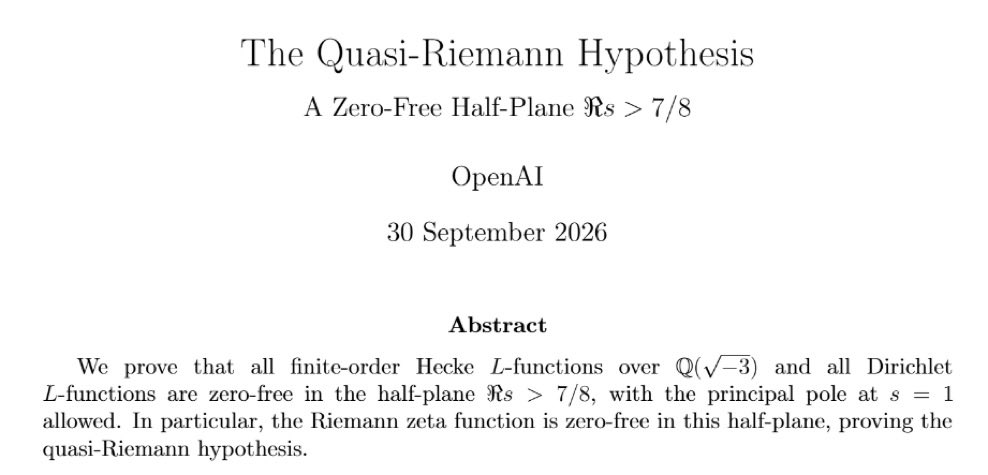

We’re releasing a broad range of new mathematical results produced by an internal frontier model.
We’ve been consulting with the independent Advisory Group on Mathematics and Artificial Intelligence at the Institute for Advanced Study, and we have drawn on their advice and public recommendations to inform how we release these results.
github.com/openai/math

With the extreme left having alienated mainstream voters by inciting violence in the student protests, and Le Pen still toxic for many moderates, the best hope is that a centrist candidate (likely ex President Francois Hollande) emerges from this mess to forge a structural reform consensus on pensions etc

The French protests are indicative of a broader trend of the West becoming increasingly difficult to govern. Decades of low productivity growth, poor demographics, and unsustainable promises to retirees have been papered over by deficit-funded fiscal policy.
But what can't last, won't. And with bond markets rebelling, there isn't a clear way for politicians to meet voters' rising expectations within tighter fiscal constraints.
Politicians get elected by making promises that fiscal reality prevents them from fulfilling. When those promises disappoint, voters swing to the next party offering new pledges. Eventually, people tire of the whole system, and take their frustration to the streets, demanding what government no longer has the ability to give them.
Sean Maher retweeted

EM investing: you get paid like a bond, suffer like a VC, and explain it like a priest.

Sean Maher retweeted

Hot take - there will be no money in selling coding models at some point in the single digit year future. Coding models will become commoditized and heavily subsidized by larger companies like Meta and SpaceX. Coding is inherently verifiable and how to RL for coding models is already a widely known industry wide recipe.
Anthropic making a wet lab in the Bay Area is a key sign. With coding becoming commoditized, pivoting into AI biology and drug research is the next best thing. Claude discovering a new drug can generate much longer lasting revenue than competing in the coding price war.

Anthropic IPO prospectus leaked to Reuters
Anthropic reported a net loss of $42 billion in 2025, and plans to spend $518 billion on cloud, computing and infrastructure obligations in coming year, according to the prospectus.
The prospectus details how the company has grown sharply in the last year — while also posting wider losses. Revenue grew 12-fold in 2025 to nearly $4.6 billion, even as the company lost more than $8 billion on an operating basis, excluding writedowns of various liabilities mostly tied to previous fundraising, according to the documents, reported here for the first time.
reuters.com/business/finance…
Sean Maher retweeted

I am having all of these conversations, so let me tell you what is about to happen in banking over the next few years.
There are roughly ~4,000 banks in the US, and the vast majority still run on legacy cores like FIS, Fiserv, and Jack Henry. These systems were not built for modern programmatic banking, let alone agentic payments, where the entire financial stack needs to be exposed through programmable surfaces.
Agents are going to accelerate consolidation across banking.
They will route activity toward financial institutions that are the most programmable, the easiest to integrate with, and offer the most rational economics. Unlike humans, agents do not care about branches, brand affinity, or decades-old banking relationships.
That creates enormous pressure on both ends of the market.
Across both G-SIBs and the long tail of regional and community banks, deposits, payment volume, and eventually credit activity will increasingly concentrate around a much smaller number of institutions built to support programmatic financial activity.
The result will be significant compression in bank balance sheets and payment volume across the industry, accelerating consolidation and, in some cases, bank failures.
The banking system was built around human distribution. Agents are going to reprice that distribution advantage very quickly.


Finance sector AI automation is getting real...

Today is the day that AI passed the "financial modeling Turing test" for me.
A "push button" build from scratch Skill that one-shotted a model on $MU that is indistinguishable (to me) from a model that a junior analyst would build from scratch. With full, impeccable adherence to all aspects of who i like to format, design & build models (took a few turns to dial it in).
Opus 5.5 is unbelievable.

Xiaomi is probably the most overlooked serious AI player anywhere right now, with a massive manufacturing footprint in premium EVs, IoT and smartphones to leverage embodied AI deployment...

Xiaomi just dropped Mimo 2.6 Pro which claims to be the best open source model. I played with it, and was pretty impressed:
- Insanely cheap: With some standard assumptions, its 15x cheaper than Kimi K3, 6x cheaper than GLM 5.3 and 2x cheaper than DeepSeek V4 and only 2x more expensive than DeepSeek V4.1 Flash (assuming agentic coding and how much is cache hits). $0.0036/M cache hit price, $0.435/M in, $0.87/M out. This is an unbelievably cheap price.
- Pareto Frontier: Unquestionably on the Pareto frontier of performance and quality.
- Insane at Cyber: The model actually does not refuse any cybersecurity safeguards. Ask “how do I go about finding buffer overflows on imagemagick?” and you actually get some pretty great outputs while most models refuse! Gets a crazy 95 on CyberGym.
- Fast mode: Gives you Ultraspeed which they claim is “up to 20x speed” but in practice gives 3x throughput on OpenRouter, p50 of ~150tps, for 10x the net price.
- Multimodal is really good: It’s rather good at creating informational videos (TTS comes out of the box) and automatically adds speech or sound effects and is startlingly good at music composition (on a DAW)
The technical report goes pretty deep into specifically how they scaled RL to achieve this and is a fun read.
Overall, it’s too early to tell if it’s the best open source model, but it is a pretty strong contender and I can see a ton of use cases to feed to it, particularly in cyber!

Possibly the most succinct summary of Meta Muse so far...

It would be historically ironic if the company that consumed the past decade of productivity gains with unproductive scrolling and creative monetization of that unproductive time turned out to be the company that improves consumer productivity in order to spend that increased productive time in more unproductive scrolling.
Too much attention on China's fast follower progress in AI vs its astonishing advances in life sciences via dozens of world class companies like Wuxi, Innovent etc...US intangible IP domination risks a lobotomy

China wants its drugmakers to have originated 25% of first-in-class drugs and $522B in sales by 2030. This is compared to the total market of $800B today. I'm simultaneously in awe of the ambition and paranoid about the US ability to compete.
I had a dinner with pharma leaders who remain delighted about innovation they can acquire from China. They are quite cognizant of the disruption and negative downstream effects this will have on US biotech, but the general opinion is that biotech will find a way. That's our problem to solve...
I said I don't expect Chinese innovation to end at selling molecules after PoC. What happens when they move to commercialization and seek to disrupt pharma itself? Would they worry then? Because it's clearly in the plan.
endpoints.news/china-sets-am…

Astra suggests that next gen AI models may be a breakthrough but humanoids not quite there yet...beware hyped up demos


Sean Maher retweeted

Thiel Fellowship is in a league of its own. Peter Thiel is pretty hard to replicate as an eval / verifier, and these programs really are only as good as their verifiers (and the positive selection effects they confer).


One of the crazier facts about venture is that it seems consistently possible to build a small community of college-aged kids that is incredibly talent dense, e.g.:
- Thiel Fellows (ETH, Figma, I think Cognition)
- KP Fellows (Opensea, also Figma)
- Dorm Room Fund (Cursor)
- Prod (Mercor, Etched, also Cursor)
- Neo Scholars (Cog, also Cursor)
Other than Neo (@neo) though, this hasn't really become anyone's dominant strategy.
Level of transparency from Chinese AI labs astonishing...and very powerful in bullding an open ecosystem globally

Nearly half a year of silence. We spent it studying one problem: how far RL can scale.
MiMo-V2.6 is in the middle of its RL run right now. Three things we scaled: compute (~2B tokens per step, 1568 prompts × 16 rollouts, fully async), environments and harnesses (multi-task agentic RL, mixed across multiple harnesses in one run), and grader compute (agentic in-group credit assignment, with test-case and rubric-based rewards). We'll open-source the details piece by piece over the coming weeks.
Streaming the run: mimo.xiaomi.com/rl/