

More light than heat. Music on Mondays. Education everyday. Substack for longish thoughts. Founded https://xitter.cf/t.co/lug88ZdzXV - DM me for booking.
East Nashville
Joined September 2010
- Tweets2.7K
- Following704
- Followers1.1K
- Likes2.7K


Pinned Tweet
On a recent college visit, my family learned that the annual cost of attendance was more than $98,000.
Four years at that school exceeds $400,000.
For me, it raised a question bigger than “Can families afford college?”
What happens to the choices graduates can afford to make afterward?
I explore that question in my new piece for The Preamble. @sharon_says_so
buff.ly/NV6idxU
The Education Freedom Tax Credit is no longer just a policy idea.
Treasury has now issued the rules for its 2027 launch.
But what matters most is that this isn't really a tax story. It's a student opportunity story.
Millions more students can access a scholarship and an educational option they didn't have before. @schoolchoicenow

Five observations from Treasury's new EFTC rules:
1. Most students may meet the income test.
2. Married couples can claim up to $3,400.
3. Income verification is manageable.
4. States can't simply narrow the program.
5. Scholarships can support more than tuition.
The common thread?
**Schools need to start preparing now.**
The goal shouldn't be to build an education program and declare it finished.
Look 10 months ahead.
Look 10 years ahead.
Ask what can be changed, improved or redesigned.
Good education systems should be built for continuous improvement.
@QMCast
Online education requires more structure, not less.
Who supports a struggling student?
How does the family stay informed?
What happens when a student starts slipping?
Those questions need answers before a student disappears from the system.
@QMCast
For those in the Nashville area. @codyfry and @JeffCoffin are picking the songs of their lives next Wednesday. This is the first time someone has picked a Christmas carol.
Four questions, eight songs, and an audience invited to the conversation.
TEDx Mixtape, Wednesday 21 October, 7pm, Analog at the Hutton Hotel in Nashville.
$20, free for TEDxNashville members.
RSVP --> buff.ly/SlN6V9D
Not in Nashville? This becomes a podcast episode so stay tuned.

If you posted about the evils of data centers but circulated AI videos of candidates or former candidates dancing to Kendrick and 50 Cent, you might want to check for internal consistency.
Shaka Mitchell retweeted

UPDATE: New Analysis of Treasury Rules Shows 42 Million Married Couples Can Claim $3,400 Through Education Freedom Tax Credit
Statement by Tommy Schultz (@Tommy_USA), CEO, American Federation for Children (@SchoolChoiceNow):
“The Education Freedom Tax Credit has the potential to transform education for millions of children, and Treasury’s latest guidance brings us one step closer to realizing its full impact. By allowing married couples filing jointly to contribute up to $3,400, more Americans will be able to support K-12 scholarships. AFC's new analysis shows that 42 million married couples could benefit from this provision, generating an estimated two million additional scholarship opportunities for students across the country. As we prepare for the January 1 launch, we're committed to ensuring this historic tax credit delivers for families nationwide through our continued advocacy efforts and the AFC Scholarship Fund.”

According to Julie Young, a virtual school shouldn't measure success by:
→ How many courses it offers
→ How many students enroll
→ How long teachers spend at a computer
Instead it should measure learning.
Are students completing their courses?
Are they learning?
Are we getting useful feedback quickly enough to improve?
🧵 The cost of attending "elite" colleges and universities is untethered to school rank, geography, surrounding costs (which would factor into things like housing and personnel). But the range of tuition is remarkably narrow. Why?
Because these schools price themselves as luxury goods. One downstream effect is that, absent massive subsidization by the schools (which begs the question - why price it so high to begin with), kids seeking careers with modest salaries will no longer attend, because they'll never pay off their student loans. That's a loss for the entire sector.
buff.ly/xym5ND2

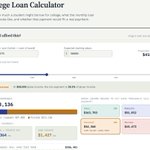
And check out this great calculator that let's you run the numbers: buff.ly/bdZaW6u

What if students didn't have to:
• Start on the same day
• Finish on the same day
• Spend 50 minutes in the same classroom
• Use the same textbook
• Learn at the same pace
Julie started asking those questions when designing virtual education.
The answers caused her to change almost everything.
@QMCast
Virtual school ≠ emergency remote instruction.
COVID blurred the two. They aren't the same.
Successful virtual schools were intentionally designed around clear learning objectives, strong teacher-student relationships and meaningful feedback.
That's a very different model.
Watch my conversation with Julie Young on @QMCast @FLVS :
buff.ly/BFPagoh
I don't want to live in a world where Atticus Finch is priced out on purpose.
But I also don't want to live in a world where becoming an Atticus Finch isn't financially sustainable.
If the cost of becoming a teacher, social worker, public servant or other purpose-driven professional requires taking on debt that the career can't reasonably support, something has gone wrong.
That's the problem I'm trying to get at in my latest piece for The Preamble.
buff.ly/Y19JIL3
New from @chadaldeman:
"Let’s take Chesapeake Public Schools as an example. Members of the Chesapeake Education Association are currently warning that the district is at risk of losing up to $22 million thanks to the state participating in the federal tax credit scholarship program. That figure comes from the Virginia Education Association (VEA), which assumes that if the tax credits induce a 4% decline in public student enrollments, that will lead to a 4% decline from each of the district’s major revenue sources.
But that’s not how public schools are financed. As one concrete counter-example, consider that Chesapeake’s enrollment has increased by about 2% over the last four years. Meanwhile, its state and local funds—which excludes one-time federal funding—increased by 37%. If enrollment were directly proportional to funding, those two figures should have increased at the same rate. But they didn’t." @schoolchoicenow @mlueken2 buff.ly/JX7o5lR

Monday Music - Oct. 5 - tonight I'll be at Wheaton College (IL) discussing the Bad Bunny's Superbowl halftime show (good on you Wheaton!). One thing that is sure to come up is that some people were, dare I say, "triggered" because the show was in Spanish. It's a topic worth discussing. Worth listening to is another @sanbenito song, "Nadie Sabe," the title track on "Nadie sabe lo qu va a pasar mañana" or "Nobody's knows what will happen tomorrow. That's a fact in any language and reminds me that holding on to anger is a heck of a way to spend what could be your final moments. Regardless of language I think you'll enjoy this dramatic song by Benito: buff.ly/zkiW9LX
The college-debt conversation usually focuses on one person:
Can the graduate afford the payment?
But there's a second question:
What happens to all of us when college becomes economically segregated?
If expensive colleges increasingly become places for students headed toward finance, consulting and tech — while less expensive institutions produce more teachers, nurses and counselors — we're not just sorting people by income.
We're sorting them by profession.
And we lose something when people who will live very different lives never have the chance to learn alongside one another.
That's the second half of my argument in The Preamble.
buff.ly/Y19JIL3


Use my calculator to run your own numbers.
buff.ly/bdZaW6u
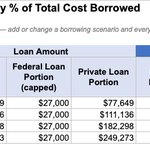
In the scenario I describe, a graduate with roughly $209,000 in student debt needs to earn more than $250,000 a year to keep the payment within the 8–10% range generally considered financially healthy.
How many recent graduates make $250K?
Not many.
So what happens to the person who wants to become a teacher, social worker, nonprofit leader, military officer or musician?
Does the debt make the career impossible?

We need teachers, social workers, and nonprofit pros.
We need people willing to serve in the military. Artists, they're pretty great to have around.
But what happens when the education required to enter those careers comes with a debt burden that their entry-level salaries can't reasonably support?
At some point, student debt becomes more than a financial problem. It becomes a career-choice problem.
That's one of the questions I explore in my latest piece for The Preamble. @sharon_says_so
buff.ly/Y19JIL3
