

Soviet cinema: rare photos, film clips & quotes. The story the world forgot to tell.
Joined July 2026
- Tweets926
- Following558
- Followers382
- Likes606



Pinned Tweet
The story behind The Ascent (1977), the only Soviet film to win the Golden Bear in Berlin. #SovietCinema #LarisaShepitko
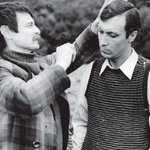
Andrei Tarkovsky and Oleg Yankovsky on the set of Mirror in 1974.
Yankovsky played the protagonist's father in the film. Tarkovsky cast him because he looked remarkably like his own father, poet Arseny Tarkovsky.
The director's real mother also appeared in the movie, playing herself in her old age.

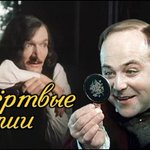
Dead Souls (1984)
Nikolai Gogol wrote this satirical novel in 1842.
Director Mikhail Shveitser adapted it into a 5-part TV series in 1984.
What is the film about?
The story takes place in 19th-century Russia. A stranger named Chichikov arrives in a quiet provincial town.
He visits local landowners and buys "dead souls." These are peasants who died after the last census.
On paper, they still exist. Chichikov plans to mortgage them for real money.
Each landowner he meets is a sharp caricature of human greed, laziness, or vanity.
Behind the scenes
Shveitser did not hire a narrator. He read Gogol's ironic comments himself behind the scenes.
The crew filmed in the ancient town of Suzdal. A local library became a tavern.
One art school played the Governor's mansion from the front and a wild estate from the backyard.


When Larisa Shepitko finished The Ascent in 1977, officials almost shelved it for being "too religious." To save the film, she and her husband Elem Klimov drove from Moscow to Minsk in an old car with the film print still wet from the lab.
Full story behind one of the greatest war films ever made — in the first comment below 👇


The story behind The Ascent (1977), the only Soviet film to win the Golden Bear in Berlin. #SovietCinema #LarisaShepitko
36
Come Tomorrow (1963), directed by Yevgeny Tashkov.
What is it about?Frosya Burlakova is an open-hearted, down-to-earth girl from a small Siberian village.
She comes to Moscow to audition for a music conservatory.
She has no clue about big-city rules, so she constantly ends up in funny situations.
In this scene, she is auditioning for a professor. She basically talked him into listening to her.
Frosya is played by Yekaterina Savinova. And yes, that is her real voice. Zero dubbing. Seriously! She had a truly remarkable and rare voice.
She is no longer with us, yet people still love and remember her Frosya Burlakova to this day.
Andrei Tarkovsky famously criticized Stanley Kubrick's 2001 A Space Odyssey.
Tarkovsky felt Kubrick got too carried away with space exoticism, shiny technology, and artificial visual effects. In the Soviet director's view, the human soul got lost behind all that spectacle.
When making Solaris, Tarkovsky deliberately went in the opposite direction. He rejected neon futures and flashy sci-fi visuals.
Instead, he filled the frame with simple, earthly textures — rainwater, wet grass, and the quiet of an old wooden house. Tarkovsky believed that humanity's encounter with the Unknown should be felt through nature and memory, not cold machinery.
Interestingly, Stanley Kubrick himself deeply admired Tarkovsky's films and called Solaris a true masterpiece.
Two cinematic giants, and two completely different visions of the universe.


Today is the birthday of legendary Soviet actor Alexei Batalov.
His favorite writer was Anton Chekhov. Batalov even played the lead role in the iconic Soviet adaptation of The Lady with the Dog.
They seemed remarkably alike, both in spirit and appearance. Two true Russian intellectuals — quiet, noble, and deeply thoughtful.
Here is how Batalov once spoke about Chekhov:
"Chekhov lived against the grain of reality. One day he coughed while writing, and drops of blood fell on his manuscript. As a doctor, he knew it was tuberculosis. Yet he still traveled to Sakhalin by horse to conduct a census of prisoners. A nation doesn't need to consist entirely of apostles, but it must have a chosen few."
Those words describe Batalov himself just as well.

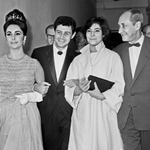
Soviet actress Tatiana Samoilova at the 1961 Moscow International Film Festival in a stylish white trench coat.
Stylish clothes were hard to find in the USSR back then. Store shelves were mostly empty and actors earned modest salaries.
Two years earlier, Minister of Culture Ekaterina Furtseva launched the Moscow International Film Festival. She wanted Soviet actresses to shine right alongside Western stars.
A lucky few got to order dresses at closed Central Committee ateliers or received rare fabrics. Still, most actresses had to get creative on their own. Against all odds, they always managed to look stunning.
At that 1961 festival, Samoilova greeted guest of honor Elizabeth Taylor at the airport ramp in a much simpler outfit. Soviet actress Marina Strizhenova stood right next to her.
By then, the story of Veronika in The Cranes Are Flying had already won hearts worldwide. Yet back home, officials initially hated the movie.
Nikita Khrushchev famously dismissed the heroine in harsh terms. When the film took the top prize in Cannes, the newspaper Izvestia printed only two lines about it on the back page.
Audiences abroad admired Samoilova's beauty and charm. Meanwhile, this famous 1958 Cannes photo wasn't even published in the USSR.
Even though all eyes at that festival were on the 24-year-old Soviet star.
From left to right Sophia Loren, Lilia Yudina, Mitzi Gaynor, and Tatiana Samoilova.


On November 19, 1972, Andrei Tarkovsky’s Solaris had its theatrical premiere in Paris.
Earlier that year, the film had already won the Grand Prix at Cannes. Now it was finally reaching regular cinema audiences in the West.
Tarkovsky, Donatas Banionis, and 21-year-old Natalya Bondarchuk attended the premiere in person.
Western critics immediately called it the Soviet answer to Stanley Kubrick’s 2001: A Space Odyssey. Yet Tarkovsky had made something entirely different — a quiet, deeply human meditation on memory, guilt, and love.


Just realized something wild while talking to readers today.
JULY RAIN, ANDREI RUBLEV, and THE BATTLE OF ALGIERS were all made in 1966.
Three completely different worlds, yet all three share that same raw, poetic black-and-white atmosphere. Must have been something in the air that year.

1
10
326
Soviet actor Leonid Filatov on why he loved playing villains:
"I genuinely love negative roles. Remember what 'positive' heroes used to be like in our cinema? Just flat cardboard cutouts. No inner conflict, no drama, no fracture.
Whereas in a villain—even one painted entirely in black—you can always find a spark of light and bring that inner struggle to the surface."
— Leonid Filatov (1946–2003)


In 1970, legendary director Andrei Tarkovsky wrote down an incredible story in his diaries about how his masterpiece "Andrei Rublev" almost never happened:
"For some reason, I just remembered how I lost the manuscript of the 'Rublev' screenplay (without having a single draft copy).
I left it in a taxi on the corner of Gorky Street, across from the Hotel National.
The taxi drove away.
Overcome with grief, I got drunk. Two hours later, as I was walking back down the street, a taxi suddenly pulled over at that exact same corner — breaking traffic rules — and the driver reached out the window and handed me my manuscript. It was a miracle."
Source: Andrei Tarkovsky's diaries ("Martyrology"), entry dated August 8, 1970.
Do you believe in such coincidences, or was it pure fate?

85 years ago today, on November 17, 1941, the musical comedy "They Met in Moscow" (Svinarka i Pastukh) premiered in the USSR.
Filming began before the war, and the movie was finished under extreme conditions in the autumn of 1941, while German air raids were hitting Moscow.
In June 1941, leading actor Vladimir Zeldin was drafted into a tank school, but three weeks later, he was ordered back to the Mosfilm studio — the country needed uplifting cinema just as much as weapons.
Here are two remarkable facts behind this classic:
1. How Vladimir Zeldin got the role. Director Ivan Pyryev auditioned dozens of actors to play the shepherd Musaib and couldn't decide.
Finally, he gathered all the women on the film crew for a secret vote using screen-test photos. They unanimously chose Zeldin.
2. The song that became an anthem. The film's signature duet, "Song of Moscow," written by poet Viktor Gusev and composer Tikhon Khrennikov, became a true symbol of hope for soldiers on the front lines and families in evacuation.
Marina Ladynina later recalled receiving hundreds of letters from the front thanking them for the film.
Watch and listen to this iconic duet performed by Marina Ladynina and Vladimir Zeldin.
Have you seen this Soviet classic?
125 years ago, on November 17, 1901, a boy was born in the village of Kamen in the Tomsk Governorate. His name was Ivan.
When Vanya was three, his father was killed in a brawl. His mother left for the city to find work, and the boy was raised by his grandfather, an Old Believer with a famously hard temper.
Ivan went to a parish school and helped his grandfather around the farm. For several years he even worked as a herdsman.
Years later, Ivan Pyryev would become one of the best-known directors in the country and make films that are now considered legendary.
Among his finest works are The Idiot (1958) and The Brothers Karamazov (1969).
Pyryev died in his sleep on February 7, 1968. He had just come back from filming The Brothers Karamazov, went to bed, and never woke up. The lead actors, Mikhail Ulyanov and Kirill Lavrov, finished the third part of the film in his place.
He was only 66. It was later established that he had suffered six heart attacks without ever stopping work. He never saw a doctor. Work was all he lived for.
Ivan Alexandrovich Pyryev is buried at Novodevichy Cemetery in Moscow.

Warm evening vibes: Soviet cinema’s timeless beauties, each graced by flowers.
Which of these 10 portraits captures your heart the most? Let us know your favorite number (or numbers) in the comments!
1. Tatyana Piletskaya
2. Irina Kupchenko
3. Vera Glagoleva
4. Klara Rumyanova
5. Elena Tsyplakova
6. Svetlana Nemolyaeva
7. Elena Proklova
8. Irina Akulova
9. Zinaida Kirienko
10. Tatyana Samoylova

July Rain (1967), dir. Marlen Khutsiev
Morning in Moscow, 1966. Fog, empty avenues, and a quiet poetry of the city that only Khutsiev could capture. Pure French New Wave mood, yet with a soul all its own.
Which 1960s film has the best atmosphere for you?
She lived to 80. So much happened to her in those years. Her life held fame, admirers, men she loved, the loss of a child, a trial, prison, betrayal by friends, being forgotten, blindness, and years in a state-run home. What remains are her film roles. And for them, she deserves a deep bow.
Valentina Malyavina was one of the most beautiful actresses of Soviet cinema, with more than 40 roles to her name.
Among them is Andrei Tarkovsky’s debut feature, Ivan’s Childhood (1962), in which she played Masha, a medical lieutenant. It remains one of the brightest roles of her career.
She presented the film at Cannes alongside the director. Because of her filming, she was expelled from the Moscow Art Theatre School.
Later she called Tarkovsky her destiny and said he had asked her to act only in his films. But after Ivan’s Childhood, they never worked together again.
She had extraordinary eyes. They drove people out of their minds. And it was her eyesight she lost at the end of her life.
In her final years, Honored Artist of Russia Valentina Malyavina lived in a nursing home, alone. Shortly before her death, Valentina Alexandrovna fell, hit her head and lost her sight. She died on October 30, 2021.
She was cremated, and the farewell was held privately. Almost no one knew about it: neither friends nor fans were able to say goodbye. Her ashes rest in the columbarium of the Troyekurovskoye Cemetery in Moscow.
Today is the anniversary. Rest in peace 🕯
#SoWeRemember

Into the Storm (1965)
Genre — Drama, Literary Adaptation.
"It was foolish to come into this world, and even more foolish to die without having done anything."
On November 15, 1965, Soviet television aired the first part of Sergey Mikaelyan’s two-part drama *Into the Storm* (*Idu na grozu*), adapted from Daniil Granin’s acclaimed novel.
What is this film about? Set during the Soviet 1960s, it follows young physicists and true romantics of science who literally fly into thunderclouds to learn how to control the weather. At the heart of the story are two friends and researchers, Sergey Krylov and Oleg Tulin. Both share the same dream, yet they see the price of success very differently. While one seeks pure scientific truth, the other is willing to compromise his principles for a fast career and recognition.
It is a sharp, honest story about friendship, moral choices, and the classic 1960s debate between rational scientists and idealists during the Soviet Thaw.
The cast features young icons of Soviet cinema Vasily Lanovoy and Aleksandr Belyavsky, alongside the legendary Anatoly Papanov and Rostislav Plyatt.
Crisp black-and-white cinematography by Oleg Kukharenko and a tense score by Vladlen Chistyakov capture the exact pulse of the era.

“I am truly fortunate.
And in general, I think acting is a very festive profession.
Yet I get the blues, too. Especially in autumn.
I am certainly prone to depression. Especially in the fall. November, when it’s dark by 4 p.m.… The body resists, and… it begins.
That’s when you have to keep yourself busy with work and tell yourself: ‘Smile, smile.’
One thought warms me up: New Year is coming soon.
And after that, the days will start getting longer.”
— Oleg Yankovsky (1944–2009), star of Tarkovsky’s Nostalghia
Do you get the autumn blues too?

COME AND SEE (1985)
Directed by Elem Klimov
While Larisa Shepitko was making The Ascent, her husband, director Elem Klimov, began working on what would become Come and See.
Pyotr Masherov himself served as a consultant on the film. He had been a partisan during the war.
Pyotr Mironovich was not just a political leader (he headed the republic from 1965 to 1980), but also a popular leader and a war hero.
I first saw Come and See in a cinema.
For almost half the film, I kept looking down or covering my eyes. I simply couldn't watch.
I had come to see it, but I couldn't bear to look at the screen. It was unbearable.
Years later, however, I finally made myself watch it again.
The story centres on a Belarusian boy named Flyora (Alexei Kravchenko), who witnesses the horrors of a Nazi punitive operation.
Alexei Kravchenko was just 14 during filming.
For almost the entire film, all we see is his face.
Over the course of 145 minutes (the running time of the two-part film), a boy turns into an old man.
This was his film debut — and what a devastating debut it was!
To help him understand his character, the director arranged a kind of test.
The boy spent four hours watching authentic documentary footage from Nazi concentration camps.
Alexei watched it all the way through and came out a different person.
Filming lasted nine months.
For six of those months, he was not allowed to see his mother. This was done to create a sense of isolation and disorientation.
To make the character look older, the make-up artists literally pulled the skin on Kravchenko's face tight with glue, creating wrinkles.
It was excruciatingly painful. The stress even caused his hair to turn grey.
Elem Klimov wanted everything to be absolutely authentic.
Filming took place in northern Belarus. The actors spoke with local people who had lived through the occupation.
Years later, Elem Klimov said in an interview:
“I wanted the viewer not simply to watch this film, but to live through it.”
The film was released in 1985, marking the 40th anniversary of Victory Day.
Ambulances were on duty outside cinemas because some viewers became physically ill from what they saw.
Even watching all 145 minutes on screen is almost unbearable.
There are no isolated scenes that simply make your heart ache.
The entire film is like that.
All 145 minutes.
145 minutes of truth.
Which war film has been the hardest for you to watch — the one you find almost impossible to revisit without that knot in your throat?
Elem Klimov with Alexei Kravchenko, who played Flyora in Come and See (1985).

8
176