

p2p full graph stack for Agentic systems, commerce and digital assets. 10,000x cheaper, 340x lower latency. https://xitter.cf/t.co/p9RVzPrqWy https://xitter.cf/t.co/BVeE4jkhkC
Distributed
Joined February 2020
- Tweets3.7K
- Following160
- Followers6.2K
- Likes2.8K




Pinned Tweet
A new chapter in proactive wellness begins.
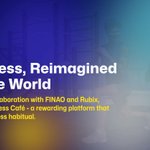
FINAO SPV Inc.- a venture between FINAO and Rubix Blockchain-has collaborated with the YMCA to launch the P0 beta of the YMCA Wellness Café™ in the Pacific Northwest.
The platform encourages members to build healthier habits by rewarding consistent wellness activities with Y COIN, a utility token backed by Rubix tokens.
Powered by the Rubix Blockchain, the platform enables secure activity records, seamless rewards, data privacy and scalable transactions.
With the YMCA serving more than 60 million members across 120 countries, this initiative has the potential to take rewarding, proactive wellness to a global scale.
Read the full announcement:
lnkd.in/d8_q2zhJ

_Graph retweeted

WE DIDN'T JUST RETHINK AUTHENTICATION. WE REDEFINED TRUST.
Identity is managed through @XSenseID . Credentials & assets are controlled through AUTHAMS, Authentication is strengthened through our @ThinC_AUTH FIDO2 Bio Keys.
#UnPhishYourself with Ensurity.
📷[email protected]
🤖 Made with AI
_Graph retweeted

Gavin Baker on the other side of Ben's bandwidth story: at the peak of the 2000 bubble, 97% of America's fiber sat dark, and today there are no dark GPUs.
"I had, depending on how you look at it, the privilege and the misfortune of being a tech investor during the year 2000 bubble, which was really a telecom bubble."
"The year 2000 bubble was defined by something called 'dark fiber.' Dark fiber was literally fiber that was laid down in the ground, and not lit up... At the peak of the bubble, 97% of the fiber that had been laid in America was dark."
"Contrast that with today. There are no dark GPUs. All you have to do is read any technical paper, and one of the biggest problems in a training run is that GPUs are melting."
@GavinSBaker

Ben Horowitz on the lesson LoudCloud, his early cloud company, taught him about today's AI neoclouds, and why they now face the opposite problem:
"It can end up being like a very dangerous arbitrage business, where you can get upside-down easily. And so if you look at LoudCloud, just as an example, here's a simple thing that happened to us."
"In 1999, bandwidth was $1,500 a megabit. And you couldn't get it. It was very hard to get it. And so you had to get a long-term contract, three years. By 2001, it was $50 a megabit... And if you borrowed money to get it, you're dead."
"That kind of thing is so out of the control of the entrepreneur."
"I think the core dynamic of AI has been working for CoreWeave, though, in that there's a massive shortage, not an overage of supply... Token prices have gone down, but GPU prices have not."
"And by the way, data center space is going up in price because even labor to build data centers is hard. The politics are making it hard to build data centers. So the whole supply chain price is going up and demand is not subsiding."
"Those are very big tailwinds for CoreWeave, despite the fact that the debt markets, kind of independent of them, are tough."
@bhorowitz w/ @chamath on @allinpod
_Graph retweeted

Hackers Jailbreak iPhone 18 Pro on Stage, and It Survives a Reboot
decrypt.co/381177/hackers-ja…

_Graph retweeted

JUST IN: Cybersecurity experts warn that AI agents are highly vulnerable to phishing emails containing hidden malicious instructions.

_Graph retweeted
We have not sorted security gaps in the pre agent era fully yet, and now with agents, its a fully different thing altogether. Build agenetic security architecture from first principles @Agent_DNA

_Graph retweeted
Don't hand your credentials and keys to AI models or model based security tools. Harden and air gap credentials/keys where possible now (for humans). Decentralize otherwise (for agents). There is little other option.
#AISecurity #cybersecurity #IAM
@EnsurityTech @Agent_DNA
_Graph retweeted
Lets quickly build better security systems for humans and agents while we can do
@EnsurityTech @Agent_DNA

Scoop: Top executives at Anthropic, OpenAI and other AI companies are privately gaming out scenarios for a public and political revolt after a catastrophic AI event…They assume one in ‘27…
axios.com/2026/10/09/ai-comp…

_Graph retweeted

I was wondering if maybe AI models were going to find some kind of hidden mathematical trap in the P-256 parameters. The opposite just happened!
anthropic.com/research/ecdsa…

_Graph retweeted

IPFS is entering its next chapter: more decentralized, more resilient, & stewarded by a growing community of independent teams supporting public infrastructure!💪
At the end of September the project celebrated a major milestone 🏁: 100% of in-browser public gateway traffic now uses direct, verifiable peer-to-peer retrieval — run by a sustainable, federated network of independent operators.🤝
Big thanks to:
🔎 IPNI / Compass — content discovery, routing, and browser-first retrieval
📊 ProbeLab — network health, measurement, and performance
🛡️ Skapa / BadBits — protecting the network from abuse
IPFS has always been about an internet that is more open, resilient, and user-controlled. Building on IPFS? Operating infrastructure? Come help shape what's next!
blog.ipfs.tech/2026-10-new-s…

_Graph retweeted

the nsa's "mystery" seed behind P-256 was just a 1997 clock time
the part people are missing: a timestamp only gives ~30 bits of wiggle room
the backdoor theory needed ~70
best case outcome. the most trusted curve on the internet stays trusted

CLAUDE FOUND THE SEEDS
anthropic.com/research/ecdsa…
_Graph retweeted
1 weak password. A country breached.
The Denmark CPR breach is a reminder that vulnerabilities can have disastrous consequences .
We help enterprises strengthen identity security through @XSenseID , @ThinC_AUTH FIDO2 Keys, & 𝗮𝘂𝘁𝗵 AMS.
#UnPhishYourself
📩[email protected]

_Graph retweeted

5/
That changes how you think about scalability.
Instead of forcing millions of unrelated events through one shared execution sequence, Rubix lets independent state evolve independently.
Over time, you don’t just get a ledger. You get a verifiable graph of digital activity.
_Graph retweeted
1/
What if a blockchain didn’t need one global sequence for everything?
What if digital systems looked more like a graph where independent objects evolve locally and only causally related events need to intersect?
That’s the intuition behind @RubixChain : The Graph of Everything.
_Graph retweeted
6/
Payments are one edge in that graph.
Agent actions are another (Check @Agent_DNA ).
Asset transfers. Agentic transactions. Identity delegation. Different systems become connected interactions in the same verifiable fabric @RubixChain .
_Graph retweeted
One global sequencer never was going to scale and run any real world application. Graph on the other hand makes immense technical sense, esp with agents @RubixChain @Agent_DNA
_Graph retweeted
2/
In account based chains even when execution becomes parallel, the architecture still begins with the idea of a common state machine.
@RubixChain through its unique p2p token based lever never combine unrelated things into one execution domain.