

Climate Scientist and #IPCC Lead Author. I put the ocean in a /shell/ and throw that shell back into the ocean. Occasionally that rains back as monsoon stories
Joined June 2008
- Tweets3.5K
- Following650
- Followers8.4K
- Likes16.5K





Pinned Tweet
People in vulnerable areas should already know their local evacuation procedure.
Read my op-ed on why we need "disaster preparedness drills" along with this article by Nirajan Siwakoti on how quick decision making and dissemination of danger helped save a few lives during the Tibet-Nepal floods.
theconversation.com/nepals-d…


In India, everyone needs a disaster drill.
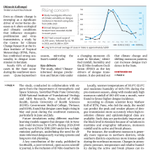
My op-ed in today’s Indian Express on why every school, college, workplace and community should hold mandatory seasonal disaster drills, with one before the heatwave season and another before the monsoon.
Read: climate.rocksea.org/images/c…

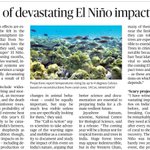
How to Survive a Super, Monster, Godzilla El Niño
In Hindustan Times, we explain what this El Niño means for food, water, ecosystems and the economy, and how we can prepare.
Read: climate.rocksea.org/images/c…

ALT How to Prepare for a Super, Monster, Godzilla El Nino. Op-Ed in Hindustan Times by Roxy Mathew Koll of IITM, and Mohammad Rafiuddin of CEEW. 14 Oct 2026
Roxy Koll ⛈ retweeted

VIDEO | Bangkok, Thailand: On key takeaways from Global Heat Forum, climate scientist Roxy Mathew at the Indian Institute of Tropical Meteorology says, "The core message from the forum and from science is that extreme heat is arriving faster than we anticipated. It is becoming more intense, occurring far more frequently, lasting longer, and getting harder to escape over time. Meanwhile, our response has lacked the speed, intensity, and urgency required to match how heat is impacting us on multiple fronts. We must act urgently, grounded in scientific evidence. Science needs to be converted into actionable data and information to build robust early warning systems that translate directly into protection at the individual, community, and administrative levels in countries like India..."
(Full video available on PTI Videos - ptivideos.com)
Heat will be harder to escape by 2050, when many of us will be older and more vulnerable. Add about 25 years to your age now. Are you prepared!
Harder to escape, both in space and time.
We come home from a hot day outdoors, expecting relief, but the heat is already in the bedroom, since our housing and urban setup trap the heat. And the nights are getting warmer, and rising humidity makes it harder for our bodies to cool.
The good news is that the data help us understand these risks and protect ourselves better. We need to learn how to grow older in a hotter world.
Global Heat Forum, Bangkok, 2026

Roxy Koll ⛈ retweeted

Proud Moment! 🇮🇳🌊
We congratulate Dr. Roxy Mathew Koll on receiving the prestigious Pavel S. Molchanov Climate Communications Prize from the American Geophysical Union (AGU) for his research on Indian Ocean warming.
His work has strengthened our understanding of the Indian Ocean and its role in the climate system, while bringing important climate science closer to the public.
A proud recognition of India’s contribution to global climate research and science communication.
#ProudMoment #Congratulations #ClimateScience #IndianOcean #AGU2026 #MoES
@narendramodi @mygovindia @PMOIndia @DrJitendraSingh @OfficeOfDrJS @PIB_India @MIB_India @iitmpune @tummalasrini

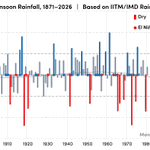
The monsoon index plotted here shows that the monsoon winds and circulation during the June-September season this year was relatively weak (compared to climatological mean).

The monsoon winds/circulation were relatively weak and less organized this season. This gave a chance for low pressure systems from the Bay of Bengal and Western Disturbances (WDs) to bring in rains (heavy rains possibly due to intensified water cycle), compensating rainfall deficits over some of the states.
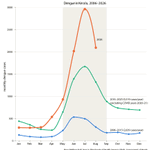
Pune rains here exemplify the monsoon of contrasts.
If we look at the total amount of rainfall during the season, we got 736 mm. If we use that number to characterize the monsoon, it is way above the long-term average of around 600-650 mm...
...but take a closer look, just 3 days delivered nearly half of what Pune normally receives over the entire monsoon season. The rest of the season was almost dead.
A seasonal total can hide the real story.


