
Professor on Productivity and Welfare @UniGroningenFEB, director GGDC, developer @PennWorldTable, PPP guru, editor @ROIWeditors
Groningen, Netherlands
Joined January 2013
- Tweets1.3K
- Following384
- Followers1.4K
- Likes7.5K






Robert Inklaar retweeted

I've been thinking about this for a few days. It's an interesting framing.
Everyone (OG AI economists, new AI economists, non-economists) should be constrained by their other explanatory commitments, their model of the world.
This is a necessary part of model-based thinking, so you don't just make stuff up anew each time.
For me (and I think many other economists), the most basic commitment are things like scarcity, trade-offs, constraints, and then equilibrium adjustments. Don't assume away these things.
When you bring this to growth, you don't ignore scarcity, even if economic growth has made scarcity a lot less binding than it was in 1500. You start to think about how improvements (falling prices) interact with other scarce resources and trade-offs. The responses generate other innovations. Growth is the net interaction of all this.
This doesn't magically go out the window when we say AGI. It maybe should but we need a reason, grounded in higher level intellectual commitments.
Take @ChadJonesEcon. If you spend a career thinking about growth through new ideas, nonrivalrous knowledge, allocating goods to research, those don't go out the window. That's your framework for thinking about what drives growth. But also so are the constraints. If you spend your time thinking about bottlenecks as a part of past growth, that's your starting point.
Lo and behold, he starts writing AI papers and that's the starting point. That doesn't mean the framework is "AI as a normal technology". It doesn't mean its the exact same in an AGI world as a non-AGI world but you have a model-based approach to thinking about what changes. The feedback is endogenous, and the same framework can generate explosive growth.
We don't want to like an approach simply because it generates big growth or dislike because it doesn't. You can't simply choose the conclusion you want independently of your account of how the world works.
Building from familiar economics models, even ones with labor and capital, aren't a failure to take AGI seriously. You can still think some things are no longer scarce. That's a huge change.
Of course, we can always use a model badly. Maybe your past model had land as a big constraint and that fit the data in a world where land is a constraint, but then the Industrial Revolution happens and ideas/trade are the constraint. But we want to be clear in the model, what is the constraint that is doing the real work and will that be the same in the future? Maybe it is or maybe it isn't.
We should be very hesitant, and I'm not saying Jan is doing this, of confusing "taking AGI seriously" with arriving at sufficiently radical conclusions. That's not a good epistemic standard.
You can't choose the conclusion you want independently of your account of how the world works. The model/account of the world constrains you the student of the world and theorist.

Few years ago, there was just a handful of economists seriously thinking about AI (@akorinek,@pawtrammell,@erikbryn,Carl Shulman & few of their collaborators) and I was like 'this is insane, there should be 10x as many'.
Now it's ~10x-30x more and frankly it is disappointing so far. Majority of the new economists bring a mindset and frames which are something between unhelpful to directly harmful for understanding AGI
- not taking AGI seriously / "AI as a normal technology"
- merchants of cope dynamic (in high demand by the labs)
- labour/capital mindset
- people were wrong about risks of tech transitions in the past and by induction they are again
etc...
coupled with epistemic arrogance. Sorry for being very blunt, by my impression is part of the problem is economists are often used to be in the broader context of humanities where they are the most quantitative and in some ways the smartest lot in various rooms, and others disagree with them for bad reasons. But this is _not_ the case relative to AI safety a few years ago!
Robert Inklaar retweeted

Meanwhile the Engineers are just lighting themselves on fire to see what happens.
COMIC ◆ smbc-comics.com/comic/reacti…
PATREON ◆ patreon.com/ZachWeinersmith
STORE ◆ smbc-store.myshopify.com/
#comics #humor

ALT 4-panel SMBC comic update. A header above the panels reads "reactions to AI automation." The first two panels show an artist and a mathematician working, and reacting to AI by saying "but I don't want to lose my job. I love it." The third panel shows an economist shouting "LONG HAVE I AWAITED THIS HOUR! DESTROY ME, EFFICIENCY AND LET UTILIZATION-ADJUSTED TOTAL FACTOR PRODUCTIVITY RISE ON THE WIND OF MY ASHES!" The final panel shows the economist getting his face blasted off as the artist and the mathematician stare perplexed.
1/ Some thoughts on the PPP debate (Russia vs UK) that @page_eco's thread covers well. First, total vs per capita is a non-issue: total real GDP is output at common prices, per capita divides by population. If one is meaningful, so is the other.
4/ World Bank PPP GDP converts the trade balance at exchange rates. In a new paper we show this comes close to output-side real GDP: world GDP differs by only 1.4%, and global inequality is nearly identical. doi.org/10.1111/roie.70091

5/ But GDP measures all products that an economy can produce, not military capacity. @wwwojtekk is right that the war question needs its own prices, for soldiers and equipment: military PPPs. militaryppp.com/ onlinelibrary.wiley.com/doi/…

Robert Inklaar retweeted

Inklaar legt nog eens uit, dat knelpunt NL economie op dit moment niet “geld” is, maar gebrek aan mensen is. En dat overheid veel te veel tegelijk wil, is belangrijke oorzaak hiervan: “Wie zegt dat dit allemaal tegelijk kan, belooft gouden bergen met andermans handen”⬇️

Robert Inklaar retweeted
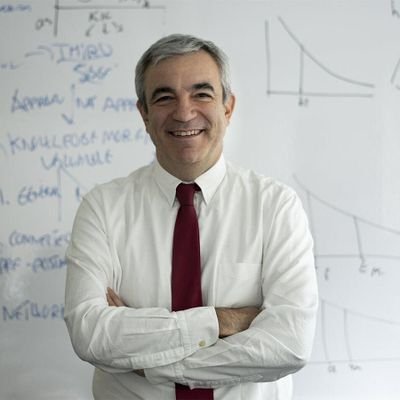
.@TheEconomist covers our "Is Europe Stagnating" debate with Krugman. It reaches three conclusions I am happy to settle for:
"First, Europe is growing slower than America. Second, that is a problem: even if Europe can free-ride on America’s dynamism, as Team Krugman argues, that is no way to run an economy. Third, the AI era may be less forgiving than the last wave of tech-driven growth."
economist.com/finance-and-ec…

As the quoted PPP guru, I support this message. For more, see: xitter.cf/RobertInklaar/status/2…

Does that matter? A high-stakes transatlantic spat has erupted over GDP figures economist.com/finance-and-ec…

Robert Inklaar retweeted
The expert on the PPP (whose work we cite in our post) chimes in with this useful thread. I hope you find it clarifying @ojblanchard1 and others.

Robert Inklaar retweeted

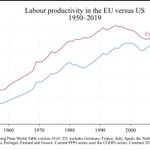
On PPP, this is good. Theory is pretty clear: take domestic output or income, deflate, look at real GDP pc or labor productivity. US growing ~1% faster than W Europe per year. Converted to current or chained PPP, you don't get this. 1/7
Robert Inklaar retweeted

The entire PPP debate I've been waiting for Inklaar and/or Fernald to weigh in. This take does not disappoint in clarifying the challenges.
Is Europe falling behind the US on productivity? The Krugman vs Aghion–Bergeaud–Garicano debate hinges on one choice: current vs constant PPPs. A new note maps the gap behind it — all 27 EU states, two data sources — and what it does and doesn't settle. 🧵
Net: Krugman and Aghion–Bergeaud–Garicano and I agree on much: faster US growth, current vs constant PPPs answer different questions, weighting isn't the driver. The disagreement is a reliability prior (which measure to trust).
Full technical note here: github.com/rcinklaar/PPPnote…. Comments welcome. cc @paulkrugman @Ph_Aghion @a_bergeaud @lugaricano @MESandbu @SethAckerman
