

https://xitter.cf/t.co/9LBJjDl8LG https://xitter.cf/t.co/lHpK4EdjQ1. Editor at Large.
Joined July 2011
- Tweets7.3K
- Following2.1K
- Followers11.2K
- Likes3.9K
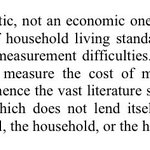






i'll try to explain this more fully because i'm not sure i was understood. although real gdp is said to be "nominal gdp adjusted for price changes," that is at best a loose shorthand, or allegory, for what is really going on. from 2016 to 2026, real gdp supposedly increased by 28%. but many products produced in 2026 — probably most — had no identical equivalents being produced in 2016. so it would be literally impossible to adjust nominal gdp for changes in the prices of the underlying products. they had no 2016 prices.
instead, what real gdp is supposed to represent, in formal, conceptual terms, is how much money would need to be charged for 2016's output to make people indifferent between buying it and buying 2026's output at its (actual) 2026 prices. for example, 2026 nominal gdp will be about $32 trillion. in order to make people indifferent between buying that specific "batch of output" at that "price" versus buying 2016's "batch of output," the latter would have to be offered for a 22% lower "price," or roughly $25 trillion. (NB: 25 is 22% below 32; 32 is 28% above 25.)
*that* is what it actually means to say "real gdp grew by 28% over the past decade."
real gdp is an attempt to "objectively" estimate people's *subjective* preferences for one batch of goods over another. it is not an attempt to measure something objective. and the same is true for "real consumption," "real wages," "real net worth," or any other real, i.e. inflation-adjusted, metric. if people's subjective perceptions of the economy — as measured in, say, surveys — seem to be diverging from what these "real" measures are telling us, that does not mean perceptions are diverging from reality. it means two different measures of perceptions are diverging.
this is not like asking people to guess how many pennies are in a jar (an objective, measurable fact) and finding that their guesses are diverging from the actual number of pennies. it's more like doing brain scans of people looking at jars of pennies and finding that the relationship between the scan results and the size of the guesses has been changing over time. that might be an interesting finding but it tells you nothing about how accurate the guesses are or about how many pennies are "actually" in the jar.


with literacy collapsing and world population regressing to neolithic levels, it makes sense we'd also see a return to animism

Seth Ackerman retweeted
that's an accurate description of how online ideological tribalism works in general - pile-ons, heresy-hunting, ideological one-upsmanship. it exists across the ideological spectrum. usually it's confined to online - the exception being when it gets institutionalized in irl spaces, like on campuses or activist circles. during "woke 1.0" it started to obtrude more and more into normie-world and ended up generating a huge backlash. that had a certain chastening effect: nowadays it's common for people to repudiate old tweets, laughing them off with "woke 1.0 was craaazy." the pro-israel world is currently trying the public's patience in exactly the same way and generating exactly the same kind of backlash. however it's largely immune to chastening. in its heyday, woke 1.0 was spurred on by the belief that history was on its side, because being on the right side of history is important to the wokesters. it is not important to the pro-israel crowd. in their view, history may or may not not be on their side at any given moment. but if it isn't, so much the worse for history.
Seth Ackerman retweeted
the pro-israel movement doesn't really underestimate its unpopularity. the cognitive distortion it suffers from is subtler than that. it divides the world into those who like israel (either actively or passively) and those who dislike israel. those who like israel can be good or bad people. but those who dislike israel are ipso facto bad, meaning their animus actually confirms the virtuousness of the pro-israel cause. in fact, the more intensely people dislike israel, the more it proves israel is right. obviously anyone with this kind of mentality will be susceptible to falling into self-destructive spirals of antagonistic self-isolation. in other words, it's a kind of personality disorder.
i get that people are skeptical. but remember, these AI people have been warning about these freaky sounding scenarios since before they even *started* writing the programs that subsequently acted out the freaky sounding scenarios nytimes.com/2026/09/20/opini…


so the chatbot owned by the nazi-curious guy announces it's "mecha-hitler"...the chatbots owned by sci-fi obsessed bay area weirdos act like HAL from 2001...and the chatbot owned by a normie s&p 500 corporation halts execution when it realizes it's doing something illegal...sounds like these things are already pretty well aligned


you have to feel for the israelis. himmler, famously, told a meeting of SS men that the extermination of the jews was a page of glory in germany's history but that they could never speak about it publicly and would take the secret to their graves. imagine if he had to deal with a bozo ben-gvir in the cabinet blabbing about it all in public every day
the idea that a group of people can be declared the rightful owners of a country they've never set foot in, and thus entitled to subjugate its present-day population, simply because some of their ancestors lived there 2,000 years ago, or because their religion was once the temple cult of some local iron age kingdoms, is too ridiculous to entertain with a straight face.
i invite tom friedman to imagine, say, dsa demanding that the state governments be dissolved forthwith and their powers transferred to the appropriate native american tribal councils. that would be infinitely easier to justify than the notion of a jewish right to self-determination in palestine.
personally i happen to think that mutual recognition of such a right would be a perfectly sensible basis for a future peace settlement between jews and palestinians, simply because, as a practical matter, they have to find a way to live together.
but for friedman to demand that midwestern senate candidates or big-city mayors perform what amounts to a ritual land acknowledgment about the indigenous peoples of the ancient kingdom of judea and their modern-day right to sovereignty over their sacred lands, unjustly usurped in AD 70 by the emperor vespasian - that is the summum of extremist lunacy!
nytimes.com/2026/08/11/opini…

Seth Ackerman retweeted

Well worth the read, by @EricLevitz:
« The US should stop sending Israel $3.8 billion each year.
But ending such aid won't be sufficient to change Israel's behavior. If the goal isn't merely to reduce American complicity -- but to force Israel to obey international law -- then much more sweeping (and controversial) measures will be needed »
vox.com/politics/498295/isra…
