

Husband to @ashleyrichey_ | Member at @CliftonBaptist | MDiv & ThM @SBTS | Neo-Calvinist
Louisville
Joined February 2013
- Tweets1.1K
- Following1.1K
- Followers640
- Likes18.1K







I’m benefiting greatly from the recent scholarship of the faculty of @ReformTheoSem! These works retrieve the wisdom of the Reformed tradition for the church today.

"Christianity cannot be restricted to the church as an historical organization viewed as a visible community. For that reason we speak of a Christian society, of a Christian school. There is nothing human that cannot be called Christian....
1/2
1
2
188
Alex Richey retweeted

One of the most fascinating things about natural law is how intuitively we live according to it, even when we cannot explain why.
Think about your ordinary day.
You exercise, eat well, and avoid unnecessary harm because you recognize that life and health are goods worth preserving.
You care for your children and want to see them flourish because you recognize that family life is inherently good.
You remain faithful to your spouse, guard your words, and nurture your marriage because you recognize that love and friendship are goods worth pursuing.
You meet a friend for coffee to talk about shared interests (like I did this morning)—not because the friend can necessarily do something for you, but because sharing your life with someone feels intrinsically valuable and life-giving.
You go for a run on a Saturday morning (like I did this morning) and find yourself captivated by the changing colors of autumn because beauty is worth appreciating for its own sake.
You pick up a book (like I’m about to), even when no one requires you to, because knowing the truth is inherently satisfying.
You pray and gather with the church because you recognize that knowing God is not merely useful but is itself a profound good.
Notice something: In each of these cases, you’re not simply pursuing something because it gets you something else. You’re pursuing goods that you recognize as worthwhile in themselves.
You don’t need a philosophy degree to recognize these goods. You already organize your life around them. You begin to see that questions of natural law do not first engage questions of speculation about human nature and theology (though those conversations will ensue); you begin with practical questions: Why do I organize my life around practical choices that enhance my flourishing?
That’s the remarkable thing about natural law. Practical reason apprehends certain basic human goods as self-evidently worth pursuing, even when we struggle to articulate why.
Now, someone might object: “If natural law is so self-evident, why doesn’t everyone agree about what it requires?”
But this objection confuses the self-evidence of basic human goods with disagreements about their moral implications.
At the level of first principles, we find a remarkable universality in the human recognition of goods like life, knowledge, friendship, family, and beauty.
Disagreements emerge when we reason about how those goods ought to be pursued, protected, prioritized, and expressed in particular circumstances.
In other words, disagreement about the secondary or tertiary entailments of natural law does not negate the self-evidence of its foundational principles. We can disagree profoundly about what constitutes a good life while still recognizing that life itself is good. We can disagree about the obligations of family life while still recognizing that family is a good worth pursuing.
The existence of moral disagreement does not mean there is no common moral knowledge. It often means we are reasoning, sometimes badly, from goods we already recognize.
And that should provoke a deeper question: Why are we the kinds of creatures who recognize these goods in the first place? Where do these goods come from? What do they reveal about our nature? And might it tell us something about the One who made us?
Christianity offers a profound answer: We are made in the image of God, created with a nature ordered toward genuine human flourishing. These goods are not arbitrary preferences. They belong to the kind of creatures God made us to be.
And from the fullness of Christian revelation, we discover that our deepest flourishing is found in knowing God through Jesus Christ, in whom our lives find their ultimate meaning and end, and through whom we learn the original intention behind our design and are better enabled to achieve the fullness of that design.
The natural law is not some obscure philosophical theory imposed upon ordinary life—though it can certainly take shape that way. But if natural law is what it is, it ought to be simple and reasonable, and it is: a way of making coherent sense of the goods you already recognize and pursue every day.
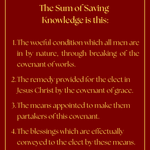
From "The Sum of Saving Knowledge," a summary of the Westminster Standards, by David Dickson and James Durham

1
73
“A human being in perfection ought always to preserve a calm and peaceful mind and never to allow passion or a transitory desire to disturb his tranquillity. I do not think that the pursuit of knowledge is an exception to this rule.
1/2

1
4
160
A few of the beautiful churches we saw on vacation in Charleston:
St. Michael’s (and St. Phillip’s not pictured), the French Huguenot Church, First Baptist Church, and Church Creek Presbyterian (where we worshipped on the Lord’s Day).


5
210
The Lord has blessed us with another daughter! @ashleyrichey_ and I are excited to welcome Baby Girl #2 in January!

2
69
1,691
Alex Richey retweeted

A good reminder that there’s no part of life outside Christ’s lordship:
“Every moment of our day—at home, at work, at school, and even in the voting booth—should be ordered by his Word and lived coram Deo for his glory.” @RicheyAlex
reformeddogmatika.com/an-int…

What is neo-Calvinism, and how does its theological vision shape the Christian life?
I'm grateful to @RefDogmatika for publishing my introduction to the thought of Kuyper and Bavinck!

Our faith shapes how we live at home, at work, and in the public sphere.
@RicheyAlex introduces the Neo-Calvinism of Kuyper and Bavinck and its vision for the whole of Christian life. ⬇️
reformeddogmatika.com/an-int…
“Now it is on the basis of this purely natural knowledge of God that the state comes to honor God in its public actions; to invoke God's holy name in state documents; to respect the oath; to dedicate a day of rest to him; to proclaim national days of prayer during disasters;
1/2

2
1
206
Alex Richey retweeted

We are delighted to present the English Annotations (3rd Ed., 1657).
Digitized, full, free, online, formatted, & public domain.

Get your copy of this Reformed sourcebook on the sin of Onanism today!
It includes never-before-translated selections from the esteemed Reformed moralist Geesink, as well as Kuyper, Bavinck, and Aalders.
Support the important work of @BerithPress!

“To destroy the unitive meaning of the procreative act is to turn it into a different act altogether, for it is no longer procreation, but production; the child is no longer an expression of his parents love, but an output, a product.”
- J. Budziszewski
1
7
604
Read a Shakespearean sonnet and a scene from one of his plays every evening to enrich your soul.
His procreation sonnets (1-17) exhort young men to marry and have children, while his plays are unrivaled in their exploration of the depths of human nature and sin.

12
586
Alex Richey retweeted
ToC
Part 1


This work collects Christian theological, pastoral, and medical reflection on sexual purity, the sin of Onan, self-pollution, and the proper ends of marriage.
Translations from @postnuance @RicheyAlex @MPooleProject include Poole, Pareus, Bavinck, and more.

I’m very thankful to contribute to this project by translating selections from the works of Geesink, Kuyper, and Bavinck! This will be an important work in Reformed ethics on a taboo subject within the broader scholarship of evangelical sexual ethics.
This work collects Christian theological, pastoral, and medical reflection on sexual purity, the sin of Onan, self-pollution, and the proper ends of marriage.
Translations from @postnuance @RicheyAlex @MPooleProject include Poole, Pareus, Bavinck, and more.
