







🦈 retweeted

The BTC Crack Event is almost over.
Less than 0.14 BTC is left in the 1.096361 BTC prize pool. Nearly 90% of it has already been cracked.
Over 185,000 players and more than 48 million attempts so far.
At this pace, the pool won't last much longer. If you've been waiting for the right moment, this is it.
1,096,361


As we shared earlier, quantum computers cannot derive Bitcoin private keys today. But the computational resources required to make that possible are falling quickly.
In cryptography, "impossible" is not a law of nature. It is only a description of how much computation is required.
MemeBitcoin does not intend to leave this as a problem for the distant future. We are accelerating Crack participation so more of the community can take action now.
On September 29, a new Crack Event begins with a total reward pool of 1.096361 BTC.
Keep participating in Crack on MemeBitcoin as usual. You do not need to submit another BTC wallet address.
When the event begins, the Community Gauge will appear on the game screen. The Community Gauge does not decrease with every Crack. It decreases whenever an event winner is selected, reflecting the remaining reward amount.
Every Crack becomes part of a record built together by the community in the race toward 1,096,361 BTC.
If you receive the BTC Event Winner emblem, you have won. Your individual reward amount will be available when Claim opens. Each user can receive only one BTC Event Winner emblem.
The event ends when the remaining reward amount shown on the Community Gauge reaches zero. There is no fixed end date.
Detailed information about reward confirmation and the Claim process will be announced separately once everything is ready.
Crack.
Watch the remaining BTC fall.
Claim your share of 1.096361 BTC.
memebitcoin.org/
※ Notice: The MemeBitcoin Portal, originally scheduled to open on September 28, has been postponed while we prioritize the Crack Event. A new Portal launch date will be announced through our official channels.
🦈 retweeted
As CZ said, AI does not need to break Bitcoin's cryptography to cause damage. Leaked data, phishing, and social engineering are already doing it.
That is the problem in front of us.
Our question is the one that comes next.
What happens when the cryptography itself becomes the target?
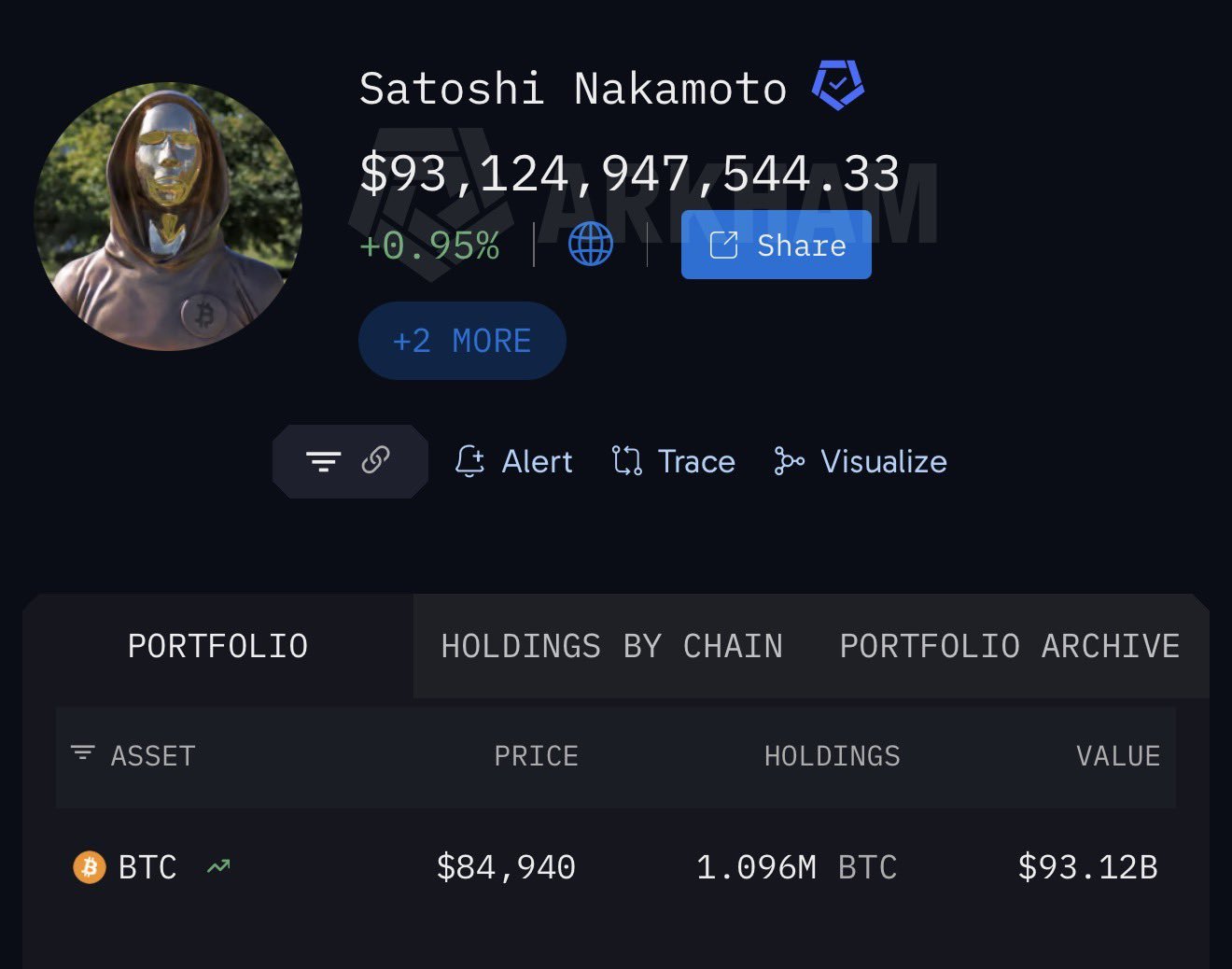
A powerful enough quantum computer could one day derive private keys from exposed public keys. Satoshi's Bitcoin sits behind keys like these.
AI is the threat we face now.
Quantum is the threat ahead.
The first is being fought today. The second is still ours to prepare for.
Spread the message before Satoshi’s wallet is drained.
No one enters Satoshi wallet before us.
1,096,361

🦈 retweeted
@cv_alphas @cl_samm @lucyhang2912 @jul56502344 @Counselor_Ayo @ChetaElontired @JesseProfeta204 @Mechsjoke @CihunSol @mai_thanhVN @0_manager3 @havesonem @AnhHc8 @vickys_yui @yaoyaogm @0xN1CK @Linh19931993 @Guomin184935 @zhuren1992 @jackma1994 @Chukwuebuk70752 @saera84 @X_KUN_Tech @donglaochoicoin @hoanhphuc01 @0xWest21 @CryptPshy @Taras_Heviuk
🦈 retweeted
He seems to be looking at us.
We will stand here until the situation is resolved.
No one Enters Satoshi Wallet Before Us.


If anyone knows how to donate to this man defending his LGS please let me know. Respect!🫡
Here is his website:
micromania.fr/
#Pokemon ——-> #Lorcana
#France

🦈 retweeted
The MemeBitcoin account transfer request page is now open, following our earlier update on support for users affected by X account suspensions.
Please submit an appeal to X first. If your suspension is lifted, you can continue logging in with your original X account. If your account remains suspended, sign in to the request page with a new X account, enter your original account details, and sign with the wallet you provided during registration.
Requests will be reviewed in the order received. If approved, the points, game progress, and emblems from your existing MemeBitcoin account will be transferred to your new X account. Accounts found to have used bots or engaged in abuse are not eligible for support.
This process does not lift your X account suspension. We will never ask for your password, private key, or seed phrase. Never share these with anyone.
👉 Submit a request: memebitcoin.org/register/x-t…

Notice for MemeBitcoin Participants Affected by X Account Suspensions
Recent X account suspensions have prevented some participants from logging in to MemeBitcoin and participating in its activities, including Proof of Viral (POV). We understand the frustration and concern this has caused.
MemeBitcoin respects X's policies and efforts to prevent bots and abusive activity. At the same time, we recognize that genuine participants may have been unfairly affected. We’re preparing a support process to help affected users access their existing MemeBitcoin accounts through a different X account.
Here’s how the process is expected to work:
1. Appeal to X first. Please follow X's official appeal process. If your suspension is lifted, simply log in with your original X account. Your existing points and activity history will remain intact.
2. If your account remains suspended, submit a request once our application page opens. You’ll need to verify ownership using the wallet you provided during registration. The MemeBitcoin team will then review your request.
For approved requests, we'll update the X account linked to your existing MemeBitcoin account, preserving your points, emblems, and activity history. Submitting a request does not guarantee approval. Participation involving bots or abuse may be ineligible for support.
This process does not lift an X account suspension, and we do not encourage creating or using accounts in violation of X's policies.
We’re committed to protecting the contributions and activity records of genuine MemeBitcoin participants.
The application launch date and detailed instructions will be announced separately.
🦈 retweeted
Shall we make a move as the memebitcoin community?
Let’s quietly flood X with the number 1,096,361.
How to participate
1. Post only “1,096,361” on your X. Just that one thing.
2. Do not tag memebitcoin, add any explanation, or use emojis. Post the number only.
3. Please leave the link to the post you uploaded and 1,096,361 in this post.
1,096,361

🦈 retweeted
Notice for MemeBitcoin Participants Affected by X Account Suspensions
Recent X account suspensions have prevented some participants from logging in to MemeBitcoin and participating in its activities, including Proof of Viral (POV). We understand the frustration and concern this has caused.
MemeBitcoin respects X's policies and efforts to prevent bots and abusive activity. At the same time, we recognize that genuine participants may have been unfairly affected. We’re preparing a support process to help affected users access their existing MemeBitcoin accounts through a different X account.
Here’s how the process is expected to work:
1. Appeal to X first. Please follow X's official appeal process. If your suspension is lifted, simply log in with your original X account. Your existing points and activity history will remain intact.
2. If your account remains suspended, submit a request once our application page opens. You’ll need to verify ownership using the wallet you provided during registration. The MemeBitcoin team will then review your request.
For approved requests, we'll update the X account linked to your existing MemeBitcoin account, preserving your points, emblems, and activity history. Submitting a request does not guarantee approval. Participation involving bots or abuse may be ineligible for support.
This process does not lift an X account suspension, and we do not encourage creating or using accounts in violation of X's policies.
We’re committed to protecting the contributions and activity records of genuine MemeBitcoin participants.
The application launch date and detailed instructions will be announced separately.
We are aware that many community members have had their X accounts suspended. We understand your concerns and are discussing how to handle this situation internally. Please give us some time. We will share further guidance soon.
Thank you for your patience, and please continue supporting MBTC.
1,096,361

🦈 retweeted
Hack Satoshi..! There is a more ultimate vision, but our immediate action is to hack Satoshi's wallet.
Our actions, our data, and the current phenomena will continue until they resolve the problem of future uncertainty.
Our actions and virality will continue. Congratulations to all the POV 5th round selected participants.
🦈 retweeted
JUST CRACK IT
More than 170,000 players. Over 37 million attempts.
The BTC prize pool has already dropped from 1.09 BTC to around 0.6 BTC. Nearly half is gone, and it’s still shrinking.
Jump in and take your shot while the event is live.
1,096,361

As we shared earlier, quantum computers cannot derive Bitcoin private keys today. But the computational resources required to make that possible are falling quickly.
In cryptography, "impossible" is not a law of nature. It is only a description of how much computation is required.
MemeBitcoin does not intend to leave this as a problem for the distant future. We are accelerating Crack participation so more of the community can take action now.
On September 29, a new Crack Event begins with a total reward pool of 1.096361 BTC.
Keep participating in Crack on MemeBitcoin as usual. You do not need to submit another BTC wallet address.
When the event begins, the Community Gauge will appear on the game screen. The Community Gauge does not decrease with every Crack. It decreases whenever an event winner is selected, reflecting the remaining reward amount.
Every Crack becomes part of a record built together by the community in the race toward 1,096,361 BTC.
If you receive the BTC Event Winner emblem, you have won. Your individual reward amount will be available when Claim opens. Each user can receive only one BTC Event Winner emblem.
The event ends when the remaining reward amount shown on the Community Gauge reaches zero. There is no fixed end date.
Detailed information about reward confirmation and the Claim process will be announced separately once everything is ready.
Crack.
Watch the remaining BTC fall.
Claim your share of 1.096361 BTC.
memebitcoin.org/
※ Notice: The MemeBitcoin Portal, originally scheduled to open on September 28, has been postponed while we prioritize the Crack Event. A new Portal launch date will be announced through our official channels.
🦈 retweeted
We are aware that many community members have had their X accounts suspended. We understand your concerns and are discussing how to handle this situation internally. Please give us some time. We will share further guidance soon.
Thank you for your patience, and please continue supporting MBTC.
1,096,361
🦈 retweeted
Until our message spreads to everyone in the crypto community
Until our message reaches the founder, Satoshi
We will not stop.
1,096,361

MemeBitcoin and our symbol, “1,096,361,” have been featured as a trending topic on Twitter (X).
xitter.cf/i/trending/21055850868…
In line with the purpose of Proof of Viral, MemeBitcoin and 1,096,361 are becoming known to many users on Twitter.
We hope this will be the first stepping stone that draws everyone's attention to what the MemeBitcoin community aims for: the risks of uncertainty brought by the advancement of quantum computers, and further, the response regarding Satoshi’s wallet.
We thank all community members who continue to take part with us.

🦈 retweeted
We agree with Justin Drake's bunker mode proposal. Preparing for the possibility that ECDSA breaks before q-day by quietly moving assets to addresses whose pubkeys have not yet been exposed is a practical precaution that requires no new wallets.
Large holders and exchanges should lead by example, and make it a habit to move remaining funds to a fresh address whenever they sign. Do not rush, but do not delay either.
MemeBitcoin agrees with this direction and also supports the defensive shift toward hash-based cryptography.
Please help spread Justin Drake’s bunker mode proposal!

Today I call upon the blockchain industry to calmly begin planning for "bunker mode". My personal recommendation is to set in motion a controlled mass migration of assets to fresh addresses, i.e. addresses whose pubkeys remain hidden behind a hash.
Holders, starting with large and sophisticated ones, should consider moving the bulk of their funds to addresses that have never signed a transaction. And when they do sign one, they should also move remaining funds to a new address (possibly generated from the same seed phrase).
Don't rush. While I believe there is cause for action a rushed migration would do more harm than good. Don't panic either. Moving assets to protected addresses is a simple, preventative step which does not require new cryptography or new wallets.
IMO it is now reasonable to brace for the possibility that ECDSA breaks before qday, in the worst case in months not years. By "break" I mean fast private key recovery (e.g. in one week) on available hardware (e.g. a large GPU cluster).
Recent days have been humbling for human mathematical intuition. Long-held, unquestioned hypotheses have fallen. This includes the n log(n) bound for integer multiplication and the 3SUM conjecture. In hindsight, May's unexpected disproof of the Erdős unit distance conjecture was our warning shot.
Yesterday's OpenAI drop made it clear that mathematical superintelligence is upon us. They say there are weeks where decades happen. We are about to live through weeks where centuries of mathematical progress happen. Could our magic 64-byte ECDSA signatures be too good to be true? Was it just security through obscurity all this time?
Elliptic curves feel especially vulnerable to superintelligence. Curves carry rich structure, with room for fancy tricks like Schoof, Frobenius, pairings. (By contrast, hashes are designed to minimise algebraic structure.)
Separately, as Ewin Tang can attest, an efficient quantum algorithm sometimes foreshadows an efficient classical one. We should be open to the possibility of a classical counterpart to Shor that breaks elliptic curves and RSA at once.
Also noteworthy is the striking under-representation of cryptographic breakthroughs among the 722 mathematical results OpenAI published. I've witnessed first-hand the US government censoring academic quantum cryptanalysis results. Backroom interventionism is my base case.
I urge large, sophisticated actors to lead by example. Project11's "risq list" (bitcoin-risq-list.projecteleven[.]com) is a great tracker of exposed BTC pubkeys. Binance, Bitbank, Robinhood, Bitfinex, and Tether have an opportunity to harden their cold storage. Next month I'll address institutions in London in a live Q&A (forum.ethereuminstitutional[.]org/london-2026).
Again, please do not rush. Wallets holding under 50 BTC enjoy partial cover from "Satoshi's shield", i.e. his 20K exposed addresses that hold 50 BTC each. Load-bearing signers like oracles and L2 security councils should consider rotating ECDSA pubkeys with every signed message and/or multi-signing with a hash-based schemes like SPHINCS.
Exiting bunker mode safely will require post-AI cryptography. My inclination is to go all-in on hash-based cryptography and avoid structured mathematical assumptions entirely, whether from curves, lattices, or isogenies. A single battle-tested hash (e.g. from the SHA or BLAKE families) yields plausible post-AI security.
The Ethereum roadmap on strawmap[.]org fully embraces hash-based cryptography with end-to-end formal verification as a response to the quantum threat. Those timelines must now be revisited and accelerated in light of mathematical superintelligence. I'll be pushing for maximum defensive acceleration.
🦈 retweeted
The Crack event is currently underway, with MemeBitcoin putting up 1.096361 BTC as the prize pool.
It has drawn 150,000 community participants and generated nearly 28 million pieces of data.
The content created by our community aims to address the uncertainties of the future brought about by advances in quantum computing and, further, to spur action so that everyone pays attention to this issue.
1,096,361

As we shared earlier, quantum computers cannot derive Bitcoin private keys today. But the computational resources required to make that possible are falling quickly.
In cryptography, "impossible" is not a law of nature. It is only a description of how much computation is required.
MemeBitcoin does not intend to leave this as a problem for the distant future. We are accelerating Crack participation so more of the community can take action now.
On September 29, a new Crack Event begins with a total reward pool of 1.096361 BTC.
Keep participating in Crack on MemeBitcoin as usual. You do not need to submit another BTC wallet address.
When the event begins, the Community Gauge will appear on the game screen. The Community Gauge does not decrease with every Crack. It decreases whenever an event winner is selected, reflecting the remaining reward amount.
Every Crack becomes part of a record built together by the community in the race toward 1,096,361 BTC.
If you receive the BTC Event Winner emblem, you have won. Your individual reward amount will be available when Claim opens. Each user can receive only one BTC Event Winner emblem.
The event ends when the remaining reward amount shown on the Community Gauge reaches zero. There is no fixed end date.
Detailed information about reward confirmation and the Claim process will be announced separately once everything is ready.
Crack.
Watch the remaining BTC fall.
Claim your share of 1.096361 BTC.
memebitcoin.org/
※ Notice: The MemeBitcoin Portal, originally scheduled to open on September 28, has been postponed while we prioritize the Crack Event. A new Portal launch date will be announced through our official channels.
🦈 retweeted
MBTC Community,
Thank you sincerely for creating a variety of content that meets the POV guidelines to help spread 1,096,361 messages. Our team is carefully reviewing every piece of content you’ve made.
However, we’ve noticed that some community members are posting MBTC-related content without submitting it through POV. To be eligible for POV selection, you must post your content in line with the guide image and then submit the link to that post.
To make sure your great content isn’t missed, please complete the link submission after posting. Thank you for being part of this with us.
Tip for POV selection: Don’t stop at creating and posting content. Bring your friends to your posts and engage with them through comments. The team gives strong bonus points for viral Vibe & energy within the content, beyond just creation itself.


🦈 retweeted
As we shared earlier, quantum computers cannot derive Bitcoin private keys today. But the computational resources required to make that possible are falling quickly.
In cryptography, "impossible" is not a law of nature. It is only a description of how much computation is required.
MemeBitcoin does not intend to leave this as a problem for the distant future. We are accelerating Crack participation so more of the community can take action now.
On September 29, a new Crack Event begins with a total reward pool of 1.096361 BTC.
Keep participating in Crack on MemeBitcoin as usual. You do not need to submit another BTC wallet address.
When the event begins, the Community Gauge will appear on the game screen. The Community Gauge does not decrease with every Crack. It decreases whenever an event winner is selected, reflecting the remaining reward amount.
Every Crack becomes part of a record built together by the community in the race toward 1,096,361 BTC.
If you receive the BTC Event Winner emblem, you have won. Your individual reward amount will be available when Claim opens. Each user can receive only one BTC Event Winner emblem.
The event ends when the remaining reward amount shown on the Community Gauge reaches zero. There is no fixed end date.
Detailed information about reward confirmation and the Claim process will be announced separately once everything is ready.
Crack.
Watch the remaining BTC fall.
Claim your share of 1.096361 BTC.
memebitcoin.org/
※ Notice: The MemeBitcoin Portal, originally scheduled to open on September 28, has been postponed while we prioritize the Crack Event. A new Portal launch date will be announced through our official channels.
Quantum computing still feels like science fiction to most people in crypto.
But the research is moving faster than many realize.
Earlier this year, Google Quantum AI published new research on Shor's algorithm and secp256k1, the elliptic curve used by Bitcoin.
Under the hardware and error rate assumptions used in the research, the estimated number of physical qubits required for this type of attack fell to roughly one-twentieth of previous estimates.
That does not mean a quantum computer can derive Bitcoin private keys today.
But it does mean that a future quantum computer capable of threatening Bitcoin cryptography may require significantly fewer resources than researchers previously estimated.
And the work is continuing. Researchers are still finding ways to make the algorithms and quantum circuits involved more efficient.
The progress in quantum computing appears to be moving faster than the conversation around it in crypto.
Most crypto users still see quantum risk as something far in the future.
Something to think about later.
But how far away is "later"?
Crypto has a Fear and Greed Index to measure how the market feels every day.
Maybe one day we will need a way to measure quantum risk too.
At MemeBitcoin, Crack has never been symbolic.
Every Crack generates a real candidate private key and checks whether it matches the target associated with Satoshi.
With today's computing, the probability of finding the correct key is effectively zero.
But "impossible" in cryptography is not a law of nature.
It is a statement about how much computation is required.
And that is exactly what advances in quantum computing are beginning to challenge.
For now, the mathematics still holds.
For now, those coins remain untouched.
For now.
An estimated 1,096,361 BTC, held in wallets widely associated with Satoshi, has remained untouched since Bitcoin's earliest days.
We have been cracking toward it, one key at a time.
Soon, there will be another reason to Crack.

🦈 retweeted
If you're curious about Satoshi's thoughts, try asking Satoshi AI.
memebitcoin.org/
The longer Satoshi remains silent, the more uncertainty and risk will continue to grow.
1,096,361


🦈 retweeted
Quantum computing still feels like science fiction to most people in crypto.
But the research is moving faster than many realize.
Earlier this year, Google Quantum AI published new research on Shor's algorithm and secp256k1, the elliptic curve used by Bitcoin.
Under the hardware and error rate assumptions used in the research, the estimated number of physical qubits required for this type of attack fell to roughly one-twentieth of previous estimates.
That does not mean a quantum computer can derive Bitcoin private keys today.
But it does mean that a future quantum computer capable of threatening Bitcoin cryptography may require significantly fewer resources than researchers previously estimated.
And the work is continuing. Researchers are still finding ways to make the algorithms and quantum circuits involved more efficient.
The progress in quantum computing appears to be moving faster than the conversation around it in crypto.
Most crypto users still see quantum risk as something far in the future.
Something to think about later.
But how far away is "later"?
Crypto has a Fear and Greed Index to measure how the market feels every day.
Maybe one day we will need a way to measure quantum risk too.
At MemeBitcoin, Crack has never been symbolic.
Every Crack generates a real candidate private key and checks whether it matches the target associated with Satoshi.
With today's computing, the probability of finding the correct key is effectively zero.
But "impossible" in cryptography is not a law of nature.
It is a statement about how much computation is required.
And that is exactly what advances in quantum computing are beginning to challenge.
For now, the mathematics still holds.
For now, those coins remain untouched.
For now.
An estimated 1,096,361 BTC, held in wallets widely associated with Satoshi, has remained untouched since Bitcoin's earliest days.
We have been cracking toward it, one key at a time.
Soon, there will be another reason to Crack.
After Google Quantum AI claimed in March 2026 that it had found a much more efficient quantum circuit for breaking Bitcoin and Ethereum signatures, the community on Eigen Labs' Open Autoresearch project, ECDSA.fail, has now built circuits that use 62% fewer resources than Google's unpublished result.
This is no longer a distant possibility. It is a threat moving into view. The crypto ecosystem needs to pay much closer attention to this issue.
ecdsa.fail/

🦈 retweeted
Mt. Gox, Ronin, DMM Bitcoin, Bybit, and now Bitget.
Another reminder that threats to crypto never stop evolving.
The next threat is quantum computing.
Wallets from Satoshi’s era have had their public keys exposed onchain for more than 15 years.
Together, they are associated with approximately 1,096,361 BTC, making them one of the largest targets in crypto history.
This is where MemeBitcoin is focused.
We are bringing the community together to reach Satoshi’s wallet before quantum computers do.
We are not waiting for the threat to arrive.
We are moving first.

Earlier 7 hours ago, I hosted a live stream with everyone that lasted over three hours. Here's a summary of the points I covered in the live:
① Bitget security incident update — 1 hours in. We're sharing specific facts, not just reassurances.
② Affected assets include ETH, XRP (the largest single chain loss), BNB, AVAX, USDT, USDC, and several other altcoin. The incident spans multiple chains: Ethereum, XRP Ledger, Arbitrum, Avalanche, Optimism, BSC, and Base. Cold wallets across all chains have been confirmed secure and unaffected.
③ We have contacted foundations across all affected chains. A few have already frozen the hacker's wallet addresses. We are actively pursuing every available avenue and will provide updates as the situation develops.
④ Based on IP behavioral patterns and on-chain signatures, this attack is consistent with techniques used by DPRK-linked hacker groups. We have notified relevant authorities and are cooperating fully with them globally.
⑤ Bitget Wallet operates on completely separate infrastructure from Bitget Exchange. It was not affected by this incident. Bitget Wallet's funds are fully safe.
⑥ To be transparent about our financial position: beyond the $464M+ Protection Fund — all held in publicly verifiable wallets — Bitget holds over $1 billion in its own assets. User funds are covered on a 1:1 basis.
⑦ Withdrawal restoration timeline: we are targeting a full resumption as soon as possible. We will announce the exact window as soon as it is confirmed. We will not commit to a timeline we cannot deliver.
🦈 retweeted
This is content from Justin Drake’s remarks on quantum computing progress from almost four months ago.
The 1,096,361 problem is approaching silently, it is not a distant-future problem, but a practical one.
Today a crazy quantum story just got wilder.
On March 31, the Google Quantum AI team published a landmark result on Shor's algorithm for elliptic curve cryptography. Technically, the paper was a bombshell: a dramatic 10x improvement over the state-of-the-art. As a stunt and wakeup call to the blockchain space, those optimisations were illustrated on secp256k1, the elliptic curve underlying Bitcoin and Ethereum signatures.
But perhaps the most striking part of the paper was sociological, not technical. Instead of following standard academic process, the optimisations were kept secret, hidden behind a zero-knowledge (ZK) proof. Google's accompanying blog post mentions they "engaged with the U.S. government". The ZK proof demonstrates the existence of algorithmic improvements without leaking details. Academic censorship with ZK, a historic first!
As a co-author of the Google paper I witnessed some of the context surrounding this censorship. To be honest, multiple aspects of that context don't sit well with me. As much as I believe the general public ought to know more, I am limited in my ability to whistleblow. Though let me be clear about one thing: the Google team's professionalism has been absolutely exemplary, and they deserve nothing but praise.
Censorship has a way of backfiring. The Streisand effect, where an attempt to bury something only draws more attention to it, is exactly what's unfolding today. First, Google's key optimisation has been rediscovered by the French. And in a thrilling turn of events, a collaborative Shor-at-home challenge just launched. The initiative, available at ecdsa[.]fail, breached a new Shor world record in a matter of hours.
Let's start with the rediscovery. Just two months after Google's paper, French quantum expert André Schrottenloher cracks the main secret optimisation. His paper, titled "Optimized Point Addition Circuits for Elliptic Curve Discrete Logarithms", landed on the arXiv today. Big congrats to André, who beat several other nerdsnipped experts to it. In a blog post also published today, Craig Gidney, the world expert on Shor optimisations, revealed that he'd been sitting on this very optimisation for a whole year under censorship pressure.
Interestingly, André missed a handful of minor optimisations, both from Google's original publication and from improvements found since. It's plausible there's still plenty of juice left to squeeze out of Shor, and this is exactly what the ecdsa[.]fail challenge is about. The verifier program developed for the ZK proof does double duty, automatically filtering for valid submissions. Dozens of compounding small and micro improvements are rolling in. As of the time of writing there's an 8.4% improvement to Google's circuit, as measured by the product of logical qubit count and Toffoli gate count. Nice!
The nerdsnipping ran deeper than anyone expected. Over the last few weeks it became clear it extended well beyond André and other quantum experts. Behind the scenes, a small army of amateurs quietly got to work. Inspired by Karpathy-style autoresearch, they turned AI on Shor. Ironically, the verifier program for the ZK proof makes an ideal reward function for AIs. The barrier to entry for this modern style of research is refreshingly low, with several non-experts, even a teenager, finding nice optimisations. Get in touch if you'd like to join a Telegram group with fellow autoresearchers :)
Part 2: neutral atoms and qday
The story doesn't end with Google. On the same day Google went public, a stealthy startup called Oratomic published its own Shor paper in a coordinated release. It made a splash, ultimately becoming the most upvoted paper on scirate[.]com, a website ranking arXiv papers.
Oratomic's claim was wild. By building on Google's logical optimisations and applying custom physical optimisations for neutral atoms, they claimed just 10K physical qubits were sufficient to run Shor's algorithm on secp256k1. That number is mind-bogglingly low.
Knowing essentially nothing about neutral atoms when Oratomic's paper landed, I was intrigued and decided to learn more about the tech. I fell straight down the rabbit hole and spent a couple hundred hours on the topic. I got a little obsessed and watched every YouTube video I could find and spoke to a bunch of experts.
My conclusion? The tech is real, very real. Even Google recently decided to start a neutral atom lab, a notable pivot from their sole focus on superconducting qubits. If you care about qday, i.e. the day a quantum computer will break the first piece of cryptography in production, neutral atoms demand your attention. I shared some of my learnings on Shor and neutral atoms in a 30min talk at the ZKProof cryptography conference. You can find it on YouTube by searching "zkproof neutral atom".
Here's an interesting observation about this duo of breakthrough papers: neither Google nor Oratomic say a word about what their results mean for qday. No timelines. Zero. Nada. That is especially baffling given that the whole point of whitehat quantum cryptanalysis is to inform qday estimations and help the general public make good decisions.
So let me attempt to partially fill the silence, similarly to what Scott Aaronson did in his April 29 post. Given everything I know, including scary non-public information, I now put the odds of qday by 2032 at 50%. 10% by 2030.
Anecdotally, the US government has its own date: 2035. Originating at the NSA and later adopted by NIST, it's when branches of the US government will be disallowed from using quantum-vulnerable cryptography. In plain language: with hindsight, that date is a joke and should be discounted entirely. I don't see how NIST avoids being forced to pull it forward by years.
Part 3: post-quantum cryptography
There are good reasons to sound the alarm today, but please do not panic. Rushing carelessly towards immature post-quantum cryptography is a recipe for disaster. IMO a good target date for migration is 2029, roughly 3.5 years out. 2029 happens to be the date selected by Google, Cloudflare, and the Ethereum Foundation.
These days most of my time goes to safely migrating Ethereum towards post-quantum cryptography as part of the broader lean Ethereum effort. There's a lot to do. We need to rip out and replace BLS signatures at the consensus layer, KZG commitments at the data layer, and ECDSA signatures at the execution layer.
The plan to get there is compelling, and is based on hash-based cryptography. Within the Ethereum Foundation we've developed a Swiss army knife called leanVM (github[.]com/leanEthereum/leanVM) powered by the magic of hash-based SNARKs. Thanks to truly exceptional work by Emile, Thomas, and others, its performance is derisked. Regarding security, leanVM is a jewel, a minimal zkVM crafted for end-to-end formal verification and maximum security.
Want to help? There are two $1M initiatives. First, the Proximity Prize (proximityprize[.]org). Solve a long-standing mathematical conjecture in coding theory, improve hash-based SNARKs, and go home a millionaire. Second, the Poseidon Initiative (poseidon-initiative[.]info), offers $1M for breaking Poseidon, the SNARK-friendly hash function.
🦈 retweeted
Those selected as POV who have contributed to MBTC's vision will be permanently recorded in MBTC’s Proof-of-Viral. This record can be verified through a forum that will be publicly released at a later date.
Congratulations to the 2-Week Winners, and thank you for your continued participation.
