


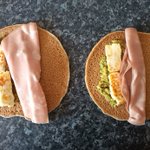


You can take the boy out of Stoke but you can't take Stoke out of the boy... #northstaffs #oatcakes #thepotteries
North Staffs oatcakes with mashed avocado, sundried tomatoes, halloumi and mortadella...

25


Rossi retweeted

You may be cool, but you're not Terry-Thomas single-handed water-skiing on one leg, smoking a cigarette in a cigarette-holder cool

Rossi retweeted

Thank you Germany 🇩🇪 and UK 🇬🇧 for heroically sacrificing your economy to save the planet 💪
_


Rossi retweeted

Finally, a proportionate response to people playing music out loud on their phone.

Armed police at St. James Park tube station
Readers added context they thought people might want to know
The Metropolitan Police have clarified that this video dates from 23 April not today. It shows officers detaining three boys aged 15-16 suspected of robbery and carrying knives. They have since been bailed. x.com/metpoliceuk/st…
Rossi retweeted

A short history of the great British improvement.
They came for beef dripping. We got margarine, then seed oils, then a cardiac ward in every hospital.
They came for butter. They told your grandmother it would kill her husband. The replacement was a tub of palm oil emulsified with rapeseed and a yellow dye, and her husband died of a heart attack in 1989 anyway.
They came for full-fat milk. We got skimmed milk, a vitamin D deficiency epidemic in children, and a cereal aisle fortified to plug the gap.
They came for mutton, the meat that fed every shepherd, miner, and mill worker for six hundred years. We got a chicken breast injected with water and a turkey twizzler.
They came for the kipper. We got a Findus boil-in-the-bag, dyed orange, and a fish oil capsule sold at the chemist to make up for the omega-3 nobody is eating.
They came for wool. We got polyester fleece, and microplastics in human placentas. Every one tested. Sixty-two out of sixty-two.
They came for leather. We got synthetic shoes that delaminate in eighteen months, and a high street with no cobbler.
They came for the cotton nappy. We got the disposable, and a landfill that will outlast the child wearing it.
They came for the cast iron pan handed down three generations. We got Teflon, and a forever chemical now found in 98% of British rivers.
They came for the wooden bowl your grandmother kneaded dough in. We got Tupperware, then BPA, then "BPA-free" plastic containing compounds we have not yet bothered to measure.
Now they are coming for the cow herself. The replacement is a textured pea isolate, extruded in a factory in the American Midwest, packaged in plastic, and marketed as the ethical option by a company called Cargill, who happen to be the third-largest meat processor in the United States.
Every traditional material we have been told to give up was working perfectly, for free, for centuries. Every industrial replacement has been worse for the body, worse for the land, and considerably better for the shareholders of the company that sold it.
The pattern is not subtle, and the people running it are not embarrassed.
Your great-grandmother is no longer here to call it.
You are.

Rossi retweeted
People ask me why I'm so fond of goats.
Here's why.
A goat will wander up the side of a Welsh cliff that a sheep wouldn't attempt and a hiker wouldn't survive, eat the brambles and gorse and thistles that nothing else on the farm can stomach, and turn the lot into milk so digestible that even the people allergic to cow's dairy can drink it without incident.
She thrives on land that grows nothing else. She fertilises it as she goes. She maintains scrubland that would otherwise become a fire hazard. She produces milk with smaller fat globules and a different protein structure to cow's milk, which is why human infants have been raised on it for ten thousand years when nothing else was on offer.
Her cheese is the oldest cheese on earth. Her meat fed the Mediterranean before olive oil was a brand. Her hide bound the first books. Her hair made the tents that crossed the Sahara. Her milk built the Maasai and the Berbers and the goatherds of every uplands the planet has.
And the modern response to all of this has been to tell us she is somehow the wrong animal.
The cheek of it.
I'll back the creature that has fed humans on every continent except Antarctica over an almond drink invented by a man with a blender in 1998.

Rossi retweeted
There is a region in southeastern Spain called Almería. If you pull it up on satellite imagery, you will assume the screen has glitched. A vast, blinding white scab where a landscape used to be.
It's not a glitch. It's 64,000 acres of plastic greenhouses. So much plastic sheeting that it is, genuinely, visible from space. The entire region has been wrapped in industrial farming film to grow tomatoes, peppers, cucumbers and lettuce for European supermarkets in January.
The plastic has created its own microclimate. The reflective surface is so vast it has measurably lowered local temperatures by bouncing sunlight back into the atmosphere. Scientists have a name for it. The Albedo effect of Almería. The only place on earth where human activity has cooled the local climate, and they did it by accident, while building the world's largest open-air plastic factory.
The plastic itself is single-use agricultural film. It sits in UV light for three to five years, degrades into microplastics, blows into the Mediterranean, and ends up in the ocean and the soil. Every year, 45,000 tonnes of plastic waste is generated just from replacing degraded greenhouse covering. Every year. Just the covering.
Inside, workers from Morocco and sub-Saharan Africa labour in 45°C heat for €30 a day. No contracts. No rights. Spraying crops with pesticides at concentrations that would be illegal on outdoor fields. Ventilation: minimal. Chemical exposure: constant. The aubergine looks lovely.
The groundwater underneath Almería is so contaminated with agricultural runoff that it has been declared unusable. The region now imports water from elsewhere in Spain while sitting on top of a poisoned aquifer it created. The land that was meant to feed Europe more efficiently has become a place that needs water flown in to keep the show running.
And this is what supplies your fresh vegetables in January. Grown in plastic factories. By exploited workers. Using groundwater they have already destroyed. Wrapped in more plastic. Shipped across Europe. Refrigerated the whole way. So a person in Manchester can have a tomato in February that tastes of nothing.
But sure. Cattle grazing on Scottish hills are the environmental problem.
Pull the satellite up. Have a look. Then tell me which system is the one that needs explaining.


Rossi retweeted
Activist: "Cattle farming is incredibly wasteful."
Farmer: "Is it? List the inputs."
Activist: "What?"
Farmer: "For my farm. What goes in?"
Activist: "Feed, water, land..."
Farmer: "Rain, grass that grows for free, and land that won't grow anything else. Where's the waste?"
Activist: "But the resources..."
Farmer: "Are solar energy and rainfall. Both happen whether there's a cow here or not."
Activist: "You're oversimplifying."
Farmer: "I'm being accurate. Sunlight hits grass. Grass grows. Cow eats grass. Cow becomes beef. Which step wastes resources?"
Activist: "The land could grow crops."
Farmer: "This land? 30-degree slope, clay soil, 45 inches of rain? Show me the crop."

Rossi retweeted
1907: Electric lights replace candles. Procter & Gamble's candle business collapses. They pivot to soap but animal fats are expensive.
They need cheaper alternatives. Enter cottonseed oil.
Cotton seeds contain oil, but it's toxic to humans - gossypol, a natural pesticide. The seeds are agricultural waste, fed to cattle in small amounts or discarded.
But chemically extract the oil, heat it to extreme temperatures, hydrogenate it with pressurized hydrogen gas, and you get solid white fat that looks like lard but costs pennies.
They patent it in 1907, launch Crisco in 1911. Crystallized cottonseed oil.
Industrial waste transformed into soap substitute.
Except they don't market it as soap. They market it as food.
Problem: nobody wants to eat textile manufacturing waste processed with industrial chemicals. Your grandmother cooks with lard and tallow like humans have for thousands of years.
Solution: Convince America that animal fats are killing them.
Procter & Gamble spends millions on marketing. Cookbooks, radio shows, free samples. They target Jewish communities advertising Crisco as kosher - "neither meat nor dairy!"
But the genius move: 1948. The American Heart Association has $1,700 in their budget. Procter & Gamble donates $1.7 million.
Suddenly the AHA has funding and influence. And suddenly they're very interested in dietary causes of heart disease.
1961: The AHA issues first dietary guidelines. Avoid saturated fat from animals. Replace with vegetable oils. Recommended oils: Crisco, Wesson, and other seed oils.
Who benefits: Procter & Gamble. Who funded the AHA: Procter & Gamble.
The conflict is blatant. Nobody cares.
Never mind that humans ate animal fats for millions of years without epidemic heart disease. Never mind that seed oils oxidize rapidly and integrate into cell membranes creating inflammation for years.
Industrial cottonseed waste is now "heart healthy" and butter is "artery-clogging poison."
1980s: Trans fats are discovered to be catastrophically unhealthy. They directly cause heart disease.
Procter & Gamble's response: Quietly reformulate, keep selling seed oils, never acknowledge their "heart healthy" product spent 70 years actively causing disease.
No apologies. No compensation. Just reformulate and continue.
Modern research shows seed oils cause oxidative stress, inflammatory cascades, mitochondrial dysfunction, increased cancer risk, and neurodegenerative disease.
Your body requires exactly zero grams. They didn't exist in human diets until 1911.
But Procter & Gamble needed to sell soap alternatives and accidentally created the largest dietary change in human history. We traded animal fats that built civilizations for factory waste that causes disease.
The soap company won.


