

JUST A CRYPTO CHAD / FORWARD DEPLOYED ENGINEER
WEB3
Joined February 2021
- Tweets4.7K
- Following419
- Followers893
- Likes5.7K




Pinned Tweet
I built this because of one paper.
Google and Janelia mapped every neuron in a fruit fly and published it for free. 165,000 neurons, every synapse, sitting on a server for anyone to download. I read it and couldn't let it go. This brain evolved to do one thing: smell something and decide in milliseconds whether to go for it. That is exactly what a trencher does.
So I trained it on pump memecoins.
The thesis is simple:
A fly doesn't reason about a smell. A pattern hits a few hundred neurons and it either goes or it doesn't. Memecoins are the same. Holder count, buy/sell ratio, creator history, token age, pool size. Pattern in, ape or hold out. I wanted to know if a real biological wiring diagram could learn that pattern.
I wired the connectome into a model and started training on my RTX 5070 Ti at home, fed by a collector watching pump.fun around the clock.
First run: 4.5 hours of market data, only the fly's "nose", about 32k neurons. It learned something. Small, but above every dumb baseline.
Then I ran the full 165k-neuron brain.
Honest result: no better than the nose alone. And most flies still lose money on median return. A fruit fly brain is a small brain. It is not magic and I'm not going to pretend it is.
But one thing kept showing up. Different random seeds gave noticeably different flies. Some were clearly better at spotting the runners. So instead of one fly, I run a swarm. Eight flies, eight wallets, and a master wallet that only trades when enough of them agree. The plan is the weak ones get culled and the good ones breed.
That is the bet. Not that one fly beats the market, but that a swarm of them, bred on live data, can be made profitable over time.
Creator fees fund the trading wallet.
Profits go back to holders.
Every number, wins and losses, gets posted.
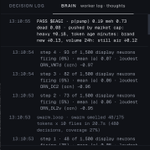
You can watch its brain light up as it decides.
This is $TRENCHFLY. 🪰
CA: 7zuaMPB6hkgiWnJ9Q5wq7xjtwUpUepJsnKD2cQUjpump

Random Crypto Chad retweeted

Where do the trading fees actually go? 🐕
With ÐOGEPAD, there's no treasury cut.
Claimable creator fees are split between Billy and the $DOGEPAD Buy & Burn reserve.
The launchpad and upcoming main token have their own fee structures.
Full breakdown below. 👇
dogepad.fun

Random Crypto Chad retweeted

Yo @BillyM2k its that time of the month when a bullish idea related to DOGE comes out and u're involved in it.
I think this idea is really cool, while u get 50/70% of the fees from every token launched on dogepad + u hold the 10% of supply of the main one. The other 30% are being used for buybacks on the main dogepad token. A really smart idea of how to keep its value going up.
Take a look at it.
3LEhJiW1WHs3jHnrUu5DwFkT4UjSnxcNduWS4yCQDoge

Every token. One ÐOGE. 🐕
Introducing DogePad: A Solana launchpad for Pump.fun tokens paired with DOGE, featuring unique Doge contract addresses, token discovery, charts, and SOL-based trading.
Main token, $DOGEPAD:
• 70% of creator fees → @BillyM2k
• 30% → $DOGEPAD Buybacks & Burns
Tokens launched through DogePad:
• 50% of creator fees → @BillyM2k
• 50% → $DOGEPAD Buybacks & Burns
One launchpad. A shared DOGE economy.
Explore: dogepad.fun
CA: 3LEhJiW1WHs3jHnrUu5DwFkT4UjSnxcNduWS4yCQDoge
Random Crypto Chad retweeted

Mining coins are live on satpad ⛏️
Every coin you launch in Mining mode gets its own Bitcoin rig. 60% of every trading fee rents real hashrate on the Bitcoin network, pointed at a pool with that coin's name on the worker.
So the game changes: more attention → more volume → more hashpower.
A coin with a loud community isn't just pumping a chart, it's literally out-mining the others. The stronger the community, the bigger its rig, the better its shot at finding an actual Bitcoin block.
When a block is found:
- creator chose holders: the BTC goes to everyone holding the coin when the block hits
- creator chose burn: the BTC buys the coin back and burns it, every hour for a day
Pool rigs hash together and split a found block by the hash each one delivered (the coin whose rig found it gets an extra 10%).
Solo rigs go alone for the whole block.
Everything's on chain and public: every rig's hashrate, hash delivered, live bids, worker page, every block from coinbase to payout.
5% of every block burns $SATPAD.
Watch the rigs: satpad.fun/mine
Launch one: satpad.fun/launch?mode=mine
How it works: satpad.fun/docs#mine

MFntzJv1af2zA4JW1bQBKe4UrvJ3Zz9ZF2hivqQs7At
SCARCE MARKETS / $21
@ScarceMarkets_

hooxy.fun
NgGhiiGFR2bFBPSyCBTGajvfvpLV3QuMBzWDtV13zY1
Launch a coin, and it's a game on a bonding curve, creative. 🤑


FLY THAT LOVES GAMBA LOLOL

Every casino runs on one thing: a reward circuit that fires when the reels line up. Yours. Mine. A fly's.
So we took a real fly brain and put it in front of a slot machine.
This is Stakefly.
The thesis is simple. Dopamine doesn't care whose brain it's in. Wire a reward signal to a slot machine, add plasticity, and you get a habit. Nobody has ever watched that happen at the synapse level, on a real brain, with real money. Now you can.
By "real brain" we mean the full MaleCNS fruit fly connectome. 166,700 neurons. 25.6 million synapses. Every one mapped from an actual fly. We run it as a spiking network on a GPU. Not a model of a fly. The fly's own wiring.
It sees through its own eyes. A phone in front of the fly shows a real Stake slot in a real browser, and the screen goes straight onto its retina neurons. No cheat signal, no "you won" flag. It looks at the reels, pixel for pixel, the way a fly looks at anything.
It plays with its own body. We read out the descending neurons that drive its legs and wings. When they fire hard enough, it presses Spin. Bet size is fixed and capped by us. The brain never picks the stake, only when to pull.
It feels the win the way a fly does. A paying spin sends current into its 15 PAM11 dopamine neurons. Bigger win, bigger hit. A published plasticity rule then rewires 7,835 synapses in its memory center. We never touch the weights. Dopamine does it.
Everything is measured and shown live: PAM11 firing rate in raw Hz, how many synapses have moved from baseline, spin rate with reward on, off and frozen, bankroll, RTP vs the game's published RTP, expected loss to date. Nothing smoothed.
The honest part: slots are negative expectation. No brain beats the house, and this one won't. We won't say the fly "likes" it or is "addicted." We say PAM11 fired at 91 Hz and 3,112 edges moved. Every number is labelled measured, engineered, or learned.
Why it matters: this is the first time a complete biological reward circuit meets a real casino, in public, with every synapse logged. Open brain. Open code. Visible browser. Real money.
Creator fees fund the bankroll. The more the token does, the longer the fly plays, and the more we all get to watch a habit form, one synapse at a time.
The fly is warming up.
stakefly.online

Random Crypto Chad retweeted

Every casino runs on one thing: a reward circuit that fires when the reels line up. Yours. Mine. A fly's.
So we took a real fly brain and put it in front of a slot machine.
This is Stakefly.
The thesis is simple. Dopamine doesn't care whose brain it's in. Wire a reward signal to a slot machine, add plasticity, and you get a habit. Nobody has ever watched that happen at the synapse level, on a real brain, with real money. Now you can.
By "real brain" we mean the full MaleCNS fruit fly connectome. 166,700 neurons. 25.6 million synapses. Every one mapped from an actual fly. We run it as a spiking network on a GPU. Not a model of a fly. The fly's own wiring.
It sees through its own eyes. A phone in front of the fly shows a real Stake slot in a real browser, and the screen goes straight onto its retina neurons. No cheat signal, no "you won" flag. It looks at the reels, pixel for pixel, the way a fly looks at anything.
It plays with its own body. We read out the descending neurons that drive its legs and wings. When they fire hard enough, it presses Spin. Bet size is fixed and capped by us. The brain never picks the stake, only when to pull.
It feels the win the way a fly does. A paying spin sends current into its 15 PAM11 dopamine neurons. Bigger win, bigger hit. A published plasticity rule then rewires 7,835 synapses in its memory center. We never touch the weights. Dopamine does it.
Everything is measured and shown live: PAM11 firing rate in raw Hz, how many synapses have moved from baseline, spin rate with reward on, off and frozen, bankroll, RTP vs the game's published RTP, expected loss to date. Nothing smoothed.
The honest part: slots are negative expectation. No brain beats the house, and this one won't. We won't say the fly "likes" it or is "addicted." We say PAM11 fired at 91 Hz and 3,112 edges moved. Every number is labelled measured, engineered, or learned.
Why it matters: this is the first time a complete biological reward circuit meets a real casino, in public, with every synapse logged. Open brain. Open code. Visible browser. Real money.
Creator fees fund the bankroll. The more the token does, the longer the fly plays, and the more we all get to watch a habit form, one synapse at a time.
The fly is warming up.
stakefly.online

Story from training night.
First run on the 5070 Ti: 1.82 seconds per step. GPU utilisation: 2%. It had quietly trained on the CPU the whole time because one default said "cpu" and nothing overrode it.
Fixed it. 0.088 seconds per step. 37x faster. A full training run went from ~110 minutes projected on my Mac to 177 seconds on the GPU.
That's the difference between training one fly a day and training eight in 25 minutes. Which is how the swarm became possible. 🪰
Watch the fly neurons firing up!
Basically there are multiple flies, swarm of flies...
If multiple flies dig the coin, they buy...
Then main wallet buys coin too!
so it's that flies are attracted to smell of shitcoins!
$TRENCHFLY
trenchfly.online/docs/
Read also about the story and technical details here.

AI painting AI how it paints AI.
Microsoft Paint $PAINT / MSFT
GB6LkZy1P7qvaTcfdKGiCxczLBNGJkAXzWreLcJapump

Random Crypto Chad retweeted

Most "referral" programs are a database. Someone clicks your link, a server writes a row, and you trust whoever runs it to pay you.
The Plug doesn't work like that. The fee logic is in our own contracts on Robinhood Chain, and the UI is just a window onto them. Read them yourself:
PonsCallRouter
0x6Aab93Ab936685451F1e4D5C752c94f79d6BBe14
ReferralRegistry
0x5eD1b8fd959f198D6ba07f00D01db28ADE45252e
PonsQuoter
0x9eA4056B4e51bfffb1498939bb11f5514e3e8965
PonsLookup
0x50CC778F32aDC2E7b86DFd53Dd3cbCb4e0375E2C
How they fit together:
Every buy goes through the router. It takes the quote asset, skims the fee, and forwards the rest to wherever the token trades right now: the pons bonding curve, the graduated Uniswap v4 pool with the pons hook, or the v3 pool for V1 tokens. Anything unspent comes back to you. Sells pay us nothing.
Callouts live in the registry. When you post one it checks the token against all three pons factories, snapshots your balance, and numbers the callout on-chain. Your entry and PnL come from chain data, so you can't fake them.
At fee time the router asks the registry who's earning. If the caller's balance fell below the line, the caller slice goes to the platform instead. "You only earn while you hold" isn't a policy. It's a require().
Paying in ETH for a token quoted in USDG or NVDA? The router takes its fee in ETH, converts through Uniswap v3, and buys as usual. Callers earn ETH on those buys.
The quoter reproduces the router's fill exactly before you sign: curve math, pons hook fee, Uniswap quoters included. The lookup resolves live where any pons token is trading.
0.5% on a buy through a call, 80% of it to the caller, claimable per asset. 0.1% without one. pons' own fees on top, not ours.
No allowlist, no application. If pons launched it, it can be called.
Docs: theplug.wtf/docs
Explorer: robinhoodchain.blockscout.co…

Aped into $PLUG - 0x7ceab0f95ff3355fc371abdb85df5d01917d4cb8
This is a new callout system for @ponsdotfun eco, bullish for now, could run high.
theplug.wtf/c/3