

Postdoctoral Research Associate @MU_CCFI_Biotech Genomics || Genetics || Opinions are my own
Perth, Western Australia
Joined May 2022
- Tweets589
- Following204
- Followers190
- Likes1.2K





Rhys G. R. Copeland retweeted

Hello, Moon. It’s great to be back.
Here’s a taste of what the Artemis II astronauts photographed during their flight around the Moon. Check out more photos from the mission: nasa.gov/artemis-ii-multimed…

ALT A crescent Earth setting behind the Moon\u2019s horizon. Credit: NASA

ALT Earth setting behind the Moon as seen by the Artemis II crew. Over half the left side of the image is filled by the gray lunar surface, pocked with craters. Credit: NASA

ALT A close view of the Moon. Jagged circles of craters dot the gray surface, fading to dark on the left side of the image. Credit: NASA

ALT A crescent Earth setting behind a hemisphere of the Moon. Credit: NASA
Rhys G. R. Copeland retweeted

🧵 1/14: Just days after Paul Ehrlich (the man whose 1968 book “The Population Bomb” predicted billions would starve) passed away, it’s the perfect moment to celebrate the scientist who proved Ehrlich and other doomsayers spectacularly wrong.
Meet Norman Borlaug, the Iowa farm boy who launched the Green Revolution and quite literally saved a billion lives. This is the ultimate story of human ingenuity triumphing over scarcity.

Rhys G. R. Copeland retweeted

Pleased to share this thoughtful essay by Jess on my flower design project🌹🧬
As a small thank-you for spreading the work, I'm randomly giving away 5 of these new morphogenesis hoodies to whoever retweets this!

You’re unable to view this Post because this account owner limits who can view their Posts. Learn more
Rhys G. R. Copeland retweeted

Last week, we had the pleasure of welcoming DPIRD Broadacre Systems Executive Director, Dr Kaara Klepper, to @MurdochUni.
Dr Klepper leads the department’s farming systems strategy, and has a wealth of experience in agronomy, soil science and environmental sustainability in both the public and private sectors.
During her visit, we had the opportunity to discuss our ongoing research, showcase our facilities, take a tour of the labs, and discuss how we can add to DPIRD’s research capabilities.
Our sincere thanks to Dr Klepper and DPIRD’s Director of Grains Research, Dr Darshan Sharma, for meeting with us and discussing how we can best serve WA’s breeders and growers.


Rhys G. R. Copeland retweeted
Proud to share that CCFI researcher Dr @GargVanika was honoured for her many research contributions at the @MurdochUni 2025 Vice-Chancellor’s Excellence in Research Awards.
Dr Garg received the award from MU Vice Chancellor Professor Andrew Deeks at a celebratory event held last night, in which she was recognised for her translational research impact, strong science communication, and commitment to mentoring early-career researchers.
Since joining Murdoch University in 2022, Dr Garg has led and contributed to major research initiatives, including the first Australian chickpea pangenome and the first Cicer super-pangenome, published in Plant Biotechnology Journal and Nature Genetics respectively.
You can read more about the Australian Chickpea research here: murdoch.edu.au/news/articles…
Learn more about the Cicer Super-pangenome research here: murdoch.edu.au/news/articles…
Congratulations on this well-deserved recognition, Vanika!


Rhys G. R. Copeland retweeted
Immensely proud to share that @MU_CCFI_Biotech Director @rajvarshney has been listed as Australia’s leading plant scientist in The @australian Top 250 Researchers list.
Compiled each year, the list highlights Australia’s best researchers and institutions, naming the top performers across 250 different fields of inquiry.
Researchers are scored by the number of citations received in the top 20 journals of each particular field over the past five years, ensuring that research quality and impact are key considerations for inclusion.
Given how strong the field of Botany/plant science is in Australia, this is an immense honour and a fantastic recognition of CCFI’s genomics, pre-breeding and bioinformatics research efforts. Congratulations, Prof Varshney!
Our sincere thanks to The Australian’s @TimDoddEDU and @paulxmccarthy for their efforts in compiling this list, and for another outstanding issue of the Research Magazine, which continues to be an invaluable resource for both the research community and the wider Australian public.
To view the list, please click here: theaustralian.com.au/special…

Rhys G. R. Copeland retweeted
Another day on the road for CCFI researchers! This week, our team travelled to Mingenew to check on one of our pulse field trials for the CCFI-led @theGRDC project that leverages genetic diversity to improve yield in chickpea, faba bean and lentil.
Yield improvements in pulses have slowed in Australia, and our soil profile in WA has proven challenging for pulse productivity. But through the “Pulses Genetic Gains” project supported by @theGRDC, our researchers are working hard to develop high-yielding pulse varieties that are adapted to Australia’s unique growing conditions.
On this field trip, Centre Director @rajvarshney joined ECRs @RutwikBarmukh and @DrOluJohnson, and PhD student Bhargava Kotte to collect data for analysis.
We also have field trials for this project happening in Merredin in Western Australia, which our researchers visited earlier this month to monitor the progress of our chickpea field trial.
In addition to WA, the project is running field trials of three pulse crops in the Eastern States, and altogether the project has:
👉Chickpea field trials in Mingenew (WA), Merredin (WA), Narrabri (NSW), Wagga Wagga (NSW) and Emerald (QLD);
👉Lentil field trials in Hopetoun (VIC), Merredin (WA), Wagga Wagga (NSW);
👉Faba bean trials in Freeling (SA), Horsham (VIC), Hamilton (VIC), Narrabri (NSW), and Kojonup (WA).
Our Genomics, Pre-Breeding and Bioinformatics team is also contributing to the following pulses projects:
• Symbiotic Nitrogen fixation (Led by Prof Michael Udavadri at @UQ_News)
• Heat tolerance in chickpea (led by Dr Millicent Smith at UQ)
• Acid soil-tolerant chickpea (led by WCGA Director and CCFI Theme Leader Prof Chengdao Li)
Through these three projects, we’re developing new pulse varieties that can withstand higher temperatures and unpredictable rainfall, flourish in soils with high acidity, resist pests or disease, and open pathways to a more sustainable agricultural sector that doesn’t have to rely on as many fertilisers or chemicals.
It’s a privilege to be spearheading efforts aimed at enhancing and future-proofing pulse production in Australia – our thanks to @theGRDC and all our project collaborators for their continued support.
Read more about the genetic diversity project here: grdc.com.au/grdc-investments…
@thegrdc @DPIRDbroadacre @ChiefSciWA @UQ_News @UniofAdelaide @Sydney_Uni @ICARDA @theCCDM @Living_Farm
Rhys G. R. Copeland retweeted

Chemistry writes the story of life.
Every cell, every second, it tells it again - powered by molecular design.
At the core of this process lies the citric acid cycle, the central hub of metabolism.
Here, acetyl-CoA derived from carbohydrates, fats, or proteins enters a precise series of reactions that convert fuel into energy.
Each step transfers electrons, drives ATP synthesis, and sustains the continuous renewal of life at the cellular level.
What may seem invisible is, in fact, the most constant motion in existence; the quiet rhythm of biochemistry that powers everything we do.
Rhys G. R. Copeland retweeted
Last week, CCFI researchers took a 700km round trip to Lake Grace, which is a strategically important field trial site for evaluating wheat yield performance under low rainfall conditions. Led by Centre Director @rajvarshney, our researchers, @Anuchitikineni, A/Prof Reyaz Mir and Food Futures Institute Business Manager, Joy Gilsenan, checked on our latest trial and evaluated yield performance.
Anu recorded key trait data as part of her PhD research, which focuses on phenotypic variation and environmental stress responses under rainfed conditions.
For Prof Varshney and A/Prof Mir, the observations they recorded will be essential in understanding wheat genotype adaptability and resilience in water-limited environments, informing our pre-breeding and stress tolerance research at @MurdochUni.
Rhys G. R. Copeland retweeted
🌟 A strong start to the 4th Annual Meeting of the Horticulture Genomics Project at the EcoSciences Precinct, Brisbane!
🎤 Inspiring inaugural session with opening remarks by Ben Callaghan from @Hort_Au, Natalie Dillion from Agri-Science QLD, DPIRD & @rajvarshney, @MurdochUni setting the tone for impactful discussions ahead.
#HortGenomics #Innovation #Collaboration #Agriculture 🇦🇺🌱


Rhys G. R. Copeland retweeted

✅✅ A reminder by Dr. Rahaf Ajaj:
She wasn’t on the Stanford list… but she made it to the Nobel stage. 🏅
Mary E. Brunkow, one of this year’s Nobel Prize winners in Medicine, has only 34 published papers and an H-index of 21.
She never appeared in Stanford’s ranking of the world’s top 2% of scientists.
She didn’t chase citations, metrics, or the spotlight.
Yet, she became part of a discovery that changed how humanity understands the immune system.
Today, while many are busy chasing numbers, titles, and rankings —
she reminds us what truly matters in science: the question.
🔹 She wasn’t running after the lists.
🔹 She was running after the truth.
Because in the end, it’s not about how many papers you publish…
It’s about how deeply your idea can reshape the world.
Focus on your idea, not your ranking.


Rhys G. R. Copeland retweeted
Today we had the honour of hosting Ms Kajari Biswas, the recently elected Consul General of India to Western Australia and the Northern Territory (@CGIPerth ), at @MurdochUni.
Ms. Biswas toured @MU_CCFI_Biotech with Centre Director @rajvarshney, before engaging in productive discussions with Food Futures Institute Pro-Vice Chancellor Prof Peter Davies and other prominent academics from a diverse range of disciplines.
The conversations centred on our cutting-edge research initiatives and explored opportunities for strengthening India-Australia collaboration in areas such as food security, agricultural innovation, and sustainable development.
We're grateful to Ms. Biswas for her time and her interest in our work!
#Research #Innovation #InternationalPartnerships #FoodSecurity #Agriculture #IndiaAustralia
Rhys G. R. Copeland retweeted
CCFI made a big splash at the #IFLRC and #APC joint conference last week, delivering oral and poster presentations, speeches, panel discussions and Centre tours to the international legume community.
On Monday, Centre Director @rajvarshney presented in the opening session, delivering a talk on utilising genomics and artificial intelligence to harness gene bank diversity for chickpea improvement. Senior researcher A/Prof Reyazul Rouf Mir followed, with a presentation on delineating candidate genes for cold tolerance in chickpea.
On Wednesday, CCFI early career researcher @RutwikBarmukh presented his research on high-yielding and drought-tolerant chickpeas, before Prof Varshney chaired a session on Localised Pulse Research in Diverse Regions.
On Thursday, Prof Varshney participated in a panel discussion with @DrStanfordBlade , Dr TJ Higgins AO, Prof Tom Warkentin (@usask) and Neil Wittwer (@AltoraBallarat) where they explored sustainability, collaboration, and the future of pulses globally.
Capping off an incredibly successful conference for CCFI were poster presentations by Dr @DrOlujohnson, Ajaya Karkee and Bhargava Kotte, who did an outstanding job explaining their ongoing research efforts.
We also had the opportunity to take delegates on a tour of our facilities, where we outlined our research focus and capabilities.
Our thanks to the event organisers for putting together a fantastic event, as well as our collaborators and investors, such as @theGRDC, for supporting CCFI’s legume research.
Rhys G. R. Copeland retweeted

Prof Rajeev Varshney FAA FRS (@MurdochUni)—a new Fellow of the Australian Academy of Science— is recognised for his work in genomics and molecular breeding has transformed global food security, enabling smallholder farmers to grow resilient, high-yield crops in harsh regions. Through initiatives like the Tropical Legumes Project, his genomics-assisted breeding has boosted nutrition and lifted millions out of poverty. Congratulations to this true champion for sustainable agriculture! #FellowsAA @rajvarshney
Rhys G. R. Copeland retweeted
Having welcomed our class of 2025 (pictured), we've just enjoyed morning tea and great conversations. (And some sweet options from the juice bar.) On now: our first New Fellows Presentations. Get ready to hear from an incredible lineup of researchers making waves across diverse fields. bit.ly/SATS-25 #ShineDome25


Rhys G. R. Copeland retweeted
Immensely proud to share that @MU_CCFI_Biotech Director @rajvarshney signed the @Science_Academy's historic Charter Book this morning and has officially joined the scientific greats who have made significant contributions to the world's store of scientific knowledge.
As part of this year's Science at the Shine Dome, Prof Varshney will be presenting his research to the Australian scientific community in Canberra tomorrow morning; you can watch a livestream of the event here:
science.org.au/news-and-even…
@MurdochUni


Prof Rajeev Varshney FAA FRS (@MurdochUni)—a new Fellow of the Australian Academy of Science— is recognised for his work in genomics and molecular breeding has transformed global food security, enabling smallholder farmers to grow resilient, high-yield crops in harsh regions. Through initiatives like the Tropical Legumes Project, his genomics-assisted breeding has boosted nutrition and lifted millions out of poverty. Congratulations to this true champion for sustainable agriculture! #FellowsAA @rajvarshney
Rhys G. R. Copeland retweeted

Our new Nature Plants paper is out (and we’re on the cover)!👉 bit.ly/4lS8sOB
By combining scRNA-seq with conserved TF binding (multiDAP) we define gene regulatory networks for 65 cell types across 4 tissues in a wide range of flowering plants!

Rhys G. R. Copeland retweeted
Day two of the 4th Annual Research Progress and Strategy Planning Workshop is underway!
Our first session covers genomics and trait discovery for stress resilience and yield, and kicks off with Dr Gaofeng Zhou, who shares his work developing a T2T genome assembly for narrow leaf lupin.
He's followed by @RGRCopeland who provides an update on his work developing papaya genomics resources to help fast-track papaya breeding.
Thanks both, these resources are essential for future crop breeding programmes.


Rhys G. R. Copeland retweeted
Our next session covers integrative genomics, trait stability, and microbiomes in crop innovation.
We start with Dr Cassandria Tay-Fernandez, who discusses her work utilising mosaic painting for banana genome assembly. This research, supported by @Hort_Au aims to deliver better genomics resources for Australia's horticultural industry.
She's followed by Dr Oluwasen Akinlade, who discussed the use of a genome-wide association study and gene-based haplotype analysis to identify key traits in chickpea.
Thanks both for your demonstration of the power of genomics, genetics and bioinformatics to improve crop varieties!


Rhys G. R. Copeland retweeted
Our last two presentations for the day focus on managing crop pests - a key challenge facing growers in WA and beyond.
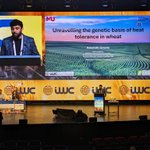
Up first is Dr Ani Agnihotri, who presented a talk titled: Advancing Insect Science: From Chemosensation to Pest Management.
We then heard from Afroja Rahman, who discussed novel research into modifying canola plants to produce sterols that insects can't utilise.
Congratulations to both for these fantastic and fascinating forays into insect science!
Sincere thanks to @SoilsWest Co-director A/Prof Fran Hoyle and Dr Tianhua He for chairing this session.


