

Dr. Mark Storey MD - Radiation Oncologist. @OKProtonCenter. Background: #MDAnderson @VanderbiltU @BMESociety #RadOnc My blog: https://xitter.cf/t.co/4S0MeQiWEI
Oklahoma City, OK
Joined June 2019
- Tweets4.5K
- Following442
- Followers1.7K
- Likes8.7K





Mark Storey retweeted

A Nova Scotia woman had precancerous cells on her cervix.
That was two years ago.
Pap smear. Abnormal cells. Referral to a gynecologist so they could find out if it was cancer. The referral sat for nine months.
She finally gets an appointment. She shows up on time — 10 a.m., in her calendar. The office says it was at 9. Won’t see her. Won’t reschedule. Start over. New referral.
She leaves crying. Seven more months go by. They call about an appointment she was never told about. She can’t take it.
She’s on a TV contract. Miss it and they can sue her.
Next opening: next year.
They don’t even call her back. She has to chase them.
She said the quiet part out loud: imagine dying of cervical cancer while you wait just to see a gyno.
That is Canada’s “universal healthcare.”
Not free care. A government monopoly that loses your referral, punishes you for their scheduling error, and hands a possible cancer case a calendar date in another year.
Coverage on paper. Care on a waitlist. You pay the taxes either way. The state decides when you’re allowed to find out if you have cancer.
This is the model they want to import as Medicare for All.
Don’t.
Mark Storey retweeted

BREAKING: The most controversial article of the year, claiming that early morning immunotherapy works better than in the afternoon, is now retracted.
After reading the responses provided by the authors to the inconsistencies raised in the web, the @NatureMedicine editors no longer have confidence in the integrity of the results. The only prospective evidence that time-of-day matters for immunotherapy is now gone.
nature.com/articles/s41591-0…
To me, this means (at least) two things.
First, it confirms that prudence on this topic was and remains critical. For as inexpensive it may be to give a drug earlier or later in the day, it carries a much more relevant cost: the one of scientific integrity. We owe our patients to make decisions based on solid data. We should not give up this practice too easily, particularly in the presence of several concerning red flags.
Second, this retraction should also prompt a broader reflection on the current state of peer review, in which unpaid reviewers struggle to keep up with a steady rise in submitted papers. Journals need to improve the process by implementing a formal, consistent, in-depth review of each paper by paid professionals. A practice that, in this case, may have avoided a retraction arriving after 22 citations and after inclusion of this study in at least one meta-analysis. And possibly, after some physicians had already changed their practice in IO administration.
For a thoughtful recap of this story, I recommend this well-written new piece in @ScienceMagazine by Laura Agudelo. I’m grateful to Laura for including my perspective in the article.
science.org/content/article/…


What are the key issues that have emerged on the @NatureMedicine time-of-day IO paper?
1. The clinical trial protocol uploaded to Nature was v1 dated Jan 2, 2022; however, the protocol includes references published in 2024. This calls into question when the protocol was written and if/when it was amended.
2. The clinicaltrials.gov record is concerning and calls into question whether the study was actually randomized.
a. In the first record 9/2022, although the study was noted as randomized, the inclusion/exclusion criteria read as though it was a retrospective study, e.g., “First-line patients received immunological monotherapy or immunological combined chemotherapy” as an inclusion criteria and “Lack of clinical diagnosis and treatment information or loss of follow-up” as an exclusion criteria.
b. In the first record, the primary endpoint, sample size, treatment and ECOG criteria do not match what was in the protocol dated Jan 2, 2022.
c. On 3/19/2024, the study was changed from randomized/interventional to an observational case-control study
d. It was not until 3/30/2024 (2 months before end of randomization) that the study was changed to the design described in the manuscript.
3. The OS K-M curve presented at ASCO had errors – i.e., the censor marks do not match the at-risk table. This raises concerns about the integrity of statistical analyses.
4. The shape of the PFS does not match expectations. With a 6-week scan schedule, one would expect a stair-step drop every 6 weeks when patients have their scheduled imaging. Their PFS curve does not – it is smooth. Of note, in an observational study, a PFS curve generally does not have a staircase look because scans are not performed on a regular set schedule.
5. The 95% CI for the lower bound of the median OS in the manuscript is NE. This is not possible as the median was estimated. There are inconsistencies in the p-values in Table 1 (Baseline Characteristics)
Credit to Daniel Brickman, Amanda Nottke and David Swank for creating this list — and to @houndcl for first identifying several of these issues.
Mark Storey retweeted

Mark, the line that really got me in your piece was this one:
"This new payment structure now becomes the path we must navigate as we race AI and progressive drug development."
Mark Storey retweeted

Really enjoyed reading this article! It got me thinking - what conditions (beyond Roach formula prediction of LN+ risk) would have to hold true for elective nodal RT to confer an OS benefit in PCa (or other sites)? Here is my list:
1) Metastatic failure is the main driver of OS (i.e., uncontrolled local disease is not a major cause of death)
2) For most pts, LN+ represents an intermediary between primary and metastatic disease, implying that:
--> direct hematogenous spread is not a predominant source of DM
--> there is some (relatively large) subset of patients who are LN+ but have no metastatic disease
3) RT eliminates all occult nodal disease without disrupting antitumor immune response in the LN
4) Other therapies (chemo, hormones, etc.) have relatively little effect on LN disease burden
5) No effective salvage treatments are available
Mark Storey retweeted

Honored to support the very first World Radiotherapy Awareness Day today, September 7th! 🌍
By working together, we can ensure every person facing cancer has access to life-saving radiotherapy.
#WorldRTDay @CamdenClarkMC
📚 Learn more: worldradiotherapy.org

Mark Storey retweeted
Here's a Tuesday tidbit for the #radonc crowd
Novartis annual sales of Pluvicto and Lutathera, two radioligand therapies, are now greater than what Part B @CMSGov Medicare spends on *all* of radiation oncology per year!
biospace.com/fda/fdas-new-ra…
cms.gov/files/document/cy-20…

Mark Storey retweeted

We looked at this in a meta-analysis: #\size of LN less important than T stage (aka laterality). Highest risk of contra failure is w T3/4 dx. Failure rates similar by N stage @hughrt7
jamanetwork.com/journals/jam…
Mark Storey retweeted

Thank you Rep. Steve Cohen for joining our effort and signing on as a co-sponsor of the Radiation Oncology Case Rate (ROCR) Act.
ow.ly/hgxo50WqN8i
@RepCohen

Mark Storey retweeted

'Better technology cures more patients with less side effects' quoting @alison_tree at the MR and RT symposium in Zurich today! #radiotherapy #ProstateCancer #RadoncGU


Mark Storey retweeted

Sadly this is 💯 correct @ProtonStorey
We are also repeating the mistakes made a generation ago with Gleason 6 #ProstateCancer and now applying it to the #BCR/#PSMA+ #BCR setting.
Overreacting to disease that may not be clinically relevant for many yrs
@urotoday

Mark Storey retweeted

After our daughter Ceci died at 15 mo of a paraspinal tumor, we’ve been committed to supporting pediatric cancer research.
We’re honored this year's Cattle Baron’s Ball will establish Ceci’s Fund through the American Cancer Society.
Please share/donate💕
cattlebaronsball.com


Mark Storey retweeted

📣#PACE - PACE C trial early toxixity data out now!
👉 thelancet.com/journals/lanon…
Mark Storey retweeted
"Here’s a wild-but-true factoid: 10 of the 20 largest companies on the new Fortune 500 list derive profit from the 340B program. I guess you can’t throw off tens of billions of profits without titans of industry figuring out how to get their hands on it" (@brianreid)
🧵
Mark Storey retweeted

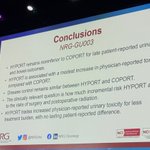
Plenary session at #PTCOG63: @SJFrankMD presented extended OS data from the randomized trial of IMPT vs IMRT in H&N cancer.
✅ Proton therapy improved survival
🔍 Not explained by disease progression or G-tube dependence
Looking forward to the full publication of this important trial.
#ProtonTherapy #RadOnc #HNcancer @MDAndersonNews @PTCOG_Official


Mark Storey retweeted

Hypofractionated, Dose-Escalated Radiation ☢️ Versus Conventionally Fractionated Radiation for Localized Prostate Cancer
ascopubs.org/doi/abs/10.1200…
The MD Anderson phase III randomized trial compared conventional (CIMRT) versus dose-escalated, hypofractionated (HIMRT) intensity-modulated radiation therapy in patients with mostly low- and intermediate-risk localized #ProstateCancer . Initial results showed fewer treatment failures with HIMRT. With updated 13-year follow-up (median 13.2 years), HIMRT continued to show a lower rate of treatment failure (13 vs. 22), though this difference was no longer statistically significant (P = .08).
Rates of distant metastases remained low and similar between groups, and no significant differences in long-term gastrointestinal or genitourinary toxicities were observed.
@PSchlembachMD
@QuynhNguyenMD
@SJFrankMD
@ChadTangMD
@KHoffmanMD
Ping @Silke_Gillessen @AOmlin
@bavilima @nataliagandur

Mark Storey retweeted
Re-irradiation is common but challenging in lung cancer.
ARS just published: American Radium Society™ Appropriate Use Criteria Systematic Review and Guidelines on Reirradiation for Non-small Cell Lung Cancer Executive Summary.
My personalized Share Link:
authors.elsevier.com/c/1l3k5…

Mark Storey retweeted

All these aside, methodology is problematic. No account for unique pts vs same pts w/ multiple scans. No individual pt info: all covariates were estimated. How many had preexisting cancer? Misleading data will prevent pts from needed scans given inequity in access already
Mark Storey retweeted
Fantastic acheivement!! #EUROPA

We’ve just enrolled the last patient in the EUROPA trial!
926 patients recruited over 4 years across 20 centres
An infinite thank you to all patients, investigators, and caregivers who made this incredible journey possible ❤️
@OncoAlert #OncoAlert #BreastCancer #radonc #medonc


Mark Storey retweeted

In patients with locally advanced hepatocellular carcinoma, stereotactic body radiation therapy (SBRT) combined with sorafenib improved progression-free survival and showed a clinically important improvement in overall survival compared to sorafenib alone. ja.ma/4bbMrXr

Mark Storey retweeted

Completely agree that Phoenix needs a rebirth. The question everyone is asking is if earlier detection leads to better outcomes.
The Coimpact consortium is a step to that direction
Join in please if you can 😊..
coimpact-project.com/
@CZamboglou
@Simon_Spohn