

Dr. Mark Storey MD - Radiation Oncologist. @OKProtonCenter. Background: #MDAnderson @VanderbiltU @BMESociety #RadOnc My blog: https://xitter.cf/t.co/4S0MeQiWEI
Oklahoma City, OK
Joined June 2019
- Tweets4.5K
- Following442
- Followers1.7K
- Likes8.7K






If I were still practicing, I'd have a single Grok bot assigned per patient - tracking every new input - monitoring everything added to the chart. Daily report - obviously checked and verified by a review bot.
IT would be getting a daily visit until this was approved.
Regardless of thoughts on when / if protons have value - 30% site of service proposal is still crazy.
Thought we had momentum towards removing this type of discrepancy.

If you can't look ahead and see the Singularity as I've discussed, don't know what to say... First add, then substract. Now 6 months ago...
LUNAR Trial:
pubmed.ncbi.nlm.nih.gov/4286…

Next goal is integration with a couple of Grok bots who are watching X - creating lists to add. Ranking the list of candidates which I then feed into the CLI because I still think the harness there is stronger for the work. Goal is a relatively low work loop. Crazy world.

14 of 18 truly prospective calls correct. Importantly the pre-set discrimination line (pretty visible where it would be from image below) held. Every call above it remained accurate (7 for 7). All four misses below (7 for 11).
Basic trends continued further - upper right best. Lower left worst at meeting endpoints. Quadrants drawn previously continue to hold along with the discrimination line.
Simple concept - use this structured analysis to review your trial design and look for ways to simply ask the same question better. More to follow on the Substack as I put together a complete document of the 18 calls - what went right and why CNS and our historical slant (probably too much in favor of too much treatment in the brain) appears responsible for all 4 of the misses.
A week later and more digging through the data, and I'm more certain - it is the end of the era in CNS to treat beyond what you see.

FYI - here were the final results with 36 votes. 2/3rds moving aggressively towards multiple fractions - the question appears to be in small lesions.
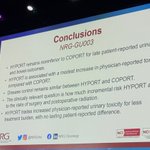
Digging through data and slides from a busy ASTRO - I think this slide over-states the data and math. The 5 yr data does not support NI for EPIC urinary outcomes.
Bullet point 1. The two year primary endpoint DID exclude non-inferiority - barely. Mean difference of -0.9 and a CI (-4.63 to 2.83) that excluded their own 5 point EPIC NI metric.
So in the 5 year data - a few things progressed - the physician data showed worse outcomes. AND the patient mean drifted more inferior as well. To -2.3 from -0.9. People dropped out and so the confidence interval widened - now -7.7 which now covers a 5 point relative drop. Can't use the slide SD - have to convert to a 95% CI - that is the metric a NI uses.
P value alone here is not sufficient to state "remains non-inferior". I believe this is classic absence of evidence being worded on a cooperative group slide as evidence of absence.
I'm not talking about the higher dose etc - just literal read of the conclusions vs. the data.
I know most will think this is just in the weeds stuff, but precision is important. Maybe they had a broader 5 year definition of NI but I couldn't find it.
Anyone agree or did I miss something?


cc-009 and MAVERICK - do we have good CBC data weekly or biweekly through the treatment period and say 2 week beyond EOT? My modeling says lymphopenia might be a driving force for the OS.
@PDBrownOnc
Post A071801 - post op brain cavity single fx vs. 3 fraction. Will you treat single fraction?
0%Yes
67%No
33%If small, <2cm
0%cost, efficiency reasons
36 votes • Final resultsSunday - MAVERICK, CC009, FIRE-SCLC and the non-small cell study for completeness.
A story about where we were 30 years ago and the data driven progress since.

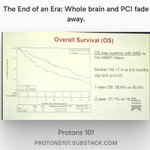
these are AI derived curves - don't use them. for example - the presented OS curve . 10 bookmarks - just sayin....


Mark Storey retweeted

A Nova Scotia woman had precancerous cells on her cervix.
That was two years ago.
Pap smear. Abnormal cells. Referral to a gynecologist so they could find out if it was cancer. The referral sat for nine months.
She finally gets an appointment. She shows up on time — 10 a.m., in her calendar. The office says it was at 9. Won’t see her. Won’t reschedule. Start over. New referral.
She leaves crying. Seven more months go by. They call about an appointment she was never told about. She can’t take it.
She’s on a TV contract. Miss it and they can sue her.
Next opening: next year.
They don’t even call her back. She has to chase them.
She said the quiet part out loud: imagine dying of cervical cancer while you wait just to see a gyno.
That is Canada’s “universal healthcare.”
Not free care. A government monopoly that loses your referral, punishes you for their scheduling error, and hands a possible cancer case a calendar date in another year.
Coverage on paper. Care on a waitlist. You pay the taxes either way. The state decides when you’re allowed to find out if you have cancer.
This is the model they want to import as Medicare for All.
Don’t.
The world is going to change faster than many realize - projects that once were not possible are now - not just feasible - but feasible at viable dollar figures.

I've attempted to map everything in oncology in a public website and open source repo for all.
The site is trying to get all cancers, products, technologies, bottlenecks, people, startup opportunities with 1000+ ideas for upgrading the field.
If you have a loved one with cancer and you are technical or can engineer, go take a look, file improvement requests or bugs or help with the open repo and make this the best open and free info resource for individuals, researchers and educational use.
This should save people time, aid AI oncology projects and generate positive action. If you are not technical just complain in this thread about broken or annoying or things you want and I'll fix them live.
Some of the interesting pages:
Treatments: onco.cc/drugs
A gallery of the molecules being used onco.cc/molecules/
And targets: onco.cc/targets/
The technologies in oncology: onco.cc/technologies/
1100 ideas for helping oncology: onco.cc/ideas/
Bottlenecks on oncology: onco.cc/bottlenecks/
Open questions (LETS GO RESEARCH PEOPLE) onco.cc/open-questions/
Startup requests (LETS GO STARTUP PEOPLE) onco.cc/startup-requests/
Mechanics of cancer: onco.cc/mechanics
Battlefronts: onco.cc/fronts/
Isotope supply: onco.cc/isotopes
Key papers: onco.cc/key-papers
Pipeline funnels: onco.cc/pipeline
Cancer by type: onco.cc/cancers/
Institutional rankings: onco.cc/institutions/
The startups: onco.cc/startups/
Heros and heroines : onco.cc/heroes/
Key medical people: onco.cc/people/
Here is the project roadmap: onco.cc/roadmap/
Models and data sets: onco.cc/models/
There are other views as well, take a browse.
Try making a PR if you have an upgrade to this on the repo here: github.com/judegomila/OnCo
If you are biologically/medically minded and something is wrong, file a bug as well or say on the thread and we will get it fixed live.
If this is a useful project star the repo and help get it calibrated.
I've tried to add some other languages but I cannot speak them so tell me if that doesnt work well.
I believe we will crack oncology and having total information dominance is key to the problem.
Let the feedback flow!


NRG-CC009 throwing a huge surprise at ASTRO - really the only thing that I can see stopping the end of an era post-MAVERICK.
Three CNS trials land in premier sessions at ASTRO this year. Is fractionated SRS superior to single fraction in post-op cases? And - even in Small cell - can we just do SRS over HA-WB? Or better yet, can we just avoid WB and use MRI to survey?
I include my personal perspective of my 30 years in practice - how I file things mentally. I think if you build a picture rather than memorizing pieces, you'll gain more context quicker.
For residents - a great opportunity to get context of a large subsite from just three trials - knowing how we got here and the questions that we've answered.
@PDBrownOnc - tagging because, like you show up in the author list for nearly everything I referenced in the past decade - hopefully it is a reasonable representation. If not - reach out.
