

Cuenta del Programa de Derecho, Economía y Comportamiento de la Universidad Nacional del Sur, Bahía Blanca.
- Tweets39.4K
- Following4K
- Followers5.5K
- Likes57.8K




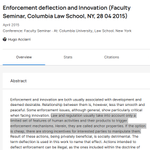



ALT Article 50 (2) of the EU Artificial Intelligence Act requires providers of generative systems to make synthetic outputs machine-readable and detectable, while qualifying the effectiveness, interoperability, robustness, and reliability by technical feasibility, cost, content-specific limits, and the state of the art. For free-form text, one important implementation route is the implementation of a generative watermarking procedure, which poses a compliance problem that is hard to address. Strong watermarking is impossible against adaptive removal, while ordinary edits attenuate statistical evidence, and unmarked human text may overlap distributionally with machine output. This article develops an auditable alternative. First, it defines a description-length robustness profile. A finite-sample bound shows that detectable bias decays and that the required sample size grows with the inverse square of the decay rate. This replaces an unidentified Shannon-entropy constant with collision entr





