

Assitant Professor @UTwente @BMSLAB_UT #Meditation, #Contemplative_Sciences & #Neuroscience #MotorLearning
Twenterand, Nederland
Joined May 2011
- Tweets826
- Following956
- Followers261
- Likes681




Dr. Russell Chan retweeted

Common Probability Distributions That Occur In Nature And Why Mathematics Is The Language Of The Universe
Fundamentally the patterns of the universe repeat themselves making machine learning and AI possible.
Basically, when training ML models, including NNs we are attempting to model the patterns in the data. A good model can predict unseen data points that are part of the original data distribution.
Here are the common probability distributions and where they occur naturally
Symmetry and normal distributions - Nature loves balance. You see it in butterfly wings, faces, and even in physical laws. Natural phenomena that exhibit symmetry often fit well with a normal distribution.
The Central Limit Theorem tells us that the sum of many independent, identically distributed variables approaches a normal distribution. These distributions are characterized by a mean and a standard deviation and everything from human heights, IQ scores, and even the velocities of molecules in a gas follow a normal distribution
Log-normal distribution - If the logarithm of the variable follows a normal distribution, then the variable itself has a log-normal distribution. The distribution of financial assets, or the sizes of particles generated by grinding, blood pressure, and metabolic rates in various organisms often follow a log-normal distribution.
The Log-Normal Distribution often arises from multiplicative growth processes, where you're repeatedly multiplying by some random factor.
Uniform Distribution. This is self-explanatory. All outcomes are equally likely. In the continuous case, the probability density function is flat between the minimum and maximum values. Rolling a fair die, or picking a card from a well-shuffled deck follows uniform distributions
Poisson Distribution It describes the probability of a given number of events occurring in a fixed interval of time or space. The events must occur with a known constant mean rate and independently of each other. It is the go-to for predicting rare events.
Poisson distribution models the number of times a radioactive atom decays in a given time period, or the number of cars passing through a certain point in a given time frame.
If a particular intersection sees an average of 10 cars passing through it per minute, the Poisson Distribution can estimate the probability of 15 cars passing through in the next minute. Similarly in sports like hockey or soccer where goals are rare, you can use distribution to model the number of goals scored by each team.
Bernoulli Distribution, the binary star of the probability universe! Scientifically speaking, it's a discrete probability distribution that models a single experiment with exactly two outcomes, often termed "success" and "failure," and is characterized by a single parameter p, the probability of success.
The flip of a coin, genetic inheritance (you either have a trait or you don't), and the polarization of a single photon (either vertical or horizontal) model this distribution.
Binomial Distribution It describes the number of successes in a fixed number of independent Bernoulli trials, each with the same probability of success.
For example, The number of heads when flipping a coin multiple times, or the number of defective items in a batch of manufactured goods can be modeled with this distribution.
Exponential Distribution models the time you have to wait for the next event in scenarios where events happen independently and at a constant average rate. It's often used to describe phenomena like the time between bus arrivals or the intervals between radioactive decay events.
In essence, it's the go-to distribution for understanding "waiting times" in various natural and man-made systems.
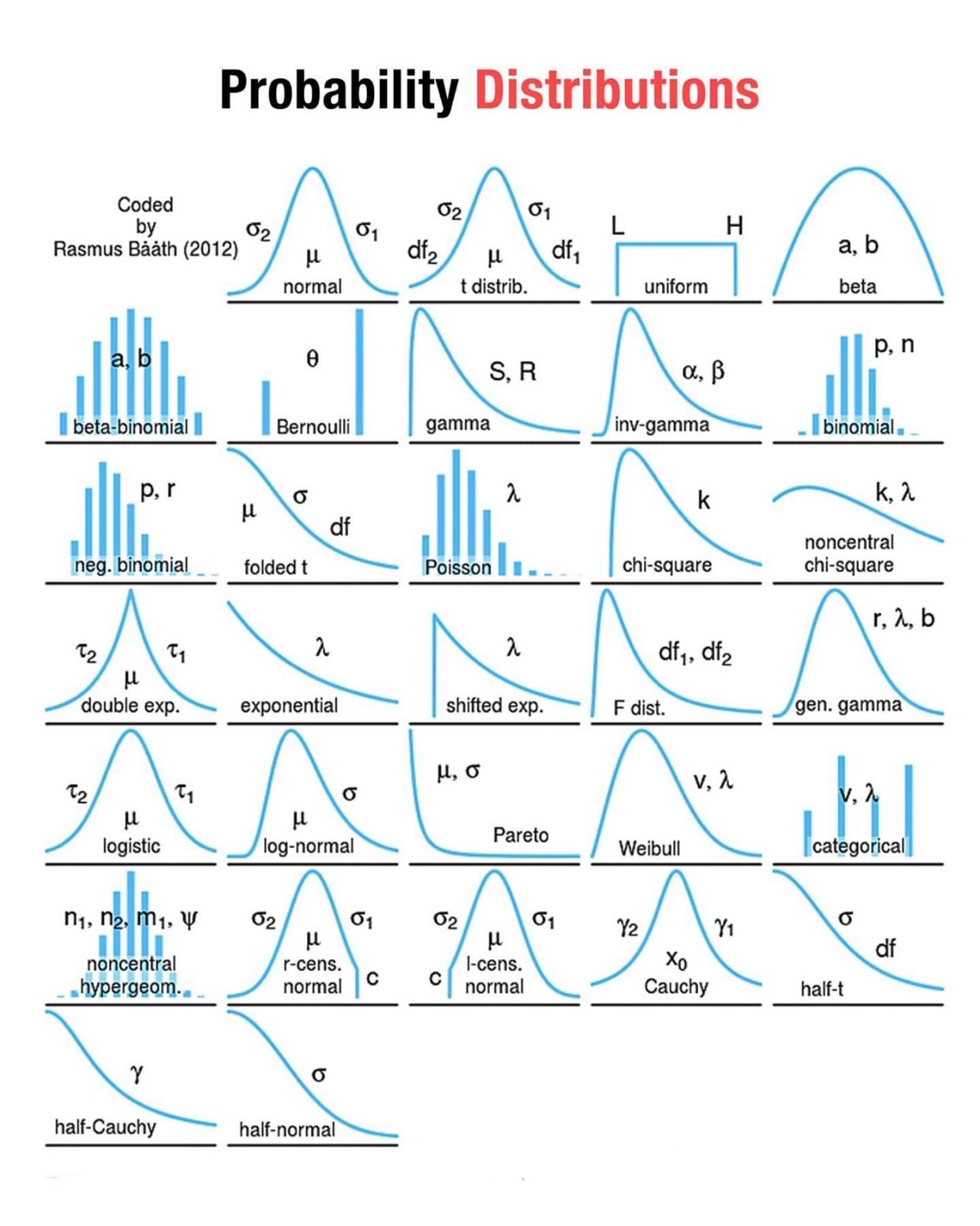
This is a summary of the most common distributions. There are a bunch of other distributions that are related or variations on the above distributions and the image below captures some of them.
These naturally occurring distributions speak to why mathematics is the language of the universe and how you can use it to model and predict its behavior
Dr. Russell Chan retweeted

A Simian Symphony (1/2): #Neural probe recording from CA1 #hippocampus. #Sonification and #visualization driven by Local Field Potential (LFP) and Current Source Density (CSD). Single-unit spikes each associated different piano keys.
#b3d #neuroscience #dataviz #electrophysiology
Dr. Russell Chan retweeted

2.9% success rate = 9 grants awarded from 307 applicants!
*For the stream specifically identified for ECRs*
And no assessor feedback!
This is a complete failure of policy, funding & leadership
"The MRFF aims to transform health and medical research" - yeah right ...

This Post is from an account that no longer exists. Learn more
Dr. Russell Chan retweeted

Thank you for having me #CNS2023 #SanFrancisco 🎉 If you are interested in knowing more about mindfulness as a cognitive training tool (and resting-state EEG), please reach out!

Dr. Russell Chan retweeted

Our #NeuroCENL talks are around the corner! 🧠
The event will finally be in english 🇬🇧
Thank you so much @FECYT_Ciencia! We are so grateful for all the support.
All the information regarding the schedule just below 👇

ALT The official poster of the NeuroCENL talks. It displays a brain coloured with tempera paint

Dr. Russell Chan retweeted
2️⃣ días.
Veníos al @ICUtrecht a hablar de IA con @J0A0Valente y @sierra_carles este miércoles. A los mandos de esta mesa estará @eTalaveraM 👏
¡Os esperamos!

Dr. Russell Chan retweeted

Last day of the #AdvMotLearn symposium starts with @docmaarten discussing mindfulness and motor learning. This Monday, Prof Immink will be presenting his work at @LeidenPsy, let me know if you'd like to attend his talk!

Dr. Russell Chan retweeted

Great talk by @UPHUMMEL_EPFL on non-invasive tTIS striatal activity modulation in humans during motor learning. #AdvMotLearn

Dr. Russell Chan retweeted
Brilliant talk by @ArnaudBoutin8 on the role of sleep spindles and hippocampal-striatal interactions in motor memory consolidation featuring concurrent fMRI and EEG data during sleep. #AdvMotLearn

Dr. Russell Chan retweeted

@advmotlearn
Final talk of an excellent Advances in Motor Learning scientific program
Sleep-related consolidation and transfer of motor skills learned by motor imagery, action observation and physical practice
by Arnaud Boutin from @UnivParisSaclay


Dr. Russell Chan retweeted

Thanks to Dr Russel Chan @PrimeYourMind for organizing and inviting me to the 1st Advances in Motor Learning symposium #AdvMotLearn

Brilliant talk by @ArnaudBoutin8 on the role of sleep spindles and hippocampal-striatal interactions in motor memory consolidation featuring concurrent fMRI and EEG data during sleep. #AdvMotLearn
Dr. Russell Chan retweeted

Fully funded summer research internship in our lab @UUtah for undergraduate students interested in memory processes and neuroimaging. Apply before Jan 29 to the SPUR program and join the team!
Project description: our.utah.edu/spur/leveraging…
Application: ugs.formstack.com/forms/spur…

Dr. Russell Chan retweeted
#AdvMotLearn
Day 2 Advances in Motor Learning Symposium
Lead off with keynote by Jordan Taylor from @IPALab on How cognitive strategies shape sensorimotor skill acquisition
@BMSLAB_UT @Princeton
#skillacquisition


Dr. Russell Chan retweeted
#AdvMotLearn
Next talk by @PrimeYourMind on individualized motor learning in ageing!
Thanks to Russell for convening the Symposium
@BMSLAB_UT


Dr. Russell Chan retweeted
Really nice academic tour through the #Netherlands 🇳🇱lined up for next month! Looking forward to networking and delivering my talks on optimizing #motorlearning
I still have open dates🗓️to visit your lab. DM or email me if interested.
#humanperformance #skillacquisition

Dr. Russell Chan retweeted

❗Das 9-Euro-Ticket ist beschlossene Sache.❗
Der Verkauf startet ab sofort über die DB-Kanäle bahn.de und DB Navigator (App) sowie an den DB-Fahrkartenautomaten und in den DB Reisezentren in Bahnhöfen. Alle Infos ➡️
bahn.de/angebot/regio/9-euro…
#9EuroTicket

ALT Eine Regionalbahn entlang der Weinberge an der Mosel
Dr. Russell Chan retweeted

The story of most scientific discoveries xitter.cf/springerthings/status/…
Dr. Russell Chan retweeted

A thing I don’t understand about modern neuroscience is why short-term plasticity is so underappreciated. Especially in a world where neural population dynamics on the same timescales are becoming an essential part of our understanding of the brain.

Dr. Russell Chan retweeted
"𝐀 𝐫𝐞𝐜𝐮𝐫𝐫𝐢𝐧𝐠 𝐪𝐮𝐞𝐬𝐭𝐢𝐨𝐧 𝐢𝐧 𝐬𝐤𝐢𝐥𝐥𝐬 𝐫𝐞𝐬𝐞𝐚𝐫𝐜𝐡 𝐜𝐨𝐧𝐜𝐞𝐫𝐧𝐬 𝐡𝐨𝐰 𝐧𝐞𝐰 𝐦𝐨𝐭𝐨𝐫 𝐬𝐤𝐢𝐥𝐥𝐬 𝐜𝐚𝐧 𝐛𝐞 𝐛𝐞𝐬𝐭 𝐩𝐫𝐚𝐜𝐭𝐢𝐜𝐞𝐝." first line from our new article in Psychological Research link.springer.com/content/pd…

Dr. Russell Chan retweeted

Hey @AcademicEEG, I wanted to give you a sneak peek of my new cleaning algorithm, iCanClean (paper in prep). This highly artifacted mobile EEG data was simply HP filtered and then sent to my algorithm (no channel rejection, no re-ref). Oh yeah, and it's running here in real-time.