







prefshares retweeted

Excited about our new Bee devices launching today. They turn your conversations into summaries, to-dos, and reminders, so the details are there when you need them.
Bee Frontier goes on your wrist or clips to your clothing, and Bee Eclipse snaps to the back of your phone to catch what you'd otherwise forget throughout your day, whether it's notes from a class you're taking, the details of a trip you're planning, or an idea that comes to you in the car.
They connect to Alexa+ and Amazon.com, so the things you mention are easy to find later. And you're always in control…one button turns it on or off, a light shows when it's on, audio is never stored, and only you can see your data.
Think folks are gonna find this really handy. aboutamazon.com/news/devices…
prefshares retweeted


Thank you @PrefShares for engaging with a constructive and thoughtful response. (anyone curious to read my original piece, go here: mbi-deepdives.com/aws-vibes/)
Let me take your points in turn.
Retail. I like Amazon’s retail business too, and I agree there are losses buried in ex-AWS. But the profit engine in core retail today is advertising, and I think it’s fair to say ads carries a question mark right now. Consumer agents on one side, the FTC case, the auction-mechanics issues or the bid shading possibilities I’ve written about on the other (see here: mbi-deepdives.com/amzn_ads/)
My base case is still that Amazon figures it out, but it’s not unreasonable to wonder that there is a legitimate fat tail risk to Amazon’s ability to COMPOUND core retail profits which can (should?) weigh on the multiple we may want to put on these profits. Also on $WMT, I haven’t met an $AMZN shareholder yet who thinks WMT is attractive at ~28x LTM EBIT.
Okay, let me now get to AWS.
Cost curve. On the $NVDA discount, I think the argument runs into NVIDIA itself. The hyperscalers are the only customers also building chips to displace it, so NVIDIA has every reason not to hand them a structural cost advantage, and it hasn’t: equity in the neoclouds, capacity backstop, or direct financing for OpenAI to buy gigawatts with no hyperscaler in between…Jensen has made it abundantly clear he doesn’t want to operate in a world where Hyperscalers call the shot. Whatever discount the hyperscalers get, NVIDIA likely hands back to the marginal producer in cheaper capital and risk sharing.
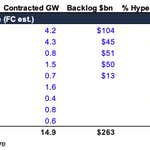
Power is a few percent of a gigawatt-year’s revenue, so cheaper PPAs are worth maybe a point or two, and unlikely to be a needle mover for overall economics. And cost of capital advantage is shared by all Hyperscalers, and also an advantage that is directly being largely negated by NVIDIA with their balance sheet support to neoclouds.
I do agree it’s not obvious to me either why neoclouds have a DURABLE advantage over hyperscalers. But the capacity they’ve bult and are building is pretty real. If AI demand disappoints or we hit a digestion period, the neocloud equities will get obliterated but the gigawatts stay, get repriced, and pressure everyone, hyperscalers included. The concern again is that NVIDIA has an obvious interest in keeping its buyer side VERY fragmented.
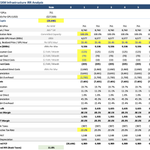
Short-term margins. No argument there. Everyone selling compute today is making money hand over fist. The question is whether 2026 is representative of medium and long-term economics. If it is, AWS isn’t $1.3T; it’s comfortably over $2T.
Bedrock as a capital-light royalty. Not sure I agree with your framing, and I think the simplest way is to follow the token. When an enterprise buys a Claude token on Bedrock, it’s generated on a Trainium chip, in an AWS data center, that AWS paid for. That chip is already in my gigawatt count. So whatever AWS keeps on that token I don't see it as a royalty on someone else’s capital, it’s just a markup on its own. Capital-light royalties do exist in AI, but they accrue to whoever owns the weights: Anthropic earns one when $GOOGL sells Claude through Vertex or $MSFT sells it through Foundry (their chips, their utilization risk, Anthropic’s cut). More importantly, let’s notice who will set the royalty rate. The enterprise pays roughly Anthropic’s list price on Bedrock, so AWS’s cut comes out of Anthropic’s margin and Anthropic, which can serve the identical token through its own API, Vertex or Foundry, decides how big that cut is (if not today, they will over time). A royalty where the payer sets both the product price and the royalty rate SHOULD/WILL be a thin one.
Enterprise / other AI. I agree with all six of your points. Those points are why that bucket earns ~2 points over its cost of capital in my model rather than zero. I know 2 points may seem a little low, but the invested capital in that bucket is $468B in 2035, so that’s ~$10B a year of economic profit. I’m hesitant to extrapolate to much more. All six advantages are more or less shared by AWS, Azure and GCP, so they’re a moat against neoclouds and the labs’ direct APIs, but probably not much against each other. The neoclouds know serving hyperscalers and labs isn’t durable, which is precisely why they’re trying to move into this segment as well. And the labs themselves are building first-party products for the same customers. Five to ten points of excess return on a ~$500B base would be $25–50B a year of rent on an input with growing number of alternatives. I’ll admit I am far from certain where that shakes out (could be anywhere between 1 and 5 points IMO).
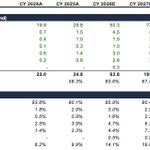
Core cloud. Fair it’s hard to separate from AI, and AI is clearly helping it. That’s why core grows ~21% in 2026 in my model, well above the ~13% it had slowed to before AI, when optimization was the story. My model still triples the core to ~$360B by 2035. But yes, reasonable people can land above me here.
The key point I was trying to drive home is the exercise actually helped me tone DOWN my own bearish “vibes” on AWS a bit once I realized market is actually fairly skeptical about AWS capex being value additive. The objective of making the assumptions explicit is to see if I perceive any vehement disagreement with what the market is underwriting. Following the exercise, I just realized I do not have such strong disagreement. Market and I are more or less likely on the same boat in evaluating AWS long-term future.
Thanks again. Always a pleasure to have diligent readers.


prefshares retweeted

Low probability, but if space data center is part of this buildout is Spacex compute to AWS/Azure what starlink was to cable and telcos?
Can see a scenario in 2028 where AMZN/MSFT are 10x EBITDA (on lower estimates, since AMZN basically there next year) and spacex is still taking their lunch
I put this low prob (maybe 5-10%) but it’s not 0 and do think hyperscaler bulls need to take this as downside node
The ingredients are there: generational CEO, true believer investors, infinite access to capital, structural low cost value proposition, and highly skeptical Wall Street analysts
Enough scar tissue from seeing bulletproof businesses lose share rapidly from dismissed competitors - CHTR, ADBE, BABA, PYPL, etc to see parallels
prefshares retweeted

New footage shows Arkansas principal Kirk Moore lunging at a school shooter, helping save students’ lives.
A real hero


prefshares retweeted

Some reasons why Kalshi / prediction markets might not impair $DKNG $FLUT market share or growth trajectory – at least in states that have legalized OSB:
1. Customers that already multi-home and shop every line will use prediction markets – these customers are less valuable to $DKNG $FLUT anyway (lower parlay mix and more EV-based bettors). The rest will not switch to a product that only offers 40% or even 70% of the feature set. In order to take more than 5-10% share in OSB-legal states, Kalshi and Polymarket will need to figure out how to offer parlay functionality on par with regulated sportsbooks.
2. Kalshi is launching custom parlays that string together multiple independent markets. This does not work for SGPs due to correlated outcomes. Additionally, unclear if the long tail of prop bets available on a sportsbook will ever have sufficient liquidity on an exchange
3. Individual parlays have too many permutations – most cannot be listed standalone contracts with meaningful liquidity
4. Due to (2) and (3), SGPs will not work except in a custom P2P model
5. This P2P model – asking for a one-off custom quote from a market maker – is a poor UX (vs. full menu of options with live, continuous pricing) and defeats the entire purpose of an exchange (better pricing and execution through two-sided liquidity)
6. Participants on CFTC exchanges must post cash collateral for each contract. A market maker providing liquidity for parlays would have to post cash equal to the full amount paid out if every single parlay hits, whereas a sportsbook has no such limitation. Even with a large price umbrella set by sportsbooks’ parlay hold, market makers will have to place various limits on parlays because time value of posted cash collateral (especially for multi-leg parlays with low odds) becomes a factor. CFTC would have to make an exception to allow participants to use margin… in order to enable the exchange trading of *parlays* – which seems unlikely
7. Exchanges have no ability to profile and limit sharps. In theory, sharps moving to prediction markets is positive since they enhance liquidity and pricing signal. However, bettors with informational edge will be able to consistently pick off market makers, which will have no recourse, leaving market makers unable to participate in a variety of markets (e.g., college prop bets)
8. Sportsbooks use higher hold to fund promotions and brand marketing that exchanges will be unable to reproduce due to their much lower take rate. Promo spend at $DKNG $FLUT is in the multiple billions annually – a large multiple of Kalshi’s future revenue even if it can scale to many tens of billions of dollars of annual volume. These are valuable customer acquisition and retention tools that exchanges cannot match
Ultimately, the impact on DKNG/FLUT seems to come down to whether SIG wants to become a full-fledged, de facto sportsbook, building the data and pricing infrastructure to offer real-time quotes for any contract Kalshi users could possibly want, including the “No” side of long-odds parlays where SIG will need to tie up a lot of capital relative to its expected payout. Without this level of commitment from SIG, I don’t think there will be enough liquidity for exchanges to offer robust parlay functionality.
Re: the cash collateral issue – take a 4-leg parlay with +900 true odds. Say a user on Kalshi selects the four legs they want and SIG immediately quotes them a “Yes” contract for $0.12. SIG buys the “No” contract for $0.88. (Ignoring fees paid to Kalshi.) With ~17% “structural hold” ($0.02 / $0.12), SIG has expected profits of $0.02 with cash collateral of $0.88. Assuming SIG can recycle this capital 50x a year yields $1 of expected trading revenue with $0.88 of capital – not that bad. If we make it a 6-leg parlay with +6000 true odds, with SIG offering “Yes” for $0.02 (18% “structural hold”), the same math yields $0.18 of annual trading revenue with $0.98 of capital – a very unattractive return. SIG would likely have to limit stakes, leg count, and/or total odds.
I wonder if there are easier ways for SIG to make money than 1) making a substantial investment to become a full-service de facto sportsbook and 2) tying up a lot of capital in “No” contracts for parlays. Nevertheless, the possibility that this kind of functionality could be available nationwide, on Kalshi and Robinhood, with no realistic avenues for states to do anything about it (3 paths for states to block prediction markets – courts/CFTC/Congress – are all tough), and SIG building all the underlying technology – is not exciting for DKNG/FLUT.


prefshares retweeted

$bam, $bn Friends, spent a little time ignoring the Tariff Tantrum by finishing up an article on Brookfield that had been collecting dust.
h/t: @PrefShares
Brookfield Corp. - Get a Buck for Fifty Cents, by @310Value open.substack.com/pub/310val…

prefshares retweeted

Terry Smith podcast in the Investors' Chronicle: Covering the following - investorschronicle.co.uk/con…


prefshares retweeted

Love to hear comments/analysis on the following assertion (which I heard from a credible family office who had done the work).
"The AFTER-TAX performance of the Yale endowment (top-performing Ivy endowment the last 20 yrs) underperformed vs. a variety of low-cost ETF-only portfolios with similar risk/reward characteristics on an after-tax basis."
cc @MebFaber
prefshares retweeted

There are no shortcuts as an investor in individual companies, you need to put in the hard yards and do the work. If your counterparty to a trade is relying on abdominal breathing and visualisation, his loss is your gain...
(link to full episode in bio)
xitter.cf/PrefShares/status/1808…

prefshares retweeted

This was a great podcast from late last week with Neil Dutta, who has been right on a lot of things over the last several years. The predictions and concerns got a bit more support in today's data.

WHY NEIL DUTTA IS WARNING OF A LOOMING FED POLICY MISTAKE
@tracyalloway and I talked to the top @RenMacLLC economist about why he thinks the Fed is at risk of an error. Waiting for too much confirmatory inflation data, while the labor market deteriorates podcasts.apple.com/us/podcas…

prefshares retweeted

WHY NEIL DUTTA IS WARNING OF A LOOMING FED POLICY MISTAKE
@tracyalloway and I talked to the top @RenMacLLC economist about why he thinks the Fed is at risk of an error. Waiting for too much confirmatory inflation data, while the labor market deteriorates podcasts.apple.com/us/podcas…
prefshares retweeted
Focus on Income Can Undermine Returns: The Case of Covered Calls--
Covered calls implemented to deliver higher derivative income should be expected to have lower total returns, more tax-drag, more negative skew. Yuck.
by @larryswedroe
cc @RoniIsraelov
alphaarchitect.com/?p=89562