

The William S. Dietrich II Institute for Writing Excellence at the University of Pittsburgh
- Tweets39
- Following78
- Followers75
- Likes30
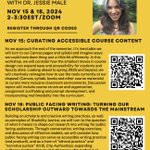






ALT 1. As we approach the end of the semester, it's inevitable that we will turn to our Canvas pages and syllabi and imagine ways we could have done thing just a little bit differently. In this workshop, we will consider how the smallest moves in course design can expand ease and accessibility for students and faculty alike. We will creatively reimagine how to use the tools currently at our disposal to curate more inclusive classroom environments. Discussion topics will include course structure and organization, assignment scaffolding and prompt development, and incorporating multimodality into the curriculum. 2. Building on scholarly and creative writing practices, as well as principles of Disability Justice, we will turn to the question of what it means to shape our research into writing for public facing audiences. We will consider how public facing writing can serve as accessible writing practice and product and as a form of "ethical practice" and "narrative justice."

ALT Join us as Dr. Mimi Khúc facilitates a conversation on mental health grounded in her new book dear elia: Letters from the Asian American Abyss (Duke University Press), a creative-critical genre-bending project reconceptualizing mental health through critical arts approaches and the framework of a pedagogy of unwellness: the recognition that we are all differentially unwell. An intimate series of letters, dear elia explores Asian American unwellness at the intersections of race, ableism, and the university, and invites readers to recognize in it the shapes and sources of their own unwellness. This talk will be open access to all who pre-register. This is the final event in the series "Creating a Culture of Access," hosted by The Writing Institute with the support of the Composition Program. Registration is required and can be done through the QR code or by visiting The Writing Institute website. Access questions and requests can be directed to Jessie Male at [email protected].

ALT Based on ideas from Dr. Hitt's book Rhetorics of Overcoming: Rewriting Narratives of Disability and Accessibility, this presentation focuses on accessible writing instruction. The idea that disabilities must be overcome is a cultural and medical narrative with a lot of power, and this ableist narrative frequently manifests in higher education. There is a tendency to try to diagnose disabled students and default to accommodations rather than crafting more accessible pedagogical environments. In this presentation, participants will discuss strategies for designing writing classrooms and curricula that are accessible and equitable, rather than simply accommodating of difference. Please register by 9am on the day of the event. If you do not receive a link to the talk by the morning of the event, contact Jessie Male at [email protected].

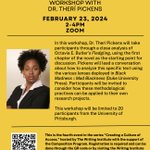
ALT In this workshop, Dr. Therí Pickens will take participants through a close analysis of Octavia E. Butler's Fledgling, using the first chapter of the novel as the starting point for discussion. Pickens will lead a conversation about how to analyze this specific text using the various lenses deployed in Black Madness :: Mad Blackness (Duke University Press). Participants will be invited to consider how these methodological practices can be applied to their own research projects. This is the fourth event in the series "Creating a Culture of Access," hosted by The Writing Institute with the support of the Composition Program. Registration is required and can be done through the QR code or by visiting the Writing Institute website at https://www.writinginstitute.pitt.edu/writers-disabilities/creating-culture-access-series. Captions will be provided during the event. Access questions and requests can be directed to Jessie Male at [email protected].

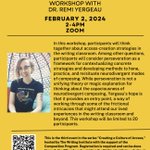
ALT In this workshop, participants will think together about access-creation strategies in the writing classroom. Among other questions, participants will consider perseveration as a framework for contextualizing concrete strategies and developing methods to hone, practice, and re/situate neurodivergent modes of composing. While perseveration is not a unifying theory or magic explanation for thinking about the capaciousness of neurodivergent composing, Yergeau's hope is that it provides an entry point, a way of working through some of the frictional intricacies that might attend our lived experiences in the writing classroom and beyond. This is the third event in the series "Creating a Culture of Access," hosted by The Writing Institute. Registration is required and can be done through the QR code or by visiting the Writing Institute website at https://www.writinginstitute.pitt.edu/writers- disabilities/creating-culture-access-series. Captions provided.

ALT In this talk, Remi Yergeau, author of Authoring Autism, will examine rhetorical constructions of what is popularly termed “trans OCD,” an OCD subtype popularly attributed to presumed cisgender people who experience intrusive thoughts about being transgender. Building upon frameworks from transgender studies and disability studies, Yergeau will unpack how constructs of "gender confusion" are deployed by anti-trans actors and mainstream OCD discourse to represent being trans as a contested form of gender certainty. This is the second event in the series "Creating a Culture of Access," hosted by The Writing Institute with the support of the Composition Program. Registration is required and can be done through the QR code or by visiting the Writing Institute website at https://www.writinginstitute.pitt.edu/writers- disabilities/creating-culture-access-series. Captions will be provided during the event. Access questions and requests can be directed to Jessie Male at [email protected].

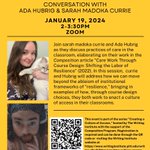
ALT Description: Join sarah madoka currie and Ada Hubrig as they discuss practices of care in the classroom, elaborating on their work in the Composition article "Care Work Through Course Design: Shifting the Labor ofResilience" (2022). In this session, currie and Hubrig will address how we can move beyond the ableism of institutional frameworks of "resilience," bringing in examples of how, through course design choices, they both work to enact a culture of access in their classrooms. Registration and Access info: This event is part of the series "Creating a Culture of Access," hosted by The Writing Institute with the support of the Composition Program. Registration is required and can be done through the QR code or visiting the Writing Institute website at https://www.writinginstitute.pitt.edu/writers-disabilities/creating-culture-access-series. Captions will be provided. Access questions and requests can be directed to Jessie Male at [email protected].


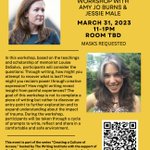
ALT Description of the workshop: In this workshop, based on the teachings and scholarship of memoirist Louise DeSalvo, participants will consider the questions: Through writing, how might you attempt to recover what is lost? How might you reclaim power through creative expression? How might writing reveal insight from painful experiences? The goal of this workshop is not to complete a piece of writing but rather to discover an entry point to further exploration and to expand understanding about the impact of trauma. During the workshop, participants will be taken through a cycle of prompts to write, reflect and share in a comfortable and safe environment. Headshots of Amy and Jessie appear on the poster. Both are white women with long brown hair in outdoor settings. QR code is included on the poster but link is included in the second Tweet. Includes logo of the University of Pittsburgh.

ALT "Alt-Text as Poetry," in an all-caps font designed by artist Finnegan Shannon. Next to the title is a side profile shot of Bojana Coklyat in action at a presentation, arms raised as she speaks to an unseen audience. The workshop will be held on Friday, March 17, 2023, from 11am to 1pm in WPU 527. Workshop description: The Writing Institute invites participants to join artist, writer and disability activist Bojana Coklyat for a workshop based on the workbook Alt-Text as Poetry, developed with Finnegan Shannon. During the workshop participants will reframe alt-text as a type of poetry and practice writing it together. They will look at examples of poetic and creative approaches to alt-text, then do several writing exercises designed to focus on issues that often come up in alt-text, including attention to language and word economy, alt-text as translation, structuring and prioritizing, subjectivity, identity, and representation.


ALT Close Reading The Emergency! poster advertising the next CAAPP Black Study series, which will take place on March 22 featuring Marwa Helal and Quenton Baker, and on March 23 featuring Evie Shockley and Damon Young. More information can be found at this address: https://www.caapp.pitt.edu/events/close-reading-emergency-part-two-black-study-series.


ALT Jay Dolmage next to a slide entitled “steep steps : hillman library” with an illustration of the future hillman library, depicting a large open room with sitting steps for students to gather, sit and work

ALT Jay Dolmage standing next to a projected slide entitled “steep steps : cathedral of learning” depicting the front steps and fountain leading into the cathedral of learning at Pitt.

ALT Image shows author photo, and another of the book Academic Ableism. Date and time and location as listed in Tweet Based on Dolmage's book Academic Ableism: Disability and Higher Education, this presentation will chart the ableist attitudes, policies, and practices that are built into higher education. We will also interrogate the minimal and temporary means we have been given to address inequities, and the cost such an approach has had for disabled students and faculty. We will explore our own ableist biases, apologies and defenses in an effort to build tools for a much more accessible future. There is a QR code that links to The Writing Institute events page. This is part of the series "Creating a Culture of Access." More information about the series can be found via QR code or at https://www.writinginstitute.pitt.edu/writers- disabilities/events. CART will be provided during the event. Access questions and requests can be directed to Jessie Male at [email protected].

ALT Contains information in Tweet, author and book photo. Description: Multimodality. Multiliteracies. These concepts have been championed in scholarship in the discipline of composition, but also across the humanities and across the contemporary university, with extraordinary volume and enthusiasm. This trend has signaled progress in higher education yet has often reproduced old exclusions. So, while the arguments that support these concepts of multiplicity are ambitious, democratic, often incisively careful and critical, and hopeful, this energy does not always lead to inclusive classroom practice. Taking this as a discursive and pedagogical test case, in this workshop I will argue that Universities argue for change through the invention of specific types of (normative, even ideal) student minds and bodies. Together, we will ask: is it possible to argue for educational change without reinforcing the stigma of disability? What other pedagogical movements can be analyzed in similar ways?