
University of Otago. Teaching: security, foreign policy, intel studies. Research: Early Cold War intelligence. Co-Director Otago National Security School
Joined August 2009
- Tweets3.1K
- Following1.4K
- Followers1.8K
- Likes5.6K




Pinned Tweet
"Sure to become the standard reference for anyone seeking to understand the intellectual foundations of American intelligence analysis," says @SecStudies_Jrnl. @IAJournal_CH says it is "meticulously researched" and the @cia journal "an insightful study." shorturl.at/tpaiJ

“…the book complements in useful and sometimes surprising ways well-known previous studies, from Fred Kaplan’s Wizards of Armageddon to Inderjeet Parmar’s Foundations of the American Century.” @fmkaplan @USEmpire @Georgetown_UP

Jervis Forum Review 193: Greg Barnhisel reviews
Peter C. Grace, The Intelligence Intellectuals: Social Scientists and the Making of the CIA.
wp.me/p2Insd-7VH

Peter Grace retweeted

Truman's Evolving Intelligence Needs. With @PeterCGrace and @BowTiedPinto
Peter Grace retweeted
Thank you Peter! You were fantastic and I highly recommend to everyone to pick up your book. Looking forward to having you on again.
amzn.to/3TakGda


Great to catch up with @timgproject and @BowTiedPinto on @CipheredPast. We compared CIA’s intelligence problems of the 50’s with those of today. I also managed to find the time (according to the photo below) to channel Martin Short’s Ed Grimley. Liking the look.
Great to catch up with @timgproject and @BowTiedPinto on @CipheredPast. We compared CIA’s intelligence problems of the 50’s with those of today. I also managed to find the time (according to the photo below) to channel Martin Short’s Ed Grimley. Liking the look.

New Episode of @CipheredPast titled "The Imponderables" with @PeterCGrace and @BowTiedPinto will be available on all streaming services at 6pm est/ 3pm pst.

Peter Grace retweeted
AI's Promise and Peril: A Look into Critical Thinking. With @PeterCGrace
My review of @BenMacintyre1's "Redwood" is in the @nzlistener today. Like Shaun Walker's "The Illegals", it's a terrifically well-researched book that leaves no historical stone unturned. Also a very human spy story: skewiff perspectives, tortured souls and (very) lucky breaks.

Great work from the Otago Vote 2026 team! instagram.com/reel/DdBNIkERG…

Peter Grace retweeted
What would Sherman Kent have made of the AI revolution in intelligence analysis? I spoke to @cenkarslan about the principles that might still hold, the augmented analyst and the motivation for today’s intelligence intellectual to work in national security. teknopolitika.com/p/intervie…

Peter Grace retweeted

🎤 TeknoPolitika’da uzun zamandır yapmak istediğimiz işlerden biri, alanın önemli isimleriyle daha uzun ve derinlikli söyleşiler yapmaktı. Peter C. Grace ile bir söyleşi gerçekleştirmek güzel oldu.
Dr. Grace’in The Intelligence Intellectuals kitabından yola çıkarak Sherman Kent’in dünyasından bugünün yapay zeka destekli analistine kadar uzanan bir sohbet yaptık.
Özellikle istihbarat çalışmaları, AI ve akademi-devlet- özel sektör ilişkisiyle ilgilenenlerin ilgisini çekeceğini düşünüyorum.


🎙️ TeknoPolitika’da ilk röportajımız yayında.
Yeni röportaj serimizin ilk konuğu, "The Intelligence Intellectuals: Social Scientists and the Making of the CIA" kitabının yazarı Dr. Peter C. Grace.
Soğuk Savaş’ın “intelligence intellectuals” kuşağından yapay zeka çağının augmented analyst modeline uzanan söyleşide, Sherman Kent’in “imponderables” (hesaplanamazlar / öngörülemezler) kavramını, insan muhakemesinin geleceğini, AI’ın istihbarat kurumlarını nasıl dönüştürebileceğini ve akademi-devlet-teknoloji şirketleri arasındaki değişen ilişkiyi konuştuk.
Yapay zeka çağında analistin asıl değeri, daha fazla bilgiye sahip olmak mı, yoksa belirsizlik içinde doğru problemi çerçeveleyebilmek mi?
📖 Interview with Peter C. Grace: From Intelligence Intellectuals to Augmented Analysts
Link yorumlarda.

“On the other hand, we see a growing OSINT movement, of which @bellingcat is just one example, which has no allegiance except perhaps to the truth. And there is enough open source data out there still to show that informational power can stay democratic…”
What would Sherman Kent have made of the AI revolution in intelligence analysis? I spoke to @cenkarslan about the principles that might still hold, the augmented analyst and the motivation for today’s intelligence intellectual to work in national security. teknopolitika.com/p/intervie…
“Albert Einstein’s view that he would spend 55 minutes defining and framing the problem and only 5 minutes coming up with a solution. This ability to work with the imponderables in framing and reframing may come to be seen – as George Kennan saw it – as a special human gift.”
What would Sherman Kent have made of the AI revolution in intelligence analysis? I spoke to @cenkarslan about the principles that might still hold, the augmented analyst and the motivation for today’s intelligence intellectual to work in national security. teknopolitika.com/p/intervie…
What would Sherman Kent have made of the AI revolution in intelligence analysis? I spoke to @cenkarslan about the principles that might still hold, the augmented analyst and the motivation for today’s intelligence intellectual to work in national security. teknopolitika.com/p/intervie…
"Grace takes us on a deep dive into the personalities and bureaucratic politics ... examining the push to shape the analytic output of CIA intelligence gathering, processing, and analysis between 1946 and 1949." says @fplantan in History: Reviews of New Books. @Georgetown_UP

Proud to see the Votechat series, started by @bryce_edwards and @JamesMeagerMP now in the very capable hands of Alex Van der Veit and Sophie Bowmar. Great first interview today featuring Sophie, @Nikau_ES and a very charming Chris Hipkins.

Fantastic meeting of intelligence studies people in Sydney at @Macquarie_Uni with MQ @SocIntelHist. Thanks to @melaniebrand68, @briancuddy5 and @aaronbateman22 for organising. Very valuable and hope to do it again soon.

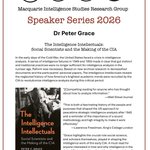
Sydney talk. Looking forward to talking at Macquarie University’s Intelligence Studies Research Group on Wednesday 12 August. Thanks to @melaniebrand68 and @briancuddy5 for the invitation! All welcome. And you can find a copy in the wild at Sydney’s @abbeysbookshop!


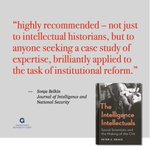
"The enduring achievement of the intel intellectuals," writes @SonjaBelkin in the @IntelNatSecJnl is “the conviction that intelligence analysis could stand as a discipline in its own right, equipped to tackle uncertainty with a scientist’s precision." @Georgetown_UP

Peter Grace retweeted

Part 1
The Intelligence Intellectuals: Social Scientists and the Making of the CIA
By Peter C. Grace
Georgetown University Press, 2026
This book quietly demolishes one of the most carefully maintained myths about the Central Intelligence Agency.
Most people imagine the CIA was born as a hard-edged spy service a place of clandestine operators, codebreakers, and tough-minded realists who understood power. The reality, according to this deeply researched 2026 history, is far more revealing. In its earliest years the CIA was an analytic disaster. It failed repeatedly, publicly, and humiliatingly. And the people who ultimately rescued its reputation and built the analytic system that still shapes American intelligence today were not spies. They were Ivy League professors and social scientists.
Peter C. Grace reconstructs the crisis of 1949–1950 in unsparing detail. The newly created Central Intelligence Agency had already suffered a string of catastrophic misses. It failed to provide timely warning of the Soviet Union’s first atomic bomb test in 1949. It failed to anticipate the Communist victory in China that same year. Then, in June 1950, it failed to warn of the North Korean invasion of South Korea. These were not minor analytical shortcomings. They were strategic shocks that left the Truman administration looking blindsided and the young agency looking incompetent.
Grace shows that the problem was structural. Early CIA leadership never fully absorbed the lessons of the wartime Office of Strategic Services, particularly its Research and Analysis Branch, which had already demonstrated the value of academic expertise during World War II. Instead of building a serious capacity for long-range strategic intelligence the kind of deep, predictive assessment of intentions and capabilities that policymakers actually needed the agency produced a steady stream of low-value current intelligence reports and background papers. Turf battles with the military services and the State Department drained energy. Leadership lacked the stature and bureaucratic skill to defend the agency’s mission. By 1950 the CIA’s reputation as a “warning bell of impending danger” was, in Grace’s words, “greatly tarnished.”
Then came General Walter Bedell Smith.
Smith, Eisenhower’s wartime chief of staff and a man Winston Churchill once called the “American bulldog,” took over the CIA in 1950 with a clear mandate: fix it. He understood that the agency needed more than better spies. It needed better thinking. To get it, he turned to a network of academic social scientists and historians who had already proven themselves in the OSS. The central figures Grace follows are William Langer (Harvard historian), Sherman Kent (Yale historian), and Max Millikan (MIT economist). These men, along with a small circle of like-minded scholars, became the “intelligence intellectuals” of the book’s title.
What they did was radical. They treated intelligence analysis as a serious intellectual discipline rather than a collection of informed opinions or journalistic current reporting. Langer took charge of building the Office of National Estimates, the institutional home of the CIA’s most important product. Kent became the intellectual architect of the new system. Millikan focused on the hard problem of assessing Soviet economic and military resources with the limited information available.

Peter Grace retweeted

thoroughly enjoyed reviewing @PeterCGrace ‘s wonderful book on the ‘intelligence intellectuals’ for @IntelNatSecJnl !
link below


