
Scientist. Inventor of CROP-seq & scifi-RNA-seq. AD @ Arc Institute & Virtual Cell Initiative | CAR T cells
Joined March 2017
- Tweets46
- Following169
- Followers953
- Likes8




Paul Datlinger retweeted

Today in @ScienceMagazine, we report a new DNA editing technology to seamlessly write massive changes into the right place in the human genome.
The reason gene editing hasn't transformed human health is that current gene editing technologies like CRISPR are very limited.
The problem with CRISPR is that it cuts up your DNA, and then hopes that unreliable cellular DNA repair will make the wanted edit. @geochurch famously called it genome vandalism. More precise versions of CRISPR only edit less than 100 bases - often only a single base. Therefore, it's not suited to make large changes safely.
However, most diseases are not the result of mutations in one location. Instead, their causes are spread all across the 3 billion base pairs in the genome.
We found bridge RNAs in bacterial “jumping genes” that allow us to make safe and arbitrary changes (insert, cut out, or flip) to every nucleotide within (up to) a 1 million bp sequence in your DNA.
In the paper, we show that we can correct the disease-causing DNA repeats that cause Friedreich's ataxia (which is a rare neurological disease). The same approach could be applied to Huntington’s and other repeat expansion disorders.
At @arcinstitute, we're working towards a full Turing machine for biology. Evo, our DNA foundation model, helps us design the optimal healthy DNA sequences. And Bridge recombination gives us the ability to seamlessly write these changes into the right place in the genome.
This work was a wonderful collaboration with my @arcinstitute cofounder @SKonermann and led by the indefatigable @ntperry13, alongside our amazing bridge editing team: @BartieLiam @dhruvakatrekar @Gabogonzalez515 @mgdurrant @james_jw_pai @AlisonFanton Juliana Martins Masa Hiraizumi @chiaroscurale @hnisimasu


What if we could universally recombine, insert, delete, or invert any two pieces of DNA?
In back-to-back @Nature papers, we report the discovery of bridge RNAs and 3 atomic structures of the first natural RNA-guided recombinase - a new mechanism for programmable genome design
Paul Datlinger retweeted

Today, Arc announced it is joining forces with @NVIDIAHealth to develop powerful computational tools that will help researchers everywhere explore and understand living systems in ways previously impossible. arcinstitute.org/news/news/a…

Paul Datlinger retweeted
Excited to partner with @Nvidia and @NVIDIAHealth to scale the potential of AI models to design, predict, and understand biology. Our goal is to discover emergent properties of life, similar to those found in language, videos, and robotics
arcinstitute.org/news/news/a…
Paul Datlinger retweeted

Enjoyed writing this perspective on an AI-powered virtual cell with amazing collaborators
But it’s been even more fun actually building it! 🔧
Check out open positions @ArcInstitute or find us @NeurIPSConf

Towards the #AI virtual cell, which would represent one the most extraordinary achievements in life science
cell.com/cell/fulltext/S0092… @CellCellPress @StephenQuake @czi @cziscience @_bunnech

Paul Datlinger retweeted

In collaboration with Reuben Saunders, @JswLab, and Xiaowei Zhuang, we are very excited to release Perturb-Multi: a platform for pooled multimodal genetic screens in intact mammalian tissue.
Check it out!
biorxiv.org/content/10.1101/…

Paul Datlinger retweeted
🧬Evo, the first foundation model trained at scale on DNA, is a Rosetta Stone for biology.
DNA, RNA, and proteins are the fundamental molecules of life—and cracking the code of their complex language is an ongoing grand challenge.
🔬Today in @ScienceMagazine, the labs of Arc Innovation Investigator @BrianHie and Arc Co-Founder @pdhsu explain how Evo captures two fundamental aspects of biology: the multi-modality of the central dogma and the multi-scale nature of evolution. Evo excels at prediction and generation tasks across all of these molecules and their interactions.
An exciting example of what Evo can do: the team used it to design a totally new CRISPR system, including a guide RNA that makes Cas9 cut even better. Evo can also design DNA sequences over one million base pairs in length, reaching the size of many real genomes.
🧠Check out the paper now in Science: science.org/doi/10.1126/scie…

Paul Datlinger retweeted

"If you asked an AI to generate a brand-new drug discovery biotech with a team of some of the biggest names in the biz for you, it couldn’t dream up one like Xaira Therapeutics." fiercebiotech.com/biotech/ne…

Paul Datlinger retweeted

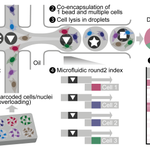
scifi-RNA-seq improves the throughput of droplet-based scRNA-seq up to sequencing millions of cells in a single experiment. @BockLab @CeMM_News nature.com/articles/s41592-0…

Paul Datlinger retweeted

The landscape of human cells! From Guoji Guo's lab- single-cell RNA-seq of 500,000 cells across 60 human tissues. Also includes biological replicates, detailed annotation, and open code/data: nature.com/articles/s41586-0…
Paul Datlinger retweeted

With Fei Chen's lab, we increase Slide-seq mRNA detection 10-fold, transforming what we can discover in these data. It's our last preprint as we prepare to shut down the lab for #COVID19. Time to catch up on #bioRxiv reading! Stay healthy. biorxiv.org/content/10.1101/…

Paul Datlinger retweeted

KB: So today we are pleased to introduce the Chromium Single Cell ATAC + Gene Expression solution. 2 modalities in one simple workflow, both at high sensitivity. #AGBT20
Paul Datlinger retweeted

We wrote the review that I wished I'd had when I started my PhD in gene regulation & genomics! Read for our take on the past 40 yrs of enhancer biology, a def of an "enhancer", and how we think modern tech (like CRISPR screens) will enable the next era of understanding the genome

#Free for 1 month: Towards a comprehensive catalogue of validated and target-linked human enhancers go.nature.com/2O6ezSC #Review by @MollyGasp, Jacob Tome & @JShendure


Paul Datlinger retweeted

Join me @FoGenomics where I'll be talking about the @humancellatlas and our work on single-cell genomics of human T cells #fog2020 #fog #genomicsfest


Dr Cecilia Dominguez Conde chats to FLG ahead of the Festival of Genomics about creating comprehensive reference maps of all human cells. #genetics #immunology #interview ow.ly/LyOO50y5Mvb
Paul Datlinger retweeted
Livestream for our free single cell workshop starts tomorrow at 9:30AM EST. If you're watching online, you can tweet questions using #singlecellgenomicsday, and we'll relay to presenters in the room. See you tomorrow! satijalab.org/scgd

Paul Datlinger retweeted

Ultra-high throughput single-cell RNA sequencing by combinatorial fluidic indexing biorxiv.org/cgi/content/shor… #bioRxiv