

Political Science Research and Methods: The journal of #EPSA (European Political Science Association), edited by John Griffin (@griffin_j_d), published by CUP
Joined November 2012
- Tweets1.6K
- Following751
- Followers10K
- Likes947




🇸🇳Can informal workers be mobilized away from clientelism toward programmatic politics?
➡️@abhitbhandari, Borba & Gottlieb find that priming workers' coordination capacity weakens clientelism, leading to political disengagement, not programmatic support doi.org/10.1017/psrm.2026.10…


🚙Can everyday encounters with foreign brands shape political attitudes?
➡️ @gonzalezrostani & Jude C. Hays find that exposure to foreign car brands raises opposition to trade and immigration and support for Trump among nationalists, but not cosmopolitans doi.org/10.1017/psrm.2026.10…


🏘️ Does racial bias shape opposition to new housing construction?
➡️ @cnbecker14 finds that factorial experiments show little evidence of racial bias, while a list experiment reveals concerns about racial change among a meaningful share of respondents doi.org/10.1017/psrm.2026.10…

🗣️ Can government-led citizens' assemblies strengthen democratic attitudes?
➡️ @MarianaC_Duarte, @JMFernandes86 & M. Pereira leverage random selection to Lisbon's citizens' assemblies and find participation increases knowledge, efficacy and trust doi.org/10.1017/psrm.2026.10…


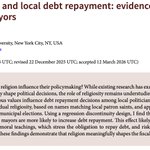
⛪️ Does a politician's religiosity influence their policymaking?
➡️ @Luca_vitalee finds that narrowly elected religious Catholic mayors in Italy increase debt repayment, showing how religious values can shape politicians' fiscal decisions doi.org/10.1017/psrm.2026.10…


🧩 Masking or lexicographic preferences? The same choice patterns can reflect very different processes.
➡️ @SimonCalmar & @MortenHjortskov show how conjoint experiments can distinguish between these two explanations of political choice doi.org/10.1017/psrm.2026.10…


📈 Does the intensity of citizens' policy preferences matter for political representation?
➡️ Zachary Peskowitz & @EddySFYeung find that preference intensity does not reliably predict policy outcomes across US states, even when measured in multiple ways doi.org/10.1017/psrm.2026.10…


🤖 Can transformer-based language models deliver accurate text classification without huge computational costs?
➡️ Cecilia Y. Sui shows how pretrain-finetune models can classify political text with modest labeled data and computing resources doi.org/10.1017/psrm.2026.10…


⚔️ Do wars follow predictable patterns, or are they unpredictable?
➡️ T. Schincariol & @thomaschadefaux use entropy-based analysis to show that conflict fatalities exhibit high levels of randomness, making their dynamics particularly difficult to predict doi.org/10.1017/psrm.2026.10…


🇪🇺 When does the European Parliament use vague language in EU policy negotiations?
➡️ @shurakhokhlova, @NYYordanova & @AnastasiaErsho8 find that the EP is more concrete during inter-institutional conflict, but vaguer when public opinion is divided doi.org/10.1017/psrm.2026.10…


👵 Do pension expansions mobilise older voters?
➡️ @GanslmeierM, M. Klymak & T. Vlandas find that a 36% pension increase in Illinois had no effect on turnout, challenging expectations that material gains increase political participation doi.org/10.1017/psrm.2026.10…


📰 How should researchers debrief participants after exposing them to misinformation?
➡️ @EmmaHoes93 & @Sacha_Altay show that debriefings with fact-checks reduce belief in false claims, while general warnings may increase skepticism toward true news doi.org/10.1017/psrm.2026.10…


🧪 Can measuring racial attitudes before a survey experiment bias its results?
➡️ Leah Christiani, Nathan Kelly & Jana Morgan find little evidence of treatment bias overall, but show that stereotype endorsement measures are an important exception doi.org/10.1017/psrm.2026.10…


🗳️ How does far-right terrorism affect support for the far right?
➡️ Studying anti-Roma attacks in Hungary, Simonovits et al. find that Jobbik gained 11-14 pp more support in attacked villages, with effects persisting and spreading to nearby areas doi.org/10.1017/psrm.2026.10…


🏛️ How does patronage shape communication within government bureaucracies?
➡️ Employing rare new data from China, @jee_haemin & @Kaiping_Chen find that patronage ties increase upward information flows, but not public-facing performance and responsiveness doi.org/10.1017/psrm.2026.10…


🏛️ Do caretaker governments really stop making policy?
➡️ Using original data on government bills from 238 cabinets in Western Europe, Mingyi Zhang shows that caretaker governments remain active policymakers during government transitions doi.org/10.1017/psrm.2026.10…


🌍Why do people support the democratic peace?
➡️In this new article, @imjuhokim revisits a recent embedding analysis and finds that it is associated with racial and ethnocentric motivations, and offers guidance for embedding analysis in political science cambridge.org/core/journals/…


📈 How do people update their perceptions of the economy?
➡️ Derek A. Epp and @CBWlezien show that people interpret the same economic changes differently depending on their prior perceptions, suggesting that public opinion is shaped by benchmarking cambridge.org/core/journals/…


🤝 Do parties reward allies or recruit rivals for cabinet?
➡️ A. Herzog and D. Schmuck show that, rather than favoring moderates, parties prefer loyal MPs: strong government defenders and fierce opposition critics are more likely to become ministers cambridge.org/core/journals/…


🌐 What shapes high-end cooperation among militant groups?
➡️ Using network data on 53 groups in Northeast India, @ilaydaonder shows that cooperation is more likely between groups with complementary capabilities and distinct constituencies. cambridge.org/core/journals/…

