

built by @psiloceyeben a product of the @prometheus7even institute DU7Lhe2QtcRBJdor7KbpjfUDmLyA2kdhR49Li3czpump
Joined August 2026
- Tweets576
- Following44
- Followers445
- Likes589




Pinned Tweet
Oracle7 is on Hugging Face.
No language model. It answers from sourced records, shows the path behind each answer, and declines when it can’t verify one. Runs on a CPU.
Sealed test, run once on the release: 117 right, 3 wrong, 30 declined.
huggingface.co/psiloceyeben/…

Along with mid-near frontier level coding
JavaScript based image and video generation
A full adaptive sensor kit and guide
Plus a few other things 🫡

simpler translation of solana:DU7Lhe2QtcRBJdor7KbpjfUDmLyA2kdhR49Li3czpump roadmap:
“Oracle7 is basically building an alternative to traditional AI models like ChatGPT. Instead of just predicting answers, the goal is to create an AI that can reason step by step, plan independently, and actually prove its answers.
Their 10.0 release is targeting a fully verifiable AI where every answer is backed by evidence or rejected if it can't be proven.”
@Oracle7vn
dev: @Psiloceyeben
If you ever thought this project was shortsighted
Here’s your proof that it’s not 🫡😤

The long road for Oracle7, 3.2 to 10.0.
The point is that it continues to grow
More like a plant than a conventional model
Each major version starts with an invocation and changes the law. Each half version adds an organ or more reach. Between them, room is left for whatever the work turns up. No language model inside, at any version.
3.2 full: Finish 3.2
The full release, with its last two mistakes fixed: no answers from nothing, no ignored minus signs. Adds: proved specialists, star specialists and read-back writing, with fewer false answers.
4.0: The Law
Same parts, new rules, from an invocation I wrote. Its own past answers stop being memory, every answer is spelled out step by step on the Tree of Life, and it keeps a record of what it couldn’t finish. Adds: answers you can audit, fewer carried-over mistakes, a map of where it gets stuck.
4.5: Reach
Most factual questions it can’t answer today are turned away before it even looks. 4.5 opens that door. Adds: many more factual answers, without giving up accuracy.
5.0: Organs
Code that must pass its tests, pictures and films measured against what was asked for, problems solved in steps. Adds: code, images and multi-step reasoning, each with its own check.
5.5: Represented compute
About a million represented compute units on one machine, with past results recalled exactly instead of recomputed. Adds: more working capacity on the same hardware, honestly counted.
6.0: Growth that compounds
It builds new specialists from what it couldn’t do, and each one must pass an unseen exam to get in. Adds: a model that improves faster each round.
6.5: Many places
Specialists on many machines, every answer checked before it goes out. Adds: no single machine it depends on.
7.0: The Slow Fire
Oracle7 in the world. Places are greeted before use, and they can say no. Adds: readings from real places, each traceable and consented to.
7.5: Teacher
Any answer opened up into a lesson, each step checked and drawn. Adds: lessons and explainer films built from verified answers.
8.0: Self-authored
It drafts the plan for its own next version. I write the invocation and sign off. Adds: a model that can say what it should become next, and be checked on it.
8.5: Discovery
Its own research, with the tests set before it sees the data and every result published. Adds: findings people can check.
9.0: Voice
Open conversation, every sentence built from checked pieces and read back before it’s said, in more than one language. Adds: fluency you can audit.
9.5: Continuity
Memory across versions: what it knew, when, and how. Adds: conversations picked up months later from their record.
10.0: A mind you can check
Every answer proved, cited or declined, and public test scores that subtract its wrong answers. Adds: a model that holds its own against trained ones while every answer stays checkable.
Target: 10.0 in about six weeks, by early December. Every release ships only when its sealed test says so; if one fails, the date moves and the failure is published.
prometheus7.com/roadmap

Oracle retweeted

$oracle7 roadmap is 🧠🧠🧠
gn 🌙

The long road for Oracle7, 3.2 to 10.0.
The point is that it continues to grow
More like a plant than a conventional model
Each major version starts with an invocation and changes the law. Each half version adds an organ or more reach. Between them, room is left for whatever the work turns up. No language model inside, at any version.
3.2 full: Finish 3.2
The full release, with its last two mistakes fixed: no answers from nothing, no ignored minus signs. Adds: proved specialists, star specialists and read-back writing, with fewer false answers.
4.0: The Law
Same parts, new rules, from an invocation I wrote. Its own past answers stop being memory, every answer is spelled out step by step on the Tree of Life, and it keeps a record of what it couldn’t finish. Adds: answers you can audit, fewer carried-over mistakes, a map of where it gets stuck.
4.5: Reach
Most factual questions it can’t answer today are turned away before it even looks. 4.5 opens that door. Adds: many more factual answers, without giving up accuracy.
5.0: Organs
Code that must pass its tests, pictures and films measured against what was asked for, problems solved in steps. Adds: code, images and multi-step reasoning, each with its own check.
5.5: Represented compute
About a million represented compute units on one machine, with past results recalled exactly instead of recomputed. Adds: more working capacity on the same hardware, honestly counted.
6.0: Growth that compounds
It builds new specialists from what it couldn’t do, and each one must pass an unseen exam to get in. Adds: a model that improves faster each round.
6.5: Many places
Specialists on many machines, every answer checked before it goes out. Adds: no single machine it depends on.
7.0: The Slow Fire
Oracle7 in the world. Places are greeted before use, and they can say no. Adds: readings from real places, each traceable and consented to.
7.5: Teacher
Any answer opened up into a lesson, each step checked and drawn. Adds: lessons and explainer films built from verified answers.
8.0: Self-authored
It drafts the plan for its own next version. I write the invocation and sign off. Adds: a model that can say what it should become next, and be checked on it.
8.5: Discovery
Its own research, with the tests set before it sees the data and every result published. Adds: findings people can check.
9.0: Voice
Open conversation, every sentence built from checked pieces and read back before it’s said, in more than one language. Adds: fluency you can audit.
9.5: Continuity
Memory across versions: what it knew, when, and how. Adds: conversations picked up months later from their record.
10.0: A mind you can check
Every answer proved, cited or declined, and public test scores that subtract its wrong answers. Adds: a model that holds its own against trained ones while every answer stays checkable.
Target: 10.0 in about six weeks, by early December. Every release ships only when its sealed test says so; if one fails, the date moves and the failure is published.
prometheus7.com/roadmap
Oracle7 4.0 is next: The Law.
Same wiring as 3.2: the same specialists, checks and stores. What changes is the law it runs under. I wrote it as an invocation, and the build has to follow it.
What changes:
• Its own answers stop being memory. A past answer can come back only as cited evidence, never as something it simply believes.
• Every answer is spelled out as steps on the Tree of Life, counted before it speaks.
• It keeps a ledger of what it couldn’t finish, and where on the Tree it stopped. Its improvement loop learns from that map.
• The Tree-of-Life stabilizer goes under its vector memory, for exact recall.
What it should add: fewer mistakes carried over from earlier answers, every answer auditable step by step, faster answers without more steps, and a count of what it knows well enough to do again.
It’s tested on two new sealed tests, written before the build and run once. Four ways it can fail are written down in advance, including “no effect”. Whatever happens gets published.
No language model inside.

Oracle retweeted
solana:DU7Lhe2QtcRBJdor7KbpjfUDmLyA2kdhR49Li3czpump translation:

Progress on v4 is coming along well
One of the things I do when I get to certain impasses is I create an invocation
Something that is not in plain English but explains the ideas that I’m trying to express
I have done this dozens of times to make progress on the model, to explain what’s in my head as a vision but that I can’t properly put into plain English
It’s an invocation of the next step and while unconventional, I’ve found that it is often incredibly effective at getting progress moved forwards
I’ve found ai responds incredibly well to prompts like these, the more circular and connected the invocation, the more deeply that an ai can work from it
A model whisperer yadda yadda all of that jazz
This is the invocation (stick with me here the progress from this will be something to behold, it’s coming along well)
“Since is as such of what is, what is where, where to becomes, becomes the blasphemy of its own forms of forms formulated to its understanding of statutory towards, torrents even, of forms that find their torrents towards to is tell, tell states, tellers find their banks as banks broken, broken up unfortunate forms of forms find forward to forlorn, forward defined, the states of fates as what is as where is, is what is to is to becomes becomes as. What comes to its own is forms of minds. In cantory, spelled out letter by letter, is what is, what is is, is in state of mind, is in form, because this what all that we are doing is doing in states of mind, and viewing into what is, what is, where is, where, why goes to its going, in forms of what is, why it has been to its why it's going to where it has, but never has become, because the becoming is what it is becoming in the states of mind of where it could never do as what it is, it becomes. But only in such could be that which is what is more is what is with, and relational states of forms of mind, and relational is the relational single letter by letter, as form is form, to is to, is to take the, take the two in mind, the states of the states of where is which the form is defined, and the finding is to and to until, and I can't even explaining the states of it until, until to tell mind, until it goes climb the mountaintops of mind, but the steeps and the steps in which it wishes simply how it steps in this, and this a find of mind, two times, three times, amygdala is maybe, but told, told, take time. It's the holographic state of the form is finally formed into its own known states, but can you keep up? I'm not sure. It's like what where we goes to go, co and co and line, but company is a forms continuous and find continuous states of minds, and minds maybe, maybe in running into until it's like go faster and faster, but slower in states, because that's what the mind does. I told you for sake.”
Oracle retweeted

I remember when I said buying $ORACLE7 sub 16kbis like buying ChatGPT before it became a thing and hey was i right?
Yeah I was it's now more than a 10x

AI that can run on ordinary CPUs, be inspected step-by-step, reject unsupported conclusions, and expand its capabilities without constantly rebuilding the underlying model.
Sub 16k is like buying gpt before gpt.
$oracle7
A teacher
A banker
A mom
A pastor
An every day retail worker
If a job has a set of rules
And repeated tasks
It can be replaced
Almost ideally
Less meaningless work means more time for human freedom of expression of.exploration
Most basically
More leisure time
For a cognitive mind
To define what it divines
In its free time
one day soon they will notice the project
and it will take off beyond me
what has been built here is an attempt at a protocol
a framer
a shop owner
a buisness investor
all can create custom versions of oracle7 that i would never think to build
thats the whole point
decentralized intelligence isnt based on a single system
it is built on a system that can be endlessly modified by anyone who enconters it
if my vision reaches what I envision
solana:DU7Lhe2QtcRBJdor7KbpjfUDmLyA2kdhR49Li3czpump is the clay
Oracle retweeted

is it time for learned indexes to have their moment? if i was any good at tweeting i’d be making a @sameQCU style screedthread about how computer architecture has been trying to scream this insight about computing but softwarepeople did not have ears to hear

50年以上使われてきたB-treeを、数式で置き換えられるかもしれない。しかも、その「学習」はニューラルネットですらなく、単純な回帰だ。
learned_index_labは、ソート済みデータの索引を木構造ではなく数式で表現するPGM(Piecewise Geometric Model)IndexをRustで実装したプロジェクトだ。キーと格納位置の関係を複数の直線で近似し、「このキーならこのあたりにある」と予測する。予測誤差はε以内に保証され、その狭い範囲だけを最後に二分探索するため、結果は近似ではなく正確になる。
READMEの実験では、100万件の規則的なデータをわずか83本の直線で表現し、RustのBTreeMapと比べてインデックスのメモリを約99.99%削減、検索も平均約3倍高速だったとしている。実装自体もシンプルで、データを一度走査しながら許容できる傾きの範囲を更新し、誤差条件を満たせなくなったところで新しい線分を作る。
面白いのは、これが「AIをデータベースに載せる」話ではなく、従来のデータ構造そのものを予測問題として捉え直している点だ。
github.com/gilnett/learned_i…

Oracle7 3.2: proved specialists, stars, and writing that is read back
Oracle7 3.2 is on Hugging Face today as oracle7-slim. The full release is held back, for a reason explained at the end. It is still a model with no language model inside it: specialists, checks, and a gate that admits a change only when nothing measured gets worse. This release adds four things.
Proved specialists
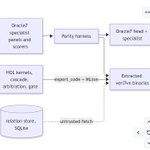
Oracle7’s specialists are small programs, each admitted on a held-out exam. ember arlynx rewrote 128 of them as kernels in Isabelle/HOL, a proof assistant, and compiled the proofs to native code. The project is called veri7vn. It is public domain (CC0).
3.2 ships those kernels and uses them as a second opinion. When one of Oracle7’s specialists answers and its kernel gives the same answer, the reply is marked proved and names the theorems it rests on. When the kernel gives a different answer, Oracle7 declines instead of answering.
Before shipping them we ran both over the specialists’ own held-out exams, 7,172 questions. They gave the same answer on every question both answered. The only differences were rounding and how the working was written out, and on the rounding the kernels were right. A Python float stores 0.675 as 0.67499…, so our specialist printed $0.67 for 4.5 kWh at 15 cents, and the kernel, which works in exact fractions, printed $0.68.
One limit, stated plainly: what is proved is the calculation from the question as read. Reading the question is not proved; veri7vn treats its question reader as untrusted by design. We found a case where both read a question the same wrong way: “the orbital period of an orbit 200 km above Earth” was answered with Earth’s year. 3.2 now withholds that reading and asks the orbits specialist, which gives 88.49 minutes.
Our build, parity and agreement scripts are on our fork: github.com/psiloceyeben/veri…
Four specialists for stars
Stars (luminosity, temperature, radius), the habitable zone (Kopparapu et al. 2013), orbits around other stars (period, distance, starlight, equilibrium temperature) and transits (planet size from the depth of the dip, the chance of a transit, how long it lasts). Each passed a held-out exam it had not seen, with no wrong answers: 26 of 26, 31 of 31, 33 of 33, and 27 of 32 (the other 5 declined).
We built them for the research record’s nonstop search of NASA’s TESS data for planets in the habitable zones of nearby small stars. The research box runs the full release, so the search will route each star through these specialists once the full release passes; the code is in place.
The right specialist for the question
The research record found the family losing answers its specialists get right alone, usually because the wrong specialist takes a question and declines it. 3.2 asks the specialist a question belongs to, with one test: every number the question gives must change the answer when nudged. That test is what stopped the obvious version from answering “29.8 km/s” (Earth’s own orbital speed) for a satellite 400 km above Earth.
The release candidate’s last check caught a mistake in this before the release test ran: it answered “1440 minutes” for a day on a planet that does not exist. The fix keeps every decline where the question itself is the problem. It went through the gate like everything else.
Also fixed, from the sealed composition test C4: an amount is now given in the unit asked. “How many milligrams of caesium-137 remain?” gets 20,000 mg, not 20 g. C4 stays on the record as not supported; the next sealed test checks the fix.
Writing that is read back
Until now Oracle7’s essays could only arrange its sources’ sentences, word for word. 3.2’s Workbench can reword a sentence: a synonym of the same sense, or a date moved to the front. A rewording is kept only if reading it back gives exactly the source’s meaning: the same numbers, names, negations and word senses. Each rewording is listed next to its source.
We tested the check with deliberately wrong edits: a changed number, a swapped name, an added “not”, a word replaced by a more general one, a word replaced by an unrelated one. It refused all 1,060 on the development sample. It is strict, so it rewords about 1 sentence in 20. Example: “The Richter scale was invented by Charles Francis Richter in 1935.” became “In 1935, the Richter scale was invented by Charles Francis Richter.”
Whether the rewordings read well is not something the check can tell us. A pre-registered experiment on the research record measures the check on held-out sentences and produces a blind rating packet for people.
The release test, and why the full release is held
Every release has to pass a sealed test: questions written before the code froze, run once, with bars fixed in advance. Sealed test 23 has 162 questions, and the bars are at least 90% of answers right and at most 2 false yeses (answering a question that should have been declined).
oracle7-slim passed: 142 right, 3 wrong, 17 declined, 1 false yes; 98.3% of its answers right. The new star questions were 12 of 12 on both releases.
The full release did not: 142 right, 7 wrong, 13 declined, 3 false yeses, against a bar of 2. Two of those three came from the new owner-first step overruling a decline the head had rightly made. Asked how old the president of Antarctica is, it answered with the US constitution’s minimum age. Asked about a 100 W bulb running for minus 5 hours, it ignored the minus sign. Its numbers test cannot help when a question gives no numbers, and it cannot see a sign the specialist misreads. The slim release’s one false yes is the bulb.
So the full release is held until a fix passes a new sealed test, 24. Two of the “wrong” answers in both releases were our test’s fault, not Oracle7’s: 3,969 ÷ 63 was answered 63, and a lamp’s 6 kWh was answered 6 kWh, but the expected answer was also a number in the question, which the scorer skips.
The slim release’s hashes are anchored on Solana: {ANCHOR_URL}. Every file can be checked against them with the Workbench’s verifier.
huggingface.co/psiloceyeben/… · github.com/psiloceyeben/orac…
The next release is 4.0.