

This Knowledge (Nonduality) is the king of all knowledge and the king of secrets. ~ Bhagavad Gita 📩 Enquiries: https://xitter.cf/t.co/QpxN316wLO
Joined September 2019
- Tweets3.2K
- Following4.6K
- Followers4.3K
- Likes11.6K




Pinned Tweet
The understanding of reality varies in degrees of abstraction. All knowledge is a graduated training of the mind. From the perceptible and concrete, we gradually refine our understanding to more abstract and higher levels of knowledge.

The Method.
"The knowledge of the Supreme Reality [i.e. Nonduality] is extremely hard to attain" (Shankara's commentary on the Mandukya Upanishad). Therefore, a method is required. Prakriyas (means "method" in Sanskrit) are the awakening teachings of Vedanta, designed to guide students to the experiential understanding or direct realization of the non-dual nature of reality.
Continue reading 👉 nonduality.net.co/method/
'What am I?' is the fundamental question of all philosophy and psychology. Go into it deeply. Find out your real being.
Your consciousness is raised to a higher dimension, from which you see everything much clearer and with greater intensity.
~Nisargadatta.

Nonduality | Advaita retweeted

“That which imparts form to forms is itself formless; therefore Tao cannot have a name.”
— Zhuangzi

Nonduality | Advaita retweeted

You have to ask yourself the question `Who am I?' This investigation will lead in the end to the discovery of something within you which is behind the mind. Solve that great problem and you will solve all other problems.
Ramana Maharshi
Nonduality | Advaita retweeted
Since the entire universe is within the mind, the notions of bondage and liberation are also within it. The pure mind is free from latent tendencies, and therefore it attains self-knowledge.
Yoga Vasishta
Nonduality | Advaita retweeted
INDIRECT VS DIRECT KNOWLEDGE
Advaita Vedanta distinguishes between indirect and direct knowledge.
Indirect knowledge (paroksha jnana) is intellectual understanding.
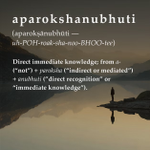
Direct knowledge (aparoksha jnana or aparokshanubhuti) is experiential, nonconceptual understanding/apprehension
True understanding is intuitive (non-conceptual) apperception.
Comprehension at the mind level means only
conceptualization and, therefore, is totally illusory.
Do understand please, the difference between
such conceptualized knowledge and the intuitive apperceiving which is not at the conceptual level.
Indeed, apperceiving is whole-seeing or in-seeing, which is vitally different from mere intellectual
seeing. Once there is apperception, the duality of counterparts, the basis of mere intellectual
comprehension, totally disappears. There is no question of any 'one' thinking that he has understood
something by the use of reasoning and logic.
True understanding is spontaneous apperception,
intuitive and choiceless, and totally non-dualistic.
~Nisargadatta.
Characteristics of a Qualified Teacher
Shrotriya and Brahmanishta are the two essential requirements of a teacher (MU 1.2.12 and Shankara's Vivekachudamani)
1. Shrotriya is someone who is well versed in the teaching (Shruti) and knows the methodology to guide the student 🧵⬇️
1
12
534

The person is never the subject. You can see a person, but you are not the person. You are always the Supreme which appears at a given point of time and space as the witness.
-Nisargadatta.


Nonduality | Advaita retweeted

Lama Surya Das
“The secret, or innermost, level of wisdom is pure intuition, clarity, lucidity, innate wakefulness, presence, and recognition of reality. This transcendental wisdom is within all of us—it just needs to be discovered and developed, unfolded and actualized.”
godbrahmanistheoceanoflovean…

Nonduality | Advaita retweeted

You look round without understanding and take appearances for reality. You believe you know the world and yourself — but it is only your ignorance that makes you say: I know. Begin with the admission that you do not know and start from there.
The Self alone exists. When you try to trace the ego, which is the basis of the perception of the world and everything else, you find the ego does not exist at all and neither does all this creation that you see.
~Ramana Maharshi.
Nonduality | Advaita retweeted
Q: Where do you live?
Nisargadatta: In the void beyond being and non-being, beyond consciousness. This void is also fulness; do not pity me. It is like a man saying: ‘I have done my work, there is nothing left to do’.
I Am That, Chapter 78
Nonduality | Advaita retweeted
The absence of intentions (because there is no one to have them) is true understanding. When no individual exists, what remains is enlightenment.
Ramesh Balsekar
Nonduality | Advaita retweeted
Some people call this God's grace but there is more to it than that. You had to be in this thing in a previous life. You did your Sadhana, you did your spiritual exercises, your spiritual practices in a previous existence and you're now waking up.
Robert Adams
