

Science info from NSF NOIRLab: the U.S. national center for ground-based, nighttime optical & infrared astronomy. Main channel is at @NOIRLabAstro
Joined March 2023
- Tweets838
- Following46
- Followers636
- Likes606





NOIRLab Science retweeted
Well, that went by fast 👀
NSF @NOIRLabAstro is turning 7!
In 2019, observatories and programs across Chile, Arizona, and Hawaiʻi came together under NSF NOIRLab as one national center for nighttime astronomy.
Here’s to our amazing staff who make it all possible! 🎉
NOIRLab Science retweeted
We rate this image ⭐️⭐️⭐️⭐️⭐️⭐️⭐️
NSF–DOE @VRubinObs joins the epic Pleiades star cluster in this 📸, created by stacking 20 background and 10 foreground images.The 7 bright stars of the asterism are clearly visible.
📸NSF-DOE @VRubinObs/NOIRLab/SLAC/NSF/DOE/AURA/H. Stockebrand

NOIRLab Science retweeted
Are you passionate about astronomy, observational science, and advanced instrumentation?
We are seeking an Assistant Queue Observer in Tucson, Arizona to support operations of the NEID spectrograph.
Apply here: ow.ly/2OV350ZQkr4

NOIRLab Science retweeted

☀️ Sun: Throws a 4.5 billion-year party.
☄️Comet 3I/ATLAS: Gatecrashes at 153k mph.
This Gemini South image gives us a rare glimpse into an ancient, alien star system.
📷 International @GeminiObs/NOIRLab/NSF/AURA/B. Bolin, J. Miller, M. Rodriguez, T.A. Rector and M. Zamani

NOIRLab Science retweeted
📖 NSF NOIRLab’s Year in Review 2025 is here. From NSF-DOE @VRubinObs’s First Look to new DESI results and discoveries around Barnard’s Star, explore a year of astronomy, technology, and cosmic surprises 🌌 bit.ly/4vvExRW
📷: NOIRLab/NSF/AURA

NOIRLab Science retweeted
This is just part of what’s on this mountain ✨🔭
For 61 years, NSF @CerroTololo in Chile has been observing the night sky. This panoramic view captures several of its telescopes under a sky split by the Milky Way.
Credit: CTIO/NOIRLab/NSF/AURA/P. Horálek

NOIRLab Science retweeted
Baby stars ✨🍼
NGC 7129 is a star-forming region and reflection nebula in the constellation of Cepheus. The stars in this nebula are only about a million years old, which is extremely young on astronomical timescales.
📸 WIYN/NOIRLab/NSF/AURA/T. A. Rector & H. Schweiker

NOIRLab Science retweeted
🛠️❄️ Every couple of years, Flamingos-2 comes down for a little maintenance break.
This instrument at the Gemini South telescope is spending a few weeks in the lab for the replacement of its cryocoolers and checks on components.
📷 @GeminiObs/NOIRLab/NSF/AURA/S. Olivares


NOIRLab Science retweeted

🔭 Planning a trigger at @GeminiObs? Want to check available instruments and get a quick look at current conditions?
👀 Take a peek at the Gemini North & South Status pages before you go!
🔗 noirlab.edu/science/programs…
Stay ready, stay informed. 🌌 @NOIRLabScience

ALT Screenshot of the US National Gemini Office “Site Status” section. The page links to Gemini North and Gemini South status pages, showing preview images of each site’s live status dashboard. Each dashboard includes sky camera views, current weather and site conditions, available instruments, telescope status, and seeing or cloud information, helping observers quickly check conditions before planning a trigger at Gemini Observatory.
NOIRLab Science retweeted
The spectrum of the binary star system Eta Carinae is seen here like a rainbow, stretching from ultraviolet to infrared. Spectra like this can tell scientists detailed information about an object’s chemical composition, motion, rotation & distance.
📷: CTIO/NOIRLab/SOAR/NSF/AURA

NOIRLab Science retweeted
Are you dizzy yet? 😵💫
Star trails in this extra-long-exposure image of NSF–DOE @VRubinObs capture the apparent motion of the stars.
Rubin will observe about 17 billion stars during its 10-year survey.
📸 NSF-DOE @VRubinObs/NOIRLab/SLAC/AURA/H. Stockebrand


NOIRLab Science retweeted
Introducing The Scope: NSF NOIRLab’s NEWEST publication!
The Scope illuminates the possibilities for early-career professionals looking to work in astronomy and shows the passion behind scientific research.
Read here 🔗 bit.ly/4tiFOdv


NOIRLab Science retweeted
This 📸 of Pickering's Triangle was taken with the NSF Mayall 4-meter Telescope at @kittpeaknatobs. Astronomers estimate that the supernova that made this nebula happened ~5000–10,000 years ago.
📸 WIYN/NOIRLab/NSF/AURA/T.A. Rector (University of Alaska Anchorage) & H. Schweiker

NOIRLab Science retweeted
Two telescopes, one mission to explore the sky. From Hawai‘i to Chile, the International @GeminiObs, operated by NSF NOIRLab, can see almost the entire sky.
📷: International Gemini Observatory/NOIRLab/NSF/AURA/Kwon O Chul (Gemini South, on left) P. Horálek (Gemini North)

NOIRLab Science retweeted
Let me take my Sombrero 🤠
About 30 million light-years away in the constellation Virgo, this striking galaxy spans ~50,000 light-years. The Sombrero Galaxy is one of the most iconic members of the Virgo Cluster.
Credit: @cerrotololo/NOIRLab/DOE/NSF/AURA

NOIRLab Science retweeted
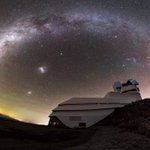
🎶 SOAR in the sky with diamonds 🎶
Stars shine like diamonds through thin clouds above the SOAR Telescope on Cerro Pachón in Chile. SOAR is among the foremost research facilities available to astronomers in the southern hemisphere.
📷: NOIRLab/NSF/AURA/P. Horálek
NOIRLab Science retweeted
Looks like a rainbow, but it’s actually the Sun broken into its ingredients 🌈☀️
This high-res spectrum reveals sunlight spread by wavelength, with dark lines marking where elements absorb light.
Captured with a FTS at NSF @KittPeakNatObs.
📸 N.A. Sharp/KPNO/NOIRLab/NSO/NSF/AURA
