

The US NGO (@NOIRLabScience) supports US @GeminiObs users in the stages of the astronomical observing cycle, from proposal to data reduction.
- Tweets3.7K
- Following556
- Followers1.5K
- Likes2.4K
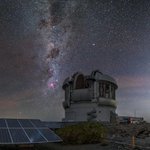







ALT This image of the Gemini South telescope is so bright that it is hard to believe it was captured at night. Gemini South is the southern half of the international Gemini Observatory, a Program of NSF NOIRLab. The wedge-shaped light on the right side of the photo is not from an artificial source (although there are city lights below it), but is a natural phenomenon known as zodiacal light. This occurs when sunlight scatters off dust particles in the plane of our Solar System, illuminating part of the sky after sundown or before sunrise. The zodiac is a belt-shaped region of the sky, as seen from Earth, and the apparent path of the planets. Gemini Observatory is named after one section of the zodiacal belt: Gemini, the constellation of the Twins.


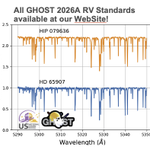
ALT A four-panel line graph showing spectral flux versus wavelength in micrometers. The y-axis on all panels is labeled "Flux F_lambda 10^(-17) W/m^2/micron" and the x-axis is "Wavelength micron". Each of the four panels focuses on a different wavelength range (approximately 0.95-1.1, 1.2-1.35, 1.5-1.65, and 2.0-2.2 microns). The graphs contain multiple colored spectral lines (black, red, cyan, and light gray) displaying various peaks and troughs. Text labels with chemical formulas are placed above specific spectral features across the panels, pointing out the absorption or emission bands of H2O, NH3, H2, and CH4, often appearing in combinations (e.g., NH3+H2, H2O+NH3) at their characteristic wavelengths.

ALT A dense image of a crowded star field against a dark background. Thousands of stars of different sizes and hues fill the frame, ranging from soft, pinpoint orange and reddish stars to luminous cyan and blue-white stars. Several of the brightest blue stars feature distinct four-pointed diffraction spikes extending outward, with two particularly prominent bright stars located near the top right. This image captures the stellar field surrounding the host galaxy of gamma-ray burst GRB 250702B.


ALT A large, face-on spiral galaxy, IC 5332, dominates the left side of the image against the deep blackness of space. The galaxy features a glowing, compact yellow-white central core with delicate, feathery spiral arms winding gracefully outward. These symmetric arms are intricately laced with dark dust lanes and dotted with vibrant pink and purple clusters of active star formation. The surrounding background is densely populated by a "blizzard" of countless smaller, distant galaxies of various shapes, sizes, and brightnesses, alongside a few prominent, brilliant foreground stars.

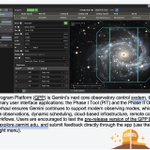
ALT A monochrome, face-on astronomical image of a grand-design spiral galaxy with a bright central nucleus and intricate, winding spiral arms set against a dark backdrop. Overlaid across the entire galaxy are dozens of green annotations. Each annotation consists of a small green circle with an adjacent green number. These numbered green markers are scattered throughout the galactic core, inner dust lanes, and outer star-forming regions, indicating specific targets or astronomical features for study.

ALT A deep space composite image from Gemini North and ALMA showing a gravitational lens against a pitch-black background. At the center is a bright, glowing reddish-orange foreground galaxy. Wrapping tightly around the top of this central galaxy is a thin, curved yellow-gold arc of light, which is the distorted, lensed image of a more distant star-forming galaxy nicknamed 'Shadow Blaster.' Directly to the lower right of the main red galaxy sits a small, distinct, bright blue cosmic object. A few other faint, blurry orange and reddish background galaxies are loosely scattered in the upper-left and lower-left areas of the frame.

ALT Two-panel astronomical image illustrating gravitational lensing. Both panels feature deep-space views overlaid with red contour lines indicating critical curves, along with compass arrows (N, E) and a 1-arcsecond scale bar in the bottom right corners. The left panel shows a central bright orange galaxy enclosed by a red loop, with multiple tightly packed, elongated lensed arcs labeled A1–D1 and A2–D2 in the lower left. The right panel displays an elongated red loop stretching across a field containing several bright yellow galaxies. It features multiple distinct blue-white lensed arcs labeled A1–C1, A2–C2, and A3–C3 distributed around the loop, as well as an inner source labeled A4–C4.