

Consultant Perf Scientist/ S&C. PhD Neuro-Muscle-Tendon Adaptations to Resistance Training 🏋♂️ https://xitter.cf/t.co/DCa8kraGfX
N. Ireland
Joined September 2013
- Tweets3.2K
- Following739
- Followers2.4K
- Likes3.4K





Pinned Tweet
🚨🚨 Interested in ⬆️ mechanical properties of tendons? 🚨🚨
Please see below for a 🧵 on why strain magnitude is an important factor
based off my recent review journals.lww.com/nsca-jscr/A…
🔥🔥Chest Hypertrophy Tip 🔥🔥
Load up heavy in the mid-range. Huge torque profile due to length-tension r'ship and mechanical advantage overlap (and bit of passive tension in there also).
#hypertrophy
A lot to get through in part 3 – apologies it’s a long one!
Stiffness & RFD, research limitations, representative 'sprinters' in research?.. and where does the increase in stiffness come from?
🏃♂️⛓️💪
See below here @LinkedInHelp – at Hillhall, Northern Ireland

Hey @LinkedIn
Why are you trying to coerce me to provide you with a government ID and facial picture to access my account? Ive 2 factor authentication in place yet you've frozen me out and forcing me to comply to access my account. Unfreeze this immediately please

Hey @LinkedIn
Why are you trying to coerce me to provide you with a government ID and facial picture to access my account? Ive 2 factor authentication in place yet you've frozen me out and forcing me to comply to access my account. Unfreeze this immediately please – at Hillhall, Northern Ireland
Dr. Gerard McMahon retweeted

Chris Beardsley has always been and always will be a social media guru with no skin in the game.
Dr Gerard coming in hottttttttt
"Sprinters have the same tendon stiffness or are more compliant than untrained controls?"
Sure - if you cherry-pick weak data and misunderstand tendon biomechanics
The usual awful stuff from Chris Beardsley here.
So this is Part 1 of a 3-part video @lahti_johan @GregLehman
Does a compliant tendon store ⬆️ energy than a stiffer one? Apparently the S&C profession are getting it wrong by ⬆️ tendon stiffness. Also, apparently compliance leads to quasi-iso contractions
So who actually knows about how tendons store energy & how the MTC functions in 🏃♂️?
"Sprinters have the same tendon stiffness or are more compliant than untrained controls?"
Sure - if you cherry-pick weak data and misunderstand tendon biomechanics
The usual awful stuff from Chris Beardsley here.
So this is Part 1 of a 3-part video @lahti_johan @GregLehman
Despite differences in 0-48hrs recovery which we showed here, the data should only be interpreted in the context of an acute window. This doesnt appear to impede adaptation as chronic training at longer muscle-tendon lengths yields improved magnitude of adaptation. @GladysOP1 – at Hillhall, Northern Ireland

Authors from @ManMetUni and @UlsterSchSport put together today's piece, Joint angle-specific neuromuscular time course of recovery after #isometric resistance #exercise at shorter and longer muscle lengths (Gerard McMahon and Gladys Onambele-Pearson):
ow.ly/ZU6k50ZOPBN

So Bruno Fernandes can
1. kick Phil Foden, then
2. kick the ball away immediately after
Thats 2 separate bookable offences, both prior to Foden kicking him. Instead of 2 yellows, he gets off completely unpunished. How does that even happen?
@SkySportsPL @GNev2 #MUNMCI – at Duneight, Northern Ireland
Our 📄 now published in @ExpPhysiol on isometric training at longer muscle-tendon complex lengths for space travel 🧑🚀🚀
🧑🚀 using dynamic 🏋 arent able to retain muscle mass & tendon properties in 🌌- can isos do a better job with less equipment?
physoc.onlinelibrary.wiley.c… – at Duneight, Northern Ireland

Congratulations @roones77 on leading on our latest publication on influence of GPS sensor vertical placement. More to come from Lee soon on collegiate gaelic football physical demands 🏐🧑🏼🎓
@Rodn3yK3nn3dy
@UlsterSchSport
journals.plos.org/plosone/ar… – at Duneight, Northern Ireland

Whats the influence of contraction mode (con v ecc) or muscle length (shorter v longer) on neuromechanical /architectural behaviour of BfLh?
Data phase in our acute study looking at 4 SLDL variations using EMG, Vicon & ultrasound @Rodn3yK3nn3dy @BasVanHooren @TonyBlazevich – at Haarlemmermeer, Nederland

If you need 5-7 days (or longer 🥴) to recover from a single resistance training session I think you should reflect on your ability to prescribe resistance training – at Duneight, Northern Ireland

Muscles require a full 5–7 days (often longer) after true high-intensity training to failure to fully recover and supercompensate.
Anything less leaves them incomplete.
Never train two days in a row.
Consecutive sessions leave zero chance for systemic recovery, your nervous system and overall physiology need that complete rest.
Ignore this and you sacrifice longevity for short-term fatigue.
Physiologists were almost certain we knew this was going on about 10yrs ago.
The steps (grift):
1. Get baseline total haemoglobin mass & blood volume measured via Carbon monoxide rebreathing technique
2. Go to 🏔⛰️🚵♀️ & train (and dope) for a few weeks
3. Retest total tHb mass & – at Duneight, Northern Ireland

Doping didn't disappear from pro cycling.
It may have just moved to 2,500 metres.
This morning I interviewed James Witts, author of a new book called Dope. Halfway through the conversation, he described something I'd never heard in all my years around this sport.
He calls it "the altitude alibi."
Here's how it works.
Every spring, pro riders disappear to the same places. Mount Teide. Sierra Nevada. Weeks at altitude preparing for the biggest races of the year.
The logic is simple. Altitude exposure raises your hematocrit. More red blood cells, more oxygen, more power.
Except there are two problems nobody talks about.
Problem one: altitude doesn't work for everyone. There are genetic responders and non-responders. Some riders come down from the volcano flying. Some come down with nothing to show for three weeks of their season.
Problem two: altitude forces a trade-off.
At camp, you have a choice of protocol. Sleep high and train high, or sleep high and train low.
Sleep high, train high: you maximise the altitude adaptation. But the thin air caps your power. You can't train at full intensity, so you lose the training adaptation.
Sleep high, train low: you descend to do your sessions at full intensity and keep the training adaptation. But you give up some of the altitude effect.
You can't fully have both. Every altitude camp is a compromise.
Now here's where James's argument gets dark.
The biological passport, the system designed to catch dopers, doesn't test for drugs directly.
It tracks a rider's blood values against their own baseline. Deviate too far from your own normal, and you get flagged.
But when a rider is at altitude, the passport expects the deviation. Rising blood values are exactly what altitude is supposed to produce.
James believes some riders have worked out what that means.
Go to altitude. Microdose EPO. The passport reads the change in your blood as a natural altitude response.
Then train low, at full intensity, and take the full training adaptation - because you no longer need the mountain to raise your blood values. The drug does that part.
The altitude camp isn't the preparation.
It's the alibi.
I've spent years interviewing World Tour coaches, sports scientists and pro riders. I have never heard it framed like this before.
The full conversation goes much deeper: what the passport can and can't see, why microdosing is so hard to catch, and what it all means for the sport we love.
It drops soon on the Roadman Cycling Podcast. Follow along so you don't miss it.
His book is called Dope: How Drugs Changed Sport. Worth your time.
P.S. Genuine question for you: can the testers ever catch up in this game or cat & mouse?

blood volume (it shoots way up - every time 😉)
4. Point to you and the support staffs really successful 8 week altitude block
5. Go around giving workshops on how to plan an outstanding altitude camp (that funnily enough won't replicate the results you've just been shown) – at Duneight, Northern Ireland
🚨Our latest paper showing no effects of interset palm cooling on performance, physiological & perceptual responses
🥶🖐🏋♂️❌️
Well done Alec Pinero leading 👏 & thanks @BradSchoenfeld for invite 2 collab 🙏
@UlsterSchSport
tandfonline.com/doi/full/10.… – at Duneight, Northern Ireland

Dr. Gerard McMahon retweeted

This is untrue. Think about this claim: "Lose 2%, and physical performance drops 10%". Elite marathon runners finish marathons at 2-4% body weight loss. You're now saying they could run 1h50 if they replaced ALL sweat losses? Nope. We are quite happy dehydrated while exercising

Thirst during exercise is a poor indicator of how much you actually need to drink. By the time you feel it, performance has likely already taken a hit.
Research is pretty clear on this: people left to drink on their own volition during exercise consume only about half the fluids they need. The body's thirst signal lags well behind actual fluid loss, especially in the cold, where you often don't feel thirsty at all despite sweating steadily.
The numbers compound fast. A 185-lb person loses 1% of body weight at just under two pounds of fluid. Lose 2%, and physical performance drops 10%. Skill-based performance – accuracy, reaction time, coordination – deteriorates even before that.
Generic advice like "drink 8 glasses a day" doesn't account for body size, sweat rate, heat, or effort. Hydration during exercise needs a concrete target.
We built a free calculator to help you figure out the right amount of fluid you need. performpodcast.com/tools/hyd…
🙏 to @bbcradioulster talkback for having me on today to 🗣 about modern elite athlete longevity w/ @MarkCarruthers7. We chatted mental & physical factors that are helping more of the best athletes play longer at the 🔝 level.
Link 👇
bbc.co.uk/programmes/m002ym4…
@UlsterSchSport


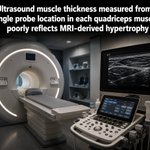
Single-site muscle thickness substantially underestimated MRI-derived hypertrophy and showed no meaningful relationship with MRI changes following 15 weeks of resistance training. See summary in image below

Great work @tombalshaw & colleagues 👏
ovid.com/jnls/acsm-msse/abst…
