
Labor, Public, Applied Econometrics | AP @ClarkUniversity | PhD @UWMadison | https://xitter.cf/t.co/NBn2L4k6qz
Worcester, MA
Joined April 2010
- Tweets585
- Following906
- Followers364
- Likes2.6K




Pinned Tweet
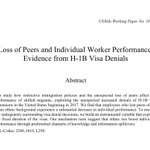
Very happy that my PhD JMP has found an incredible home. This is special as it was part of the process of discovering my interest to understand the equilibrium of unequal outcomes.
From the very inception of the idea, I can only recall tremendous support from everyone at grad school with whom I spoke, who came to my presentations and stayed back to chat more, hours of discussions with my best buddies and my committee members. Many thanks to you all and I hope to pay it forward! ❤️ #EconTwitter

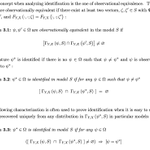
Under incomplete info, preferences and beliefs both drive choices. Varying info and eliciting compensating differentials identifies both, circumventing non-innocuous variance normalizations as a dollar's value is invariant across info. @MoshiAlam et al.
econometricsociety.org/publi…

Moshi Alam retweeted

strong endorse of this. So far at least, AI writing on academic economics, and AI summaries, are not great in terms of prioritizing what is and isn't important, or how to write academic econ well.

A signature feature of academic AI writing is (currently) that it is has bad judgment on what is important and what is not important, even refine.ink.
This is one of the most damaging AI "tells", b/c it reflects bad judgment on the part of the author as well. 1/
Moshi Alam retweeted

I've considered that thought experiment


Consider this thought experiment: "University X has seen graduation, retention rates increase after new adopting policy of giving all students As, regardless of how they perform -- and whether they even come to class."
Not far from reality in many cases.
calmatters.org/education/hig…

Moshi Alam retweeted

🚨Understanding Migration Responses to Local Shocks
New version of paper with @borusyak and Brian Kovak!
1/6 Many papers find that local labor demand shocks have sizable effects on wages and employment, but surprisingly small or imprecise effects on local population.

Moshi Alam retweeted

Ok, this is in progress! Here's a preview
(Top-5 pubs from the last ten years with a simple TWFE specification + replication data; matched samples between TWFE, Callaway-Sant'Anna, and Borusyak-Jaravel-Spiess)
with thanks to Astra, Kevin Chen, & Jon Roth


Moshi Alam retweeted

PhD students do this sometimes — and since they're new to research and writing, often the AI *can* express the ideas better than them.
But if you outsource this step, when are you going to get good at it?
I worry this practice may be cognitively disabling.
Moshi Alam retweeted

Many reasonable concerns but it is bad/odd to ban the submission of letters. Admit committees could bayesian update...banning hurts those who came to econ late and have no other real options. Banning only benefits those from an elite college who wanted to do econ as freshman...
Moshi Alam retweeted

Aditya Ghosh, Stefan Wager and I have a new paper on regression discont designs. arxiv.org/abs/2503.09907 nber.org/papers/w35699Two contributions: (1) a new PLRD estimator in the spirit of the Armstrong-Kolesar (2018) and Imbens-Wager (2019) optimal weights approach. (1/9)

Moshi Alam retweeted

Looking forward to next Friday chamberlain seminar.
We will discuss recent advances in econometrics for the study of development programs and RCTs in a joint session with @PpM_O and @MikeGechter .
Here is the link with details chamberlainseminar.org

Moshi Alam retweeted

My wife is also on the education policy job market this year if you are looking for a terrific education policy/comparative education candidate. As a PhD student, she has 9 publications and over 100 citations.


Moshi Alam retweeted

Just out in the Journal of Political Economy!
With Silvia Saccardo and Sally Sadoff, we find that incentives increased the share of weeknights students slept at least 7 hours by 26% and improved grades by 0.10–0.11 SD. @PittTweet
doi.org/10.1086/740221

Moshi Alam retweeted

Apropos of nothing in particular: Something I learned when I was a student at HBS is that, from a competitive strategy perspective, leaning into self-commoditization is generally ill-advised because it makes it easier for others to copy or supersede your product.
One implication for AI in education is that one wants to look for ways in which the tools expand the capabilities of our pedagogy, rather than serving as a commoditized replacement for it.
Moshi Alam retweeted

We’re super delighted to host Simon’s new book, Deep Learning for Solving and Estimating Dynamic Models in Economics and Finance❣️❣️❣️

Thrilled that "Deep Learning for Solving and Estimating Dynamic Models in Economics and Finance," found a home at @QuantEcon. Access the e-book/code here: quantecon.org/books/ . Huge thanks to Matt McKay, @john_stachurski , Tom Sargent, QuantEcon team for making this happen!

Moshi Alam retweeted

Cognitive psychologist Dan Willingham: "Students should only use AI for things they already know how to do well." dtwuva.substack.com/p/studen…
Moshi Alam retweeted

Using randomized pay experiments among Uber drivers, paired with a natural experiment in access to a competitor, to examine how outside options shape labor supply to the firm, from @sydneecaldwell and Emily Oehlsen nber.org/papers/w35626

Moshi Alam retweeted
Come be my colleague! We're hiring as assistant professor in health policy this year (link below). We're open to candidates from a variety of disciplinary backgrounds including Econ, Poli Sci, etc
I'm biased but UT is great, Austin is awesome, and you can join our great group!
Moshi Alam retweeted

When I start teaching complex analysis on Monday, I've been wondering what to say to my class about why math is still worth studying in the age of AI.
Here is Francis Su's (@mathyawp) answer: studying math develops human virtues like tenacity and creativity.


With the start of the semester just a week away, here’s what I decided to say to my upper division math course about how AI will or won’t change what they’re learning…
The Enduring Value of Math, in an Age of AI francissu.substack.com/p/the…
Moshi Alam retweeted

Universities should probably get ahead of this and consider banning these sorts of AI wearables now
They will it make extremely difficult for professors to give in-class exams

A video of Toluwa Omitowoju received hundreds of thousands of views online — but she didn’t post it, nor did she know that she was being recorded at the time with Meta’s AI glasses.
Her story is part of growing privacy concerns surrounding people recording their surroundings without the consent of others.
Meta told CBS News about safety features, like an LED light that turns on when the glasses are recording, but some users have allegedly tried to tamper with those safeguards. CBS News’ Anna Schecter put one such method to the test.


