

Health Economist. Professor, Harvard Medical School. Tweets reflect my views alone and not those of any organization I am affiliated with, including MedPAC
Boston, MA
Joined April 2014
- Tweets1K
- Following112
- Followers7.7K
- Likes269

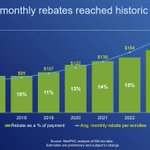





MA efficiencies & explicit program features are unlikely to be high enough to explain the roughly $200/month MA rebates. Work with @JMichaelMcW and JingWei Sun suggest selection and coding of roughly @medicarepayment estimates magnitude could explain. healthaffairs.org/doi/10.137…

That said, the added payments finance lower premiums, lower cost sharing and added benefits. I would love to shift policy focus to the value of those benefits, what would we lose if we pay less (see healthaffairs.org/doi/abs/10…) and if we can get same benefits for fewer $
Michael Chernew retweeted

Helpful look at loss ratios across different health insurance markets & and how stable they’ve been over time in the large-group market.
Health insurance premiums tend to grow broadly in line with the amounts insurers pay out for health care claims.

Thrilled to see STARS program getting some thoughtful attention. See: articles in this thread by @EricaSocker; @Katie_Keith; @sacjai; Must be more than measure refinement/ culling. & we need legislation. See Save Medicare Act. @efusebrown; @Hayrook @djmeyers2.


Michael Chernew retweeted

A Jay Holmgren @UCSF & coauthors find that primary care physicians receive a median of 9.6 messages weekly, with the top quartile receiving 53.3 messages. 💬 The authors call for payment models to address the uneven distribution of portal-based care. @UCSFDOM
healthaffairs.org/doi/10.137…

I really really like this paper by @PeterHuckfeldt and colleagues. Peter can correct me, but I think it implies a bit less than 10% (~7.5%) savings from MA (I am sure effects are heterogeneous across plans). healthaffairs.org/doi/abs/10…
Agree or disagree: we need a significant rethink of how we improve the quality of the American health care system. nejm.org/doi/abs/10.1056/NEJ…

Great to see this out. Really interested in reactions to chapter 1.

It's the perfect day for some summer reading on Medicare payment policy! Today, MedPAC released its June 2026 Report to the Congress. Find the report on our website here: medpac.gov/document/june-202…
Looks like links for didn’t work. @MedicareMeddler and @DanMunro. Take 2 (of what may be 3 or more). Re price reg see healthaffairs.org/content/fo…

@MedicareMeddler Appreciate the shout out. Love your work, but I interpret this differently. Maybe like @DanMunro

#100policyarticles100days
#22. Price Transparency. @Michael_Chernew and friends find only 48% of inpatient and 53% of outpatient insurance contracts rely on DRGs and APCs as the method of payment.
Might be the best argument yet, against price caps....
bit.ly/3Sg172f

My bigger concern is that payment var complicates ability of transp. to improve competition. I know rules are work in progress, but in my view we aren't there yet because of inherent barriers to shopping for many pops and services. I think worth asking if bang is worth the buck
maybe @Ateevm will weigh in on the prospects of transparency to combat market failures. Promise and Reality of Price Transparency | New England Journal of Medicine
Agree. Issue extends to health care (quasi-public?). See healthaffairs.org/doi/abs/10… w/@Ateevm. What do we get if we pay more or lose if we pay less. But if market based, we need to address market failures (antitrust, regs, etc). Surprise billing shows how we can mess this up.


A fundamental tension in public-sector comp is whether pay should be determined by the labor market, as it largely is in the private sector, or by a broader and more subjective notion of what public employees "deserve."
Great article throughout by @nicholas_bagley

Congrats to @AmolNavathe, @ben_ippolito and Danielle pierotti on appointments to medpac. Onward and upward. gao.gov/press-release/gao-ma…

My term as Medpac chair ended last month. It was an incredible honor to serve with the exceptional staff and commissioners. (I am told I served with 61 of the past 65 commissioners). I have a few broad takeaways
I hope going forward that the work launched on the complexity of the Medicare program and the challenges that presents to beneficiaries continues.