

Neuroscientist at MRC Cognition an Brain Sciences Unit at the University of Cambridge, studying memory, cognitive control, and mechanisms of adaptive forgetting
Cambridge, England
Joined April 2015
- Tweets631
- Following524
- Followers1.8K
- Likes808





Michael Anderson retweeted

Excited to be heading to #CNS2026 in Vancouver this weekend!
Come say👋 if you’re around as I will be presenting some very promising results from the first completed study of my PhD work into affective blunting conducted @mrccbu
Poster Session B, March 8, 8-10 AM (Number: B19)


Michael Anderson retweeted

Review paper arguing that the #brain has a built-in mental brake that stops unwanted thoughts. Via a fronto-temporal pathway, it relies on GABA to calm mental loops. Weak brakes may underlie #PTSD, #OCD, anxiety, and #depression nature.com/articles/s41583-0…

To my surprise, our Nature Reviews Neuroscience review on the Brain Mechanisms Underlying the Inhibitory Control of Thought has landed on the cover! Cover art below! For an "explainer thread", see our earlier tweet. @mrccbu #memory #ptsd xitter.cf/Memory_Control/status/…


How does the brain stop thoughts? Find out in my article in @natrevneuro.nature.com with S. Subbulakshmi & Maite Crespo-Garcia integrating 25 yrs of psychology and neuroscience on this function. @mrccbu nature.com/articles/s41583-0… #memory #ptsd @PsychToday @Psychonomic_Soc @SfNtweets
Research on inhibitory control over memory provides a rich neurocognitive framework through which to understand disordered thought control.More broadly, it complements response inhibition as a tool for understanding the control of action and thought.
Fundamentally, if neuroscience is going to inform how unwanted thoughts are controlled by the brain and address central features of psychiatric disorders, a theoretically valid construct and set of tools for measuring that construct are needed.
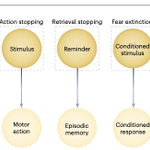
We also discuss the idea that affective stopping engages the same domain general prefrontal components as retrieval stopping, providing an account of fear extinction's benefits.
@StephenMaren

Thought suppression benefits contradict clinical wisdom about the inadvisability of suppression. Yet, they are consistent with the (popular) notion that inhibitory control is fundamental to coping with perseverative thoughts and with resilience broadly. lir-mainz.de/en/home
Critically, we review evidence that retrieval stopping of unwanted thoughts plays an important role in attenuating affective responding to suppressed content, and also that training people to suppress fearful thoughts improves their mental health. science.org/doi/10.1126/scia…

In another example, hippocampal subfield CA1 volume predicts prefrontal suppression of hippocampal activity during intrusions in a retrieval stopping task, and CA1 volume reduction also predicts intrusive symptoms in people with PTSD. sciencedirect.com/science/ar…
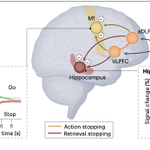
For example, successful thought stopping is strongly influeced by concentrations of GABA in the hippocampus, that enable hippocampal down-regulation to occur, when people suppress retrieval. nature.com/articles/s41467-0…
To capture this fundamental difference, we introduce the concept of a fronto-temporal inhibitory control pathway to highlight mental control's distinct features. This pathway has unique parameters that dictate thought stopping success that are not measured by response inhibition.
We integrate 25 years worth of research on the cognitive and brain mechanisms underlying retrieval stoppping. Retrieval stopping shares prefrontal and striatal components with action stopping. But it instead modulates hippocampal and cortical regions that represent thoughts.

Indeed, intrusive thoughts are usually retrieved in response to reminders. If so, stopping unwanted thoughts would involve engaging inhibitory control to stop retrieval, given a cue. This conceptualization captures every form of intrusive symptom across psychiatric disorders.

Retrieval underlies much of the thinking we do. Thoughts do not emerge from nowhere. Perceptual cues or other thoughts elicit them.
But what do we do instead? Is there another model system for inhibitory control that is conceptually relevant and well understood? YES! RETRIEVAL STOPPING.

And response inhibition will NOT be influenced by unique parts of thought stopping circuitry. It's a little like testing models of audition by using a using a visual task. No matter how precise, elegant, and simple your visual task is, it's at best partially relevant to the goal.

This is not a small point. Inhibitory ability does not equate to prefrontal function. Your ability is determined by the full circuit that implements stopping. Response inhibition measures will include influences of downstream motor circuitry irrelevant to thought stopping.
But there is a problem. Stopping actions does not invoke thought inhibition, and cannot be used to identify its unique properties. Stopping actions affects motor cortex; stopping thoughts, must affect cortical areas represent the thought. The pathways must differ.

Nevertheless, the clear importance of inhibitory control has earned it a seat at the table as a construct relevant to controlling intrusive thoughts, and more broadly, as a fundamental component of executive function. nature.com/articles/s41386-0…