

PhD student in ML @EPFL_en, previously Apple MLR. @matpagliardini.bsky.social
Lausanne
Joined June 2020
- Tweets118
- Following439
- Followers877
- Likes291





Pinned Tweet
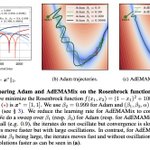
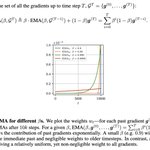
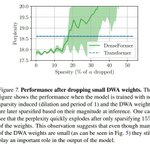
Stop discarding your old gradients! Introducing AdEMAMix, a novel (first-order) optimizer capable of outperforming Adam. Let’s have a thread on momentum and the surprising relevance of very old gradients. A joint work with @GrangierDavid and @PierreAblin #ml #optimization
1/🧵

Matteo Pagliardini retweeted

New research from our MLO Lab @EPFL: Improving Neural Network Training by Decoupling the Magnitude and Direction of Weight Vectors.
Magnitude-Direction Decoupling (MD): a simple optimizer tweak, and what we (currently) think is the right way to train efficiently at scale. 🧵

Matteo Pagliardini retweeted

10/ Length extrapolation is where things get very interesting.
We evaluate pre-trained models with 1024 tokens, then test on sequences up to 10,240 tokens.
PoPE maintains stable performance without any fine-tuning or frequency interpolation.
Even beats YaRN, which uses both!

Matteo Pagliardini retweeted
Our new paper shows that RoPE—the positional encoding used in most modern LLMs like Qwen, Gemma, DeepSeek—has a fundamental flaw: it entangles "what" (content) and "where" (position) information.
Our fix (PoPE) is simple but powerful. Paper: arxiv.org/abs/2509.10534

Matteo Pagliardini retweeted

The next generation of open LLMs should be inclusive, compliant, and multilingual by design. That’s why we (@EPFL @ETH_en) built Apertus.


Matteo Pagliardini retweeted

Amazing "competing" work from @wen_kaiyue @tengyuma @percyliang
There are some good stories about optimizers to tell this week 😃
arxiv.org/abs/2509.01440
arxiv.org/abs/2509.02046

Matteo Pagliardini retweeted

🚀 Together with ETH Zürich and the CSCS, we have just released Apertus, 🇨🇭 Switzerland’s first large-scale, open, multilingual language model — a milestone in generative AI for transparency and diversity.
Find out more: go.epfl.ch/a672aa

Matteo Pagliardini retweeted
New work from our MLO lab @EPFL_en:
Benchmarking the variety of different proposed LLM optimizers: Muon, AdEMAMix, ... all in the same setting, tuned, with varying model size, batch size, and training duration! Huge sweep of experiments by @AndreiSemenov17 @MatPagliardini M Jaggi

Matteo Pagliardini retweeted

📢 New Paper: Thinking Slow, Fast: Scaling Inference Compute with Distilled Reasoners.
w/ Junxiong Wang, @MatPagliardini, @kevinyli_ , @avivbick, @zicokolter, @_albertgu, @francoisfleuret , @tri_dao.
Paper: arxiv.org/abs/2502.20339 pic.x.com/NyIzBefWcR
1/N

Matteo Pagliardini retweeted
Excited to present "Recurrent Complex-Weighted Autoencoders for Unsupervised Object Discovery" at #NeurIPS2024!
TL;DR: Our model, SynCx, greatly simplifies the inductive biases and training procedures of current state-of-the-art synchrony models. Thread 👇 1/x.

Matteo Pagliardini retweeted

Enjoy attention? Want to make it ~18% faster? Try out Sigmoid Attention. We replace the traditional softmax in attention with a sigmoid and a constant (not learned) scalar bias based on the sequence length.
Paper: arxiv.org/abs/2409.04431
Code: github.com/apple/ml-sigmoid-…
This was an amazing collaboration with some great researchers at Apple: Federico Danieli, @EeshanDhekane, @FlorisWeers, @danbusbridge, @PierreAblin, Tatiana Likhomanenko, Jagrit Digani, Zijin Gu, @AmitisShidani1 and Russ Webb.
More details in 🧵below.


We provide pseudocodes in Optax and Pytorch in our preprint: arxiv.org/abs/2409.03137
We plan to release the optimizer code in the near future.
11/🧵