

Machine Learning Research @ Apple (opinions are my own)
London, United Kingdom
Joined November 2014
- Tweets166
- Following922
- Followers878
- Likes1.4K






Pinned Tweet
Reading "Distilling Knowledge in a Neural Network" left me fascinated and wondering:
"If I want a small, capable model, should I distill from a more powerful model, or train from scratch?"
Our distillation scaling law shows, well, it's complicated... 🧵
arxiv.org/abs/2502.08606


Uncertainty methods and correctness metrics often share "mutual bias" (systematic errors from a common confounder like response length), skewing LLM evaluations.
New paper from my colleagues shows that "LM-as-a-judge" evaluation is more robust and human-aligned. Important work - check it out!
arxiv.org/abs/2504.13677


Happing now in East Exhibition Hall E-2310, with @AmitisShidani1, looking forward to discussing our work!

Data mixtures are crucial for achieving strong pre-trained models. Loved collaborating on this project led by @PierreAblin and @MustafaShukor1 tackling data mixing ratios through the lens of scaling laws. Check out @MustafaShukor1's 🧵.


Happening in 30 minutes in West Ballroom A - looking forward to sharing our work on Distillation Scaling Laws!


Excited to be heading to Vancouver for #ICML2025 next week!
I'll be giving a deep dive on Distillation Scaling Laws at the expo — exploring when and how small models can match the performance of large ones.
📍 Sunday, July 13, 5pm, West Ballroom A
🔗 icml.cc/virtual/2025/46785
Excited to be heading to Vancouver for #ICML2025 next week!
I'll be giving a deep dive on Distillation Scaling Laws at the expo — exploring when and how small models can match the performance of large ones.
📍 Sunday, July 13, 5pm, West Ballroom A
🔗 icml.cc/virtual/2025/46785
and Scaling Laws for Forgetting and Fine-Tuning (E-2708)
with @LouisBAlgue, David Grangier, Eleonora Gualdoni, Marco Cuturi, and @PierreAblin
🔗 icml.cc/virtual/2025/poster/…
Here's an Apple@ICML guide with all our talks, posters, and booth events:
🔗 machinelearning.apple.com/up…
Come say hi if you're around, always happy to chat. Looking forward to a week of great research, and catching up with familiar faces (and meeting new ones too).

Dan Busbridge retweeted

Stop by poster #596 at 10A-1230P tomorrow (Fri 25 April) at #ICLR2025 to hear more about Sigmoid Attention!
We just pushed 8 trajectory checkpoints each for two 7B LLMs for Sigmoid Attention and a 1:1 Softmax Attention (trained with a deterministic dataloader for 1T tokens):
- Sigmoid: gs://axlearn-public/experiments/gala-7B-sigmoid-hybridnorm-alibi-sprp-2024-12-03-1002/checkpoints/
- Softmax: gs://axlearn-public/experiments/gala-7B-hybridnorm-alibi-sprp-2024-12-02-1445/checkpoints/
Inference code at github.com/apple/ml-sigmoid-…


I’ve been curious about how early vs late-fusion multimodal approaches compare in controlled conditions. Great to see this studied in depth. Turns out, optimal late fusion has higher params-to-data, and performance between early and late fusion is similar. Brilliant work from @MustafaShukor1 and team!
Check it out: arxiv.org/abs/2504.07951

Dan Busbridge retweeted

Parameterized Transforms 🚀
Here is a new tool that provides a modular and extendable implementation of torchvision-based image augmentations that provides access to their parameterization. [1/5]

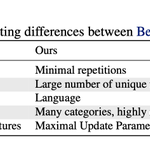
Several people have asked me to comment further on the connection between our work and the Patient and Consistent Teachers study by Beyer et al., as In Section 5.1, we note that our findings appear to contradict theirs.
arxiv.org/abs/2106.05237

Reading "Distilling Knowledge in a Neural Network" left me fascinated and wondering:
"If I want a small, capable model, should I distill from a more powerful model, or train from scratch?"
Our distillation scaling law shows, well, it's complicated... 🧵
arxiv.org/abs/2502.08606
In contrast, our teachers and students are trained on the same data distribution, and we compare with supervised models that can access the same distribution. This lets us to make statements about what distillation can do given access to the same resources.