

Environmental animator / science enthusiast (main interests/tweets on agriculture/nutrition)
Joined November 2010
- Tweets5.1K
- Following558
- Followers832
- Likes10.8K




Pinned Tweet
New animation:
🌍 What will we eat in 2050?
A brief overview of the challenges our global food system faces, and what we can do to address these issues.
Watch on youtube: youtu.be/o2atI8PSLYQ

Some quick math on the "lion" diet:
- The production of 1kg of beef requires 326 m² of land per year (Poore & Nemecek 2018).
- Eating 100lbs (45kg) of beef per month leads to a land use of 326*45*12=
176.040 m²
Per person.
Per year.

There are 107 million square kilometers of habitable land on earth.
If we would use all of it to produce beef - removing every forest and even all buildings and roads - we would still need:
13 🌎🌍🌏🌎🌍🌏🌎🌍🌏🌎🌍🌏🌎
additional earths to produce enough beef for everyone.
Marijn Raeven retweeted

The science shows regenerative grazing simply doesn't work
And I get it, it's a captivating well funded story ($200M from McD's otw), & it's easier to convince many that tweaks are all that's needed vs. systemic changes away from beef
🧵8 reasons why this won't make beef eco.


Marijn Raeven retweeted
People in Italy eating carnivore/McDonalds/whatever in 2026 is not "the Mediterranean diet".
The Mediterranean diet refers to a historical diet. It was much lower in animal sourced foods and junk, and higher in plant protein.

Marijn Raeven retweeted
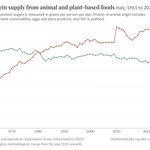
Global protein consumption has increased by 1/3 since 1960
More than 1/2 of this growth has come from animal sources despite plant protein still making up 62% of all protein.
Being clear on plant protein wins (fibre, planetary health, equal muscle gain) can help reverse this

ALT "relative" change in protein supply, showing animal protein growing faster via: https://ourworldindata.org/food-supply Other references: FAOSTAT & Poore & Nemecek (2018) note: 2010 is because of FAO methods change.
This news has a "trace amounts of pesticides on all vegetables" vibe.

Scientists tested 212 plant-based meat alternatives. Every one contained fungal toxins sciencedaily.com/releases/20…

2
13
685
Marijn Raeven retweeted

Reminder that oats, soy and canola oil are health-promoting foods, most people need more fiber and statins save lives.
Happy Saturday!
Marijn Raeven retweeted
While the decline of alt milk is grossly overstated, this is yet another case of the "ultra-processing" discourse potentially leading consumers to far less sustainable and potentially even less healthy food choices.
bloomberg.com/news/articles/…

Marijn Raeven retweeted

Organic farms are legally required to treat animals better.
But a new @MercyForAnimals investigation into a @Costco organic chicken supplier revealed extreme abuse and neglect, along with flouting nearly all of the main organic welfare rules.
Link to my new story + more 🧵
Marijn Raeven retweeted
I regret to inform you that the absolute worst people in food academia have teamed up to write a truly cynical screed against meat reduction.

I think people just lie in these surveys.

In a world that often feels deeply polarized, it is rare to find a topic where almost everyone agrees. The treatment of farm animals is one of them.
Surveys across many countries show that a strong majority of people, regardless of their diet, oppose common practices in animal agriculture. In the chart you can see survey data from the UK.
Given these surveys, and with the increasing availability of plant-based meat alternatives, one might expect people in these countries to be shifting away from consuming animal products.
But the data shows a different story.
At a global level, meat consumption is not only high but also increasing. Each year, hundreds of billions of land animals, fish, and crustaceans are farmed and killed to produce food.
There is a clear gap between what people want — meat produced without suffering — and what the food system delivers. Understanding this gap is the first step to closing it.
In a new article, Pablo Rosado makes the case that one of the biggest opportunities of our generation is to build a system where the food we eat reflects the values we already hold.

ALT Bar chart of survey responses from about 1,000 UK adults in 2022 where most respondents rate a range of common farming practices for chickens, cows and pigs as "not acceptable," highlighting a gap between public concern for farm animals and current practices. Data source: Bryant Research (2022). License: CC BY.
1
8
433
Marijn Raeven retweeted

This is a headline generated from a cross-sectional study published in a Radiology journal using a shortened Food Frequency Questionnaire and a totally made up metric of UPF intake. Countless issues with zero potential for causal inference. What are we even doing @cnnhealth ?
Academics, plz stop giving quotes to media about your studies that will just be clickbait, and plz restrain your comms offices from running press releases on this stuff.
When legacy media and academia opine that nobody trusts science anymore, they should look in the mirror.

Marijn Raeven retweeted

Looks extremely thorough, integrating both health and nutrient needs, sustainability and food safety. Well done! voedingscentrum.nl/professio…

New Dutch dietary guidelines:
- Meat max 300g per week (down from 500g). 🥩🍗
- Cheese max 20g per day (down from 40g). 🧀
- Legumes 250g per week (up from 120g-180g). 🫘🫛
- Switching from 100% dairy to 50/50 with soymilk/gurt. 🥛 (huge step given Dutch history with dairy).
There's also a change from the one size fits all approach. The website now includes a tool to customize your diet, allowing for dietary patterns like vegetarian, lower carb and vegan.
More (in Dutch): voedingscentrum.nl/nl/gezond…
CC @VivaLongevity
The setup for these debates is silly, but @DrJackSymes delivers a masterclass in communication here. Worth a watch for anyone doing online communication/debates on difficult topics.
Also, not a single negative comment under the video. youtube.com/watch?v=tsNBKKRX…

1
7
252
Turns out that a bunch of teens generating ugly fanfiction while shouting that the technology is going to end film making is actually not a great business model.
theguardian.com/technology/2…

1
2
171