

War of Attrition advocate. Political & military analyst | Geopolitics, strategy & security | Breaking down power, conflict & statecraft
Joined March 2025
- Tweets787
- Following86
- Followers280
- Likes537






Pinned Tweet
Focusing on political and military analysis, with a focus on understanding how strategy, power, and security dynamics shape global affairs. My work examines the intersection of geopolitics, military doctrine, and statecraft.
I think the strike's against Yandex has revealed a rather convenient tactic: When you don't want to engage with the opposition, simply label them as bots rather than address their arguments and dig yourself deeper into an echo chamber.

MagnusMatrix retweeted
The most dangerous assumption within the Russo‑Ukrainian war is that a single technology can replace the wider military system required to achieve victory.
Ukraine should not approach the debate between Syrskyi and Fedorov as a choice between conventional warfare and technological innovation. The core rationale is that war is holistic, and no single system, technology or doctrine can independently deliver victory. A healthy tension must therefore exist between both perspectives.
Fedorov is correct to emphasise drones, innovation and procurement reform. Drones are highly effective for reconnaissance, precision strikes, area denial and the disruption of enemy logistics. His efforts to reduce corruption and create a more transparent procurement system are also important, as they allow resources to reach operational units more efficiently.
However, drones cannot currently replace personnel or combined-arms warfare. Drones are aforce multipliersnot substitutes for combined arms or personnel. Drones can identify, isolate and degrade an enemy position, but soldiers are still required to assault, clear, occupy and defend territory.
Military success also cannot be assessed solely through confirmed kills or destroyed equipment. Artillery may not always produce visible evidence of destruction, but it can suppress enemy positions, restrict movement and enable friendly forces to advance. Similarly, electronic warfare, logistics, engineering, air defence and medical evacuation provide critical support despite not always producing easily measurable results.
This highlights the danger of gamifying war. If military performance is judged primarily through visible drone strikes or point-based systems, units may prioritise targets that generate measurable results while neglecting essential support capabilities. Metrics should support military judgement, not replace it.
Syrskyi’s perspective therefore remains relevant. He understands that personnel and conventional military formations remain necessary to fight, capture and hold ground. However, the major criticism of his approach is that operational results may be achieved at an excessive human cost. Personnel are essential to victory, but they must also be treated as a limited strategic resource.
An attritional war does not require constant territorial advances. Ukraine can weaken Russia by imposing personnel and equipment losses, disrupting logistics and preserving its own forces. However, attrition must ultimately support wider political and territorial objectives. Territorial advances should result from successful attrition rather than being pursued regardless of cost.
Ukraine may not require Syrskyi personally, but it still requires a military leader capable of representing the conventional realities that Fedorov’s technological vision cannot replace. Technologists should challenge commanders who rely too heavily on manpower-intensive operations, while commanders should challenge technologists who risk confusing measurable drone strikes with strategic victory.
The strongest military approach is therefore a synthesis. Drones, artillery, electronic warfare, logistics, intelligence and infantry are most effective when integrated into a unified system.
Warfare is holistic. No single weapons system will determine the outcome of an entire war. Both drones and artillery are extremely important in this conflict.
Drones are tools of exceptional precision.
Artillery is a tool of suppression and the destruction of enemy fortifications.


Update incoming tonight on the Stepnohirsk offensive.
TLDR: this is a genuine victory for the Ukrainians, as they managed to secure a defensive node that can be used to leverage the wider frontline situation.
I am currently studying for my final exam in japanese.

Update incoming tonight on the Stepnohirsk offensive.
TLDR: this is a genuine victory for the Ukrainians, as they managed to secure a defensive node that can be used to leverage the wider frontline situation.

MagnusMatrix retweeted

This could well be the most important battle of 2026 of the war in Ukraine, if the momentum from 2025 does not pick up again. Everything seems to indicate that the first phase of the Ukrainian collapse in Kostiantynivka is beginning.

Ukrainian-Russian war. Day 1548-1552: 🇺🇦🇷🇺
Situation on Konstantinovskaya front: During the last week, Russian Army has made a series of advances in the city of Kostiantynivka. Intense shelling of Ukrainian army’s rear and supply routes, located in the northern part of the city, is paying off, allowing Russian forces to infiltrate new areas in the southern half of the city, expanding the gray zone and, with it, urban combat.
- In the south, Russian forces captured the Tabachna factory and the industrial landfill, as well as most of the Stara Santurynivka district
- In the east, Russian forces crossed the Hora district, advancing along Bahmutska Street until they reached the school on Mykhaila Savchuka Street. Russian troops also crossed the Hruzka Forest and managed to enter Teatralna Street, which leads to the central market.
- In the west, heavy Russian shelling of high-rise buildings has allowed troops to advance in the Tsentralnyi, Chervóne mistéchko, Prohresyvnyi, and Zinkovy districts, increasing pressure on Ukrainian forces still deployed in the Ukrayinsky Khutir district (which have established a base in the former bus station).
Map: [ google.com/maps/d/viewer?mid… ]

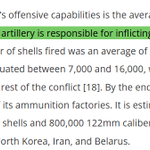
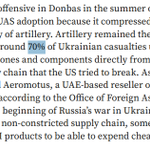
It appears that around 70% of Ukrainian casualties are being caused by Russian artillery, SPGs, and other gun systems.
Artillery remains one of the main killers on the battlefield and still plays a decisive role in shaping the tactical situation.
Source: static.rusi.org/rp-drone-sup…
iwm.org.uk/history/contempor…


No Crimea is NOT simply “going to fall.”
Ukraine is increasing pressure on Russian logistics, but pressure is not the same as a full operational cut-off. Russia still has multiple options to resupply Crimea, including the land corridor, limited ferry/sea routes, and air transport where needed.
The Kerch Bridge was struck in June 2025, but it has not been removed from the logistics picture. The road section has been repaired, and the rail section is still part of Russia’s wider effort to keep Crimea connected.
The bigger issue is scale. Ukraine can harass logistics, destroy exposed vehicles, and raise the cost of movement. But it does not currently have the drone strength to completely sever Russian supply into Crimea.
Drones in the 3rd and 4th echelon are acting more like opportunity predators. They punish exposed logistics, fuel trucks, depots, and air defence systems. That makes Russian logistics more expensive and forces Russia to spread air defence and EW along key routes.
But that is still very different from forcing Russia to abandon Crimea or Kherson. Crimea is one of Russia’s major territorial goals in this war. They are not going to give it up just because logistics become harder. A Ukrianain takeover of Crimea will require a land operation to succeed.

I disagree with the idea that this fully “redefines the depth of the kill zone.” In the 3rd and 4th echelons, drones are not necessarily creating a continuous kill zone in the same way FPVs do near the line of contact. Instead, they are acting more like opportunity predators: searching for exposed logistics, fuel trucks, air defence systems, depots, and other high-value targets.
The closest modern comparison is not a traditional frontline kill zone, but something closer to close air support applied against logistics and rear-area movement from World War 2.
Because drones are cheap, flexible, and supported by systems such as Starlink, Ukraine can increasingly harass and disrupt Russian logistics deeper behind the front. This will raise costs, slow movement, and force Russia to spread air defence and electronic warfare assets along key logistics routes.
However, I do not think this alone will force Russia to abandon positions in Crimea, Kherson, or other rear areas. Even near the line of contact, both sides can still accumulate armoured forces when enough concealment, dispersal, and protection are used.
These drones do not make the entire rear impossible to operate in. Rather, they make logistics more expensive, more dangerous, and more complicated. This will force Russia to spread out its AD to maintain its logtics web or employ new forms of electronic warfare.

With more and more drone strikes reaching the key Rostov-Crimea highway, Ukraine 🇺🇦 redefines the depth of the "kill zone".
🔹The first echelon extends to approximately 20 km (this is the case on both sides of the front). It primarily consists of FPV drone strikes, which generally operate at a depth of 5 to 15 km, although some drones with wings fly further. This is the basic kill zone; anything that moves is quickly targeted, movement is severely restricted, and losses are high.
🔹The second echelon is very recent, extending to 50 km or more, with enhanced conventional FPV strikes, notably via Starlink or sometimes with added wings, increasing their range. This is particularly the case around Donetsk. In this instance, the targets are logistics, deployment points, and key roads leading to the front. Losses are also significant, especially in terms of vehicles, which are often unarmored.
🔹The third echelon is twofold: on the one hand, there are tactical strikes against high-value targets carried out primarily by FP-2 drones (rear bases, training centers, ammunition depots, repair facilities, air defenses, radar installations, etc.), and now also by roving munitions that fly over key routes and target Russian logistics, particularly military equipment and fuel trucks.
🔹The fourth echelon extends even further, towards Crimea and Russia. This echelon mainly involves the FP-1 drone, but also frequently the FP-2 and other long-range drones. Targets include the foundations of the Russian economy (refineries, ports, industries), the Russian army in Crimea, fuel depots, and command centers.
🔹An additional echelon is made possible by the launch of conventional FPV drones from the decks of naval drones (USVs) and sometimes aerial drones, enabling FPV strikes far from the front lines.
My map with a basic understanding of the different echelons ⬇️

Again, I do not understand the optimism within parts of the Ukrainian community.
There was only limited success with the Huliaipole offensive, while Kostiantynivka is currently under serious threat of falling, and the Lyman front remains under heavy pressure.


MagnusMatrix retweeted
There is currently a lot of optimism within the Ukrainian community around the slowing, and in some areas reversal, of Russian gains. But I think that optimism needs to be treated carefully.
This war remains fundamentally attritional. The key question is not just whether Russia gains less land in one month, but whether Ukraine is trading equipment in a sustainable way.
@Willy_OAM: Fully credit to him for the following information:
1. Early 2025: High Russian Losses, Modest Russian Gains Lower Ukrainian Losses
From January to April 2025, Russia was taking heavy tank losses for relatively modest territorial gains.
Russian tank losses were roughly:
Jan 2025: 55 tanks
Feb 2025: 72 tanks
Mar 2025: 64 tanks
Apr 2025: 62 tanks
Yet Russian territorial gains were only around 230–340 km² per month, far below the later 2025 peaks.
Ukraine’s losses during this same period were lower in comparison. Ukrainian tank losses were mostly around 28–47 tanks per month, while Ukrainian SPG losses were around 14–28 per month. Early 2025 looked like this:
Russia: high tank losses + modest gains Ukraine: lower losses while slowing Russian advances.
2. Mid-to-Late 2025: Russian Losses Fall, Russian Gains Rise Ukrainian Losses Increase
The major shift happens from around May 2025 onward.
Russian tank losses drop sharply:
May: around 32 tanks
June: around 30 tanks
July: around 28 tanks
October: around 24 tanks
November: around 21 tanks
Russian SPG losses also collapse from roughly 10–15 per month earlier in the year to almost 1–5 per month by late 2025.
But at the same time, Russian territorial gains increase dramatically:
May 2025: around 640 km²
June 2025: around 570 km²
July 2025: around 530 km²
October 2025: around 660 km²
November 2025: around 745 km²
Russia was no longer losing large numbers of tanks while gaining modest land. Instead, Russia was gaining significantly more territory while losing fewer tanks and SPGs.
Meanwhile, Ukrainian losses did not fall in the same way. Ukrainian tank losses remained in the 20–38 range, while Ukrainian SPG losses rose into the high 20s and 30s by late 2025.
Trend becomes:
Russia: reduced losses + higher territorial gains Ukraine: continued and rising material pressure. This suggests Russia either adapted tactically, relied less on tank-heavy assaults, or shifted more of the fighting burden onto infantry, drones, glide bombs, artillery, and smaller assault groups.
3. Early 2026: Russian Losses Stay Low, Russian Gains Slow But Ukraine Still Takes High Material Losses despite gaining ground
By early 2026, Russian losses remain low compared with early 2025.
Approximate Russian tank losses:
Jan 2026: 12 tanks
Feb 2026: 5 tanks
Mar 2026: 13 tanks
Apr 2026: 9 tanks
Russian SPG losses remain extremely low, around 2–3 per month.
Russian territorial gains also appear lower than the late-2025 peak:
Jan 2026: around 420 km²
Feb 2026: in the negative.
Mar 2026: around 100 km²
Apr 2026: around 260 km²
This is where some of the current optimism comes from. Russian gains slowed, and in some areas Ukraine may have reversed ground losses.
The material picture is still concerning. Ukrainian SPG losses remain high:
Jan 2026: around 18 SPGs
Feb 2026: around 35 SPGs
Mar 2026: around 50 SPGs
Apr 2026: around 22 SPGs
So even when Russian territorial gains slow, Ukraine is still taking serious artillery and SPG losses.
A slowdown in Russian gains is positive, but it does not automatically mean the attritional balance has changed. If Ukraine is reversing some ground but losing high-value systems at an elevated rate. This raises serious concerns because Ukraine cannot afford sustained losses of critical systems such as SPGs. These systems are central to Ukraine’s ability to provide mobile fire support, engage drone-identified targets, suppress Russian positions, and support mechanised assaults.
Losing them at an elevated rate weakens Ukraine’s combined drone-artillery-manoeuvre capability. In a war of attrition, the question is not simply who gained or lost land this month. The real question is who can sustain the exchange ratio over time. For Ukraine, being smaller force in this war, that remains the central problem. Ukraine gaining ground is excellent news. My greatest concern, however, is whether they can sustain it over time, especially if continued SPG and armour losses leave them with fewer critical systems to defend against future Russian assaults.
Full credit to @Willy_OAM for providing the chart seen in this Article link bellow to his youtube channel:
youtube.com/@willyOAM

@TheStudyofWar , estimated that from 13 May 2025 to 12 May 2026, Russia made a net territorial gain of 1,669 square miles, with an average gain of around 143 square miles per month over that 12-month period. That supports the broader point that Russia has still been trending toward taking more ground over the longer timeframe, even if the most recent period shows a slowdown or reversal.
This is why I remain cautious. A short-term Ukrainian reversal is excellent news, but it does not automatically erase the broader attritional trend. Russia may be gaining less, or even losing some ground in the short term, but Ukraine still has to sustain this while managing high SPG and armour losses.

@AMK_Mapping_ chart adds another important point: Russia did suffer a net territorial reversal in February 2026, with Russian-controlled territory falling by around -142.08 km². However, the key issue is what happened next. In March 2026, the trend returned to Russian net gains, with Russia gaining around +135.59 km².
In April 2026, Russia remained in positive territory again, gaining around +78.91 km². So while February showed a clear Ukrainian reversal, it did not develop into a sustained multi-month trend of Russian territorial losses. Instead, the data shows Russia moving back into net-positive territorial gains almost immediately afterwards.
To be clear, these March and April gains are much lower than Russia’s late-2025 peaks, where gains reached around +639.83 km² in October, +724.93 km² in November, and +534.05 km² in December. So Russia’s offensive tempo appears reduced. But reduced tempo is not the same as strategic reversal.
The broader concern remains that Ukraine may be able to temporarily reverse Russian gains, but Russia is still capable of returning to net territorial expansion shortly afterwards. This supports the wider attritional concern: Ukraine gaining ground is excellent news, but if those gains are not sustained, and if they come alongside high SPG and armour losses, then the long-term balance remains dangerous.

@TheStudyofWar data, estimated that from 13 May 2025 to 12 May 2026, Russia made a net territorial gain of 1,669 square miles, with an average gain of around 143 square miles per month over that 12-month period. That supports the broader point that Russia has still been trending toward taking more ground over the longer timeframe, even if the most recent period shows a slowdown or reversal.
This is why I remain cautious. A short-term Ukrainian reversal is excellent news, but it does not automatically erase the broader attritional trend. Russia may be gaining less, or even losing some ground in the short term, but Ukraine still has to sustain this while managing high SPG and armour losses.

@AMK_Mapping_
chart adds another important point: Russia did suffer a net territorial reversal in February 2026, with Russian-controlled territory falling by around -142.08 km². However, the key issue is what happened next. In March 2026, the trend returned to Russian net gains, with Russia gaining around +135.59 km².
In April 2026, Russia remained in positive territory again, gaining around +78.91 km². So while February showed a clear Ukrainian reversal, it did not develop into a sustained multi-month trend of Russian territorial losses. Instead, the data shows Russia moving back into net-positive territorial gains almost immediately afterwards.
To be clear, these March and April gains are much lower than Russia’s late-2025 peaks, where gains reached around +639.83 km² in October, +724.93 km² in November, and +534.05 km² in December. So Russia’s offensive tempo appears reduced. But reduced tempo is not the same as strategic reversal.
The broader concern remains that Ukraine may be able to temporarily reverse Russian gains, but Russia is still capable of returning to net territorial expansion shortly afterwards. This supports the wider attritional concern: Ukraine gaining ground is excellent news, but if those gains are not sustained, and if they come alongside high SPG and armour losses, then the long-term balance remains dangerous.
