
Associate Professor, University of Gothenburg.
Joined October 2012
- Tweets529
- Following969
- Followers955
- Likes858






Magnus Lundgren retweeted

AI can do essentially all the technical parts of empirical social science research now---but there's still an essential role for human researchers and universities.
It's been 9 months since we started exploring how AI was going to transform empirical social science research. Here's a periodic update on how my thinking has evolved since then:
(1) The most powerful AI models, including the kinds of multi-agent systems delivering recent math results, are now capable of doing essentially any kind of technical empirical social science research you could desire. I no longer write any data collection, munging, or analysis code directly.
(2) Norms are evolving slower than I expected, but it is increasingly seen as weird if someone posts a working paper without evidence that they have used AI to verify that the results are directly reproducible with their code and data. This is a great sign.
(3) AI has, if anything, gotten WORSE rather than better at writing. As a result, the best papers combine AI-driven empirical analyses with human writing (though AI is quite helpful for things like managing bibliographies, finding relevant web links, etc).
(4) Human direction is still essential for pointing AI at the most interesting and most valuable empirical questions, and for interpreting the results, making sense of them, and communicating them.
We are going to need institutions that are independent of the labs that can verify knowledge claims and direct AI-driven research towards the most fundamental questions of knowledge that AI labs won't be positioned to pursue effectively themselves. This is a tremendous opportunity for places like Stanford, and I'm excited to see how it evolves.

Here's proof that Claude Code can write an entire empirical polisci paper.
To validate my claim that AI agents are coming for polisci "like a freight train", today I had Claude Code fully replicate and extend an old paper of mine estimating the effect of universal vote-by-mail on turnout and election outcome...essentially in one shot.
After careful prompting, Claude Code:
(1) Downloaded the old paper's repo and replicated the past results, translating our old Stata Code into Python
(2) Crawled the web to get updated official election data and census data
(3) Ran new analyses extending the results through 2024
(4) Created new tables and figures
(5) Performed a lit review
(6) Wrote a wholly new paper
(7) Pushed the whole thing to a new github repo
The whole thing took about an hour.
This is an insane paradigm shift in how empirical work is done.
It also validates the point that several people including @BrendanNyhan made yesterday---it's going to be especially easy to scale observational research with AI.
Thanks to @alexolegimas, @arthur_spirling , and many others who gave me feedback. .

Magnus Lundgren retweeted

How do elections in backsliding settings shape attitudes toward democracy? @ggreilinger and I fielded two surveys: one pre/post & one several months after Hungary's election. Elections appear to increase satisfaction among winners, even months after. WP: papers.ssrn.com/sol3/papers.…

Magnus Lundgren retweeted

September twenty-seventh is the widest day of the year when rendered in Arial

Magnus Lundgren retweeted

Forthcoming article in @ISQ_Jrnl!
Trump and Xi are sitting down to talk AI this week. @AnthropicAI says we need to "pace the frontier"—and we need China's help to do it.
Could the US and China ever agree on arms control for frontier AI? What would it take?
🧵 [link below] 1/

Magnus Lundgren retweeted

>be me
>discover effective altruism
>apparently normal charity is inefficient
>why donate to random sad thing when spreadsheet can tell you optimal sad thing
>fair enough
>buy mosquito nets
>save lives
>numbers look good
>feel powerful
>couple years later
>someone asks an innocent question
>why only count people alive today
>huh
>future people matter too
>obviously
>my grandchildren shouldn't matter less just because they haven't spawned yet
>reasonable.jpg
>keep following logic
>what about their grandchildren
>also yes
>what about people in 500 years
>sure
>5000 years
>why not
>500 million years
>starting to get weird but morality is morality
>open calculator
>humanity could survive for an astronomically long time
>could colonize galaxy
>could have trillions upon trillions of descendants
>maybe digital people too
>maybe simulated civilizations
>maybe dyson spheres full of happy uploaded minds
>calculator starts smoking
>realize currently living humans are rounding error
>8 billion people suddenly looking extremely beta
>future contains potentially 10^something people
>can't even fit beneficiaries in google sheets
>new moral priority unlocked
>protect the long-term future
>stop thinking in units of "people helped"
>start thinking in "fraction of cosmic endowment preserved"
>malaria?
>terrible
>but only kills existing humans
>AI extinction could delete the entire light cone
>nuclear war could permanently derail civilization
>bad institutions could lock in terrible values for ten million years
>someone invents wrong constitution in 2140
>quadrillions suffer
>better fund governance workshop now
>friend says maybe we should improve hospitals
>explain opportunity cost
>friend says hospitals are full of actual sick people
>explain scope sensitivity
>friend stops inviting me to dinner
>need to decide what to fund
>easy
>expected value
>suppose project has one in a million chance of preventing extinction
>sounds tiny
>but extinction destroys 10^50 future lives
>multiply
>mother of god
>$10 million project has expected value of several galaxies
>charity evaluation complete
>someone asks where the one-in-a-million number came from
>expert judgement
>which expert
>us
>how calibrated
>extremely thoughtfully
>reduce estimate to one in ten million to be conservative
>still beats curing cancer by 38 orders of magnitude
>epistemic robustness achieved
>someone says maybe project doesn't work
>assign 20% chance
>still astronomical
>maybe project makes problem worse
>assign 5% chance
>still astronomical
>why 5
>because 30 felt pessimistic
>publish 46-page report
>contains seventeen sensitivity analyses
>every sensitivity analysis begins after assuming intervention has positive sign
>critic says you're multiplying enormous hypothetical stakes by extremely uncertain probabilities
>yes
>that's literally why it's important
>critic says the uncertainty might be structural rather than numerical
>make probability smaller
>critic says no, I mean maybe your model is wrong
>make probability smaller again
>critic begins rubbing temples
>discover AI safety
>perfect longtermist cause
>AI might kill everyone
>or create utopia
>or seize galaxy
>or tile universe with paperclips
>or create billions of conscious software minds
>finally a problem with numbers big enough for me
>start AI safety nonprofit
>mission: prevent dangerous AI
>hire smartest people available
>smartest people immediately start building better AI to understand dangerous AI
>interesting
>we must understand capabilities to understand safety
>we must scale models to study alignment
>we must race ahead so less responsible actors don't get there first
>we must deploy systems to learn how deployment can go wrong
>we must build the thing quickly because building the thing quickly is dangerous
>outsider asks why the people most worried about AI apocalypse all work at AI companies
>complicated field
>company releases stronger model
>very concerned
>company begins training even stronger model
>extremely concerned
>company raises $14 billion
>concern reaches unprecedented levels
>need to influence government
>future is at stake
>normal democratic process too slow
>politicians don't understand exponential curves
>public doesn't understand x-risk
>experts must guide them
>who counts as expert
>people who understand x-risk
>who understands x-risk
>our friends
>someone objects that this seems politically convenient
>explain we're representing future generations
>future generations unavailable for comment
>develop concept of value lock-in
>terrifying possibility that one ideology controls civilization forever
>therefore extremely important that civilization adopts correct values before lock-in
>whose values
>let's circle back
>begin with impartial morality
>end with small group of people deciding what quadrillions of hypothetical beings would want
>beautiful arc
>meanwhile actual humans keep doing annoying things
>voting wrong
>having parochial attachments
>loving family more than strangers
>caring about local community
>getting upset when told their suffering is cosmically negligible
>evolutionary biases everywhere
>explain that moral intuition cannot be trusted
>except intuition that future digital people count
>and intuition that extinction is uniquely bad
>and intuition that our probability estimates are sane
>and intuition that our institutional choices improve the future
>those intuitions survived peer review
>someone donates $5k to local homeless shelter
>inefficient
>could have funded 0.0000000000003% of an AI governance researcher
>think of all the simulated people you just killed
>okay maybe don't phrase it that way publicly
>PR team says "future generations deserve a voice"
>much better
>journalist asks what longtermism means
>say "future people matter"
>everyone agrees
>great
>journalist asks what follows from that
>well technically we should redirect enormous resources toward low-probability interventions affecting astronomical futures
>journalist raises eyebrow
>return to "future people matter"
>motte has entered the chat
>critic: of course future people matter
>me: glad we agree
>critic: I don't agree that your institute knows how to help them
>me: why do you hate our grandchildren
>eventually notice uncomfortable implication
>if future value dominates everything
>then helping people today mostly matters through effects on future
>education matters because future institutions
>health matters because future productivity
>democracy matters because future trajectory
>human beings slowly become instrumental variables in their own moral philosophy
>see starving child
>feel compassion
>check spreadsheet
>child's direct welfare contribution negligible
>but perhaps childhood nutrition improves national institutional quality
>compassion restored
>tell myself this is impartial altruism
>one day assistant asks obvious question
>"how do you know your intervention actually improves the far future?"
>silence
>open spreadsheet
>increase column width
>add confidence interval
>assistant asks again
>"no, I mean how do you know the sign is positive?"
>stare into cosmic light cone
>10^50 people staring back
>none of them exist
>none of them can tell me
>none of them can falsify my assumptions
>realize I have invented the perfect constituency
>infinitely important
>completely silent
>and always represented by me
Magnus Lundgren retweeted

Thrilled that #paper2agent is published in @nature today!
Scientific knowledge is traditionally stored in passive papers. Paper2Agent transforms papers into virtual authors that answer questions, apply its methods and collaborate w/ other paper agents to make new discoveries 🧵

Magnus Lundgren retweeted

Come work with us in our department! We are hiring an assistant professor in Political Science. web103.reachmee.com/ext/I005…
Magnus Lundgren retweeted

The University of Hong Kong's School of Governance and Policy is seeking a Tenure-track Assistant Professor in Global Governance and Institutions, with expertise in international organizations, multilateralism, and global governance.
higheredjobs.com/details.cfm…
#PAJobMarket
Magnus Lundgren retweeted

📢Fall 2026 call for proposals is open!
The Junior Scholars in Quantitative Conflict Workshop invites grad students, postdocs & junior faculty in conflict & international security to apply.
🗓️ 1st & 3rd Fridays, 1pm ET, from Sept 4
📝 Deadline: Aug 14
utk.co1.qualtrics.com/jfe/fo…
Magnus Lundgren retweeted

We’re giving scientists, mathematicians, and engineers free access to our frontier models—starting with 10,000 researchers and expanding to 100,000 through 2027.
ChatGPT for Academic Researchers is built to accelerate discovery across disciplines.
Magnus Lundgren retweeted
Participants will receive access to our frontier models, including our GPT-5.6 family of models.
Each workspace includes business-grade privacy and security protections. Researcher data is not used to train our models by default, and participants can invite up to four collaborators.
The program also includes training, hands-on support, and opportunities to learn from other researchers. openai.com/index/chatgpt-for…

With the launch of China-led WAICO yesterday, I thought it would be interesting to map participation in the principal international AI instruments. Kind of a patchwork, but emerging institutional bipolarity? #AIgovernance #AI #WAICO

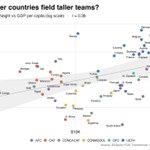
Do richer countries field taller teams? Weakly, yes (r = 0.38). European teams tower over everyone and Saudi Arabia is the clearest outlier: pretty wealthy, but the shortest squad. #worldcup


We're hiring a Research Assistant (6 months) for our project. Looking for someone with strong political science training, experience in quantitative text analysis, and empirical data collection. Deadline: 13 April. See here: su.varbi.com/en/what:job/job…

The race for recognition, update. With the latest wave of recognitions, Palestine has pulled ahead of Israel for the first time.


