

Breaking down ideas in AI, Software, and Tech as an industry. Chocolate Milk Cult Leader reaching 1M+ people monthly. The best meme maker in all of tech
United States of America
Joined October 2020
- Tweets5.6K
- Following375
- Followers2.2K
- Likes2.3K







Harvey refused to defend their approach because they know it's a scam.

This is going to be a pretty long answer, but just to preface it: if you really disagree with this, or you feel strongly that you have data that proves me wrong, let’s discuss it properly.
We can do a public roundtable with you, your research team, engineering guys, whoever else you think would add value to the discussion. My community is almost at 2 million people monthly now, and I think it would be a great way to show people how you guys are thinking about this, why you’re so confident in the approach, and where you think my analysis is wrong. The point would not be "debate" (I think that's corny af), but to have a good-faith discussion about our differences in opinion/technical thesis in a way that everyone can walk out with a better understanding of things.
Happy to also talk privately if that's better. Or just argue with code, as they say. We'll define a task, define a budget, we build it in our own ways, and let’s compare the results.
Now onto the answers. TLDR: training custom models would be wasteful for law firms and most challenges around sensitive agentic deployments are not a model layer problem. Trying to solve them in the model layer creates major security issues that law firms will not want to deal with.
1-- when you talk about helping law firms build their own models/building on their private data, you're likely suggesting post-training, because obviously they will not have the amount of money and data required to train a completely new intelligent model from scratch. Especially one that’s competitive against the really good open models out there currently.
This is not useful to them because stacks of research have already shown us that most of the knowledge of an LLM comes from the pre-training stage, not from the post-training. Post-training is essentially just a way to change how the model samples from its latent space, but the way concepts are organized and information is actually learned is mostly coming from the pre-training stage.
This is a problem for law firms because they don’t want their own custom knowledge, their client data, their own proprietary knowledge, to be confused with generic off-the-shelf internet insights (since you're not changing the pre-training). The whole point of training a model on your custom data would be that it’s much more precise, much more grounded in your data (including private data that isn't available in generic models). If you’re only post-training and not pre-training, most of your knowledge is still coming from that generic base.
You can actually confirm this for yourself with your tenant models. Compare outputs on identical tasks between the tenant model and the base model it was post-trained from. You’ll see that the distributions are actually quite similar, especially when you account for the amount of resources you would have had to spend getting there.
2) let’s say you realize this and you’re post-training the model not to be more knowledgeable, but specifically to navigate a law firm’s spaces better: learn how to navigate through Google Drive connectors, any enterprise software they’ve bought, DISCO, Clio, etc. The problem there is most generic off-the-shelf LLMs, especially the really cutting-edge ones, will already have had access to the same tools and will know how to navigate these environments themselves. It’s not like these environments are alien technology that intelligent models will not be familiar with. So then you’re again stuck on the same issue: what is the ROI?
Especially when you consider the fact that once you start getting into post-training, what happens when the next generation of model comes out? Are you just going to start post-training again? You’ll have to post-train that and redo all of your investment.
So really all that gets left are the very, very specific law firm things: ways they want to practice, where the templates are, how to find their templates, how to use their templates, etc. That is incredibly valuable. But any generic intelligent model plus a well-defined harness and a well-defined customized context map can handle this much better. Customizing the harness (this includes setting up things like access controls, which we will talk about in a sec) and context map will be 10x cheaper and much better than training a model. If you're skeptical about this, let's back both of our claims with code.
3) Now let’s say for the sake of argument that your law firm is committed to investing a lot of money into pre-training and post-training a model. They have the data, they have the compute, and they have the stubbornness to go ahead with this. The final problem here is that agent deployment in sensitive enterprise settings is not blocked by intelligence. In most cases, it’s blocked by other important aspects, such as data access control, strict edit permissions, etc.
Certain employees should be able to access certain kinds of data; other employees should not. For some questions, answering them might require the system to access data that the employee should not see directly. It should be able to use that data to produce an allowed answer without exposing the raw data, or simply say that at their level of access control it cannot do this. Both are valid, depending on the org rules, but monitoring and enforcing these rules should not be purely left to LLM calls.
Similarly, what about edit controls? You should be able to edit your files, not edit files above your permission level and absolutely not touch client data. If you try to solve these kinds of problems in the AI model layer, you are just introducing unnecessary stochasticity. You will have mistakes.
Look no further than coding models for prood. despite tens of billions of dollars invested into post-training coding models, coding models continue to do stupid shit like delete production databases and rewrite access controls.
And coding models have orders of magnitude more investment behind them. Coding is more verifiable, so it’s easier to train with post-training techniques. Coding is also a domain AI researchers and engineers are familiar with, so there’s much greater domain understanding there compared to something like law, where your AI researcher and your AI engineer will usually not know law particularly deeply. Despite all of those advantages, coding models still have not solved these problems because these are not AI model-layer problems.
Anybody trying to solve these problems by just training a law-firm AI model is introducing unnecessary security risks and unnecessary costs. All of which will compund when the agents spins out subagents in swarms.
4) And I haven’t even started to mention the fact that even if you do train your own model, you still have to worry about inference. There’s a reason AI inference companies and providers that optimize GPU utilization and inference utilization make so much money. What are you going to do? Go to a cloud/neo cloud provider and tell them to host your model? Host it in a VPC?
Because otherwise you’re asking law firms to invest not just in research teams and model teams, but also inference engineers, cloud-serving engineers, DevOps guys, and everything required to make sure one person’s query doesn’t get messed up with another person’s query. These problems continue to compound. You’re adding a lot of unnecessary headache onto people, and you’re doing all of this for basically no gain.
It is much simpler for a law firm to take, if they want, an open model hosted in their environment or through something like OpenRouter. Fine. Or if they want a closed model, they can use an API with ZDR and no training guarantees. Then worry about setting up the harness, the context map, the access controls, and building a system with the security and access-control structure in place.
That will give you 10 times the results.
Happy to hear where you see things differently
Devansh: chocolate milk cult leader retweeted

Training Your Own Models is an Incredibly Stupid Idea artificialintelligencemadesi… < tell me how you really feel, @Machine01776819. 😀 His main point: "Your company’s knowledge doesn’t need to live inside a model’s weights. Your AI needs to know how to use it." Seems right to me.

news.ycombinator.com/item?id…
Our research into how useless training models on your data is made it to hackernews!!!
Devansh: chocolate milk cult leader retweeted

BREAKING: After 1 year in stealth, @rdominguezibar and I are launching GR Angel.
We invest in exceptional founders, put them in front of one of the biggest tech audiences in the world: + 600k followers, + 400k subs & 10M weekly views.
Across our personal angel investments and GR Angel, we’ve now backed:
→ A portfolio that has raised $1.2B+
→ Companies including HappyRobot, Replit, Nozomio, Throxy, Apollo Atomics, Gru Space, Didit, Aktoria Robotics, Arga Labs, Hyperspell and QFEX
→ Alongside investors including a16z, Sequoia, Founders Fund and General Catalyst
→ 1 Exit: Portco went from $10Kmrr to 7M arr in close to 1 year
Our distribution has helped startups get millions of views, one doubled its ARR and another received a $1M investment offer and much more.
Now we’re looking for the most cracked founders worldwide, investing bigger checks and starting our growth phase, you can reach out to us 24 7 and hiring 👀
It's time to deconstruct one of the most hyped and useless myths in all of AI right now: "training LLMs on your own data".
You see multiple multi-billion-dollar AI companies making promises about how they have specialized language models trained on their domain to get better responses than your standard GPT/Claude setup.
Some go even further and try to sell you the promise that they will help you train models on your own company's data for even better results . This seems like it makes sense, but unfortunately this is 2019 BERT-era science when models were tiny. The same mechanism doesn't hold up now in 2026, where models are much bigger, and we still have no reliable way to inject knowledge into them without creating all kinds of unexpected side issues.
This scam typically breaks down like this--
Pre-training is where models learn most of their factual knowledge. However, this is extremely expensive, which is why most vendors use the language of pretraining (“train on your own data”, “models that remember your facts”) but in reality try to sell post training.
However, post-training is much better at teaching behaviors than reliably injecting new facts. So the mechanism they’re trying to sell doesn’t actually meet do what their marketing departments promise. While not the focus of this article, this is also why companies like Hippocratic AI, which imply that they have special ways to train domain-specialized LLMs, are misleading customers. There just is no way to reliably inject knowledge in the weights of already trained LLMs.
This is clear when we look at the benchmark marketing. Vendors show impressive gains from training, but these amazing numbers are often compared against weak baselines or unreproducible reasoning infrastructure.
The latter is especially important when you consider that multiple bits of research have shown us that you can get really impressive results by improving the harness, w/ no investments in model training required.
This means that for most people, investing in your own training pipeline doesn’t manifest much ROI. This is especially true for systems that draft a lot (environments where files are changed constantly, tool specs are rebuilt etc). This drift is increasingly common with agentic systems (which tend to change a lot of things), hence we have seen the rise of continual learning.
However…Continual learning doesn’t magically solve the problem. Your
knowledge, software, and workflows keep changing. Training-dependent improvements need ongoing updates and testing. Better retrieval, memory, and reasoning infrastructure can instead be reused across successive generations of models.
All in all, most of the conversation around training your models is smokes and mirrors that is meant for headlines but has almost no merit in actual research and products.
The article below breaks down the argument in much more detail, along with an open challenge to any vendor that wants to counter the claims.
artificialintelligencemadesi…
linkedin.com/pulse/training-…

NVIDIAs Nemotron 3.5 is an interesting release for a company whose business depends on selling compute: much of the work is about making inference cheaper.
I recently wrote about where AI companies expect to make their money. Anthropic is betting on automating expensive work; OpenAI on distributing and monetizing intelligence; Meta on improving its existing businesses.
NVIDIAs bet is slightly different. It doesnt need Nemotron to dominate the model market. It needs more companies building and running AI. Nemotron 3.5 Super VL has 120B parameters but activates only 12B per token, using a hybrid Mamba-Transformer, Mixture-of-Experts architecture. It supports text, images, video and up to 1M tokens of context. But the detail I find most interesting is its native speculative decoding.
Ordinarily, language models generate one token at a time. Speculative decoding drafts multiple tokens ahead, then verifies them together. NVIDIA builds multi-token prediction into the model itself, rather than depending entirely on a separate drafter, and trains specifically to improve acceptance. Native speculative decoding appeared in Nemotron 3 Super; 3.5 advances it with a 100B-token prediction warm-up and further acceptance optimization. NVIDIA reports average accepted draft length increasing from 3.79 to 4.61 tokens, about 22% more per verification cycle.
Alongside sparse activation, hybrid-state caching and NVFP4 quantization, NVIDIA reports 2.43× the serving throughput of BF16 in its evaluated interactive workload. Artificial Analysis separately observed roughly 630 output tokens/sec with a 100K-token prompt on a pre-release endpoint.
This is a good indication that they are all-in on agentic future. An agent can make hundreds of model calls to retrieve documents, use tools, verify results and correct errors. The cost of those intermediate steps determines which workflows are commercially viable. Cheaper inference makes more enterprise applications worth deploying, and NVIDIA wants those applications running on its infrastructure. As intelligence gets cheaper, companies will use much more of it.
All in all, an amazing release from NVIDIA.
artificialintelligencemadesi…


This is an actual problem that one of our users flagged with Irys. Never a dull moment when you’re working on legal AI.

Devansh: chocolate milk cult leader retweeted

Looks like you copied Chandra OCR 2 into your repo, renamed it, changed the license, and made the output worse (your olmocr score is 83.8 vs our 85.8).


Introducing interfaze-1-lite, the first general open-weight model for deterministic work
OCR, speech-to-text, extraction, classification and more
It returns confidence scores and metadata like bounding boxes on every run
huggingface.co/interfaze-ai/…
Readers added context they thought people might want to know
Interfaze appears to have copied the Chandra OCR 2 model, renamed it, and changed the license, without disclosing that the model is not orginal. See x.com/VikParuchuri/s…
Random question -- why is every YC founder typing in lower cases? Do they hate punctuation over there?
A lot reach out due to my newsletter/open source research and I've seen thjs weird pattern wjtb the .
Devansh: chocolate milk cult leader retweeted

Devansh, I agree with your reasons but there is one additional reason why post-training is a problem in a practical sense.
The minute you implement SFT, DPO, RL, etc., you are stuck to *that particular base model*. But frontier and open-src models continue to improve rapidly.

Devansh: chocolate milk cult leader retweeted

I read about 1000 pitch decks a year.
Unfortunately most never get an investor meeting.
Friends ask me for feedback at least 3x per week.
So I removed myself as the bottleneck.
Introducing: 🪄 PitchMagic!
P.S. Comment "deck" for a perk code. First 100 :)
Devansh: chocolate milk cult leader retweeted

it's not a fad... it's not even a thing
literally zero serious F500 is post training their own model, no one wants to become the next BloombergGPT and have case studies written about how stupid you are in HBS for the next 5 years

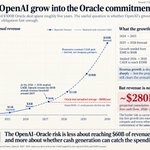
A lot is made out of OpenAI committing to pay Oracle $300 billion while they themselves don't have that amount. I decided to look into the deal a little bit more and to see if their growth could really justify it and it seems a little bit more realistic than the headlines make it seem.
@Oracle @OpenAI

The hardest thing about writing about AI Strategy and Investing in them is that there are so many interesting moving parts that every remotely interesting concept turns into War and Peace, GPU Editions. Can’t analyze models without analyzing compute financing contracts, debt-equity ratios and the different risk profiles taken up by underwriters.
I’ve never been more tempted to leave everything and become a full time writer just to have the time to document everything regularly.
Who gets hit first in the AI Crunch?
A common mistake people make is to assume whoever owns the GPUs is taking the biggest risk. While this simplification is true at time, it’s wrong more often due to the complicated nature of compute contracts. Imagine a simplified scenario where two companies build exactly the same $1 billion GPU cluster: Company A rents it out on-demand; Company B signs a customer to pay a fixed price for three years.
If compute prices fall 40%—
Company A gets hit almost immediately. Customers move to cheaper capacity or ask for lower prices.
Company B is in a very different position since the customer is already locked into the contract until the end of the period.
This simplified scenario is playing out IRL right now.
CoreWeave sells both on-demand capacity and committed contracts, but 98% of its revenue in Q2 came from customer commitments. These committed contracts are generally take-or-pay, meaning the customer commits to paying for the capacity whether they end up using all of it or not. Customers have also historically prepaid around 15–25% of the total contract value. These commitments insulate all parties from risk (customers get some capacity locked so they can plan ahead (and remember that uncertainty is often costlier than payments) while CoreWeave gets to show revenue).
Therefore, if the market price of compute drops next year, it will be the customer, not CoreWeave that eats the brunt of the loss (of course, this protection only lasts as long as the contract does; after which CW will have to deal with this loss in asset).
But financing contracts IRL make the whole situation much more interesting than just this. CoreWeave recently raised a $2.6 billion financing facility with a roughly five-year maturity, while the customer contracts supporting it average roughly three years. In other words, the customer pays CoreWeave for three years while the debt lasts around five.
If the market still loves those GPUs three years from now, no problem. CoreWeave renews the customer, finds somebody else, or refinances the remaining debt.
But if compute has gotten much cheaper, newer hardware has changed the economics, or customers simply refuse to sign contracts at the same price, there is now a gap between the revenue CoreWeave originally locked in and the debt that still needs to be serviced. That can cause some serious problems.
So then are the true people at risk the financiers of this boom? Not completely, since the actual financing has minimum coverage requirements, collateral, a parent guarantee, and mechanisms that can force CoreWeave to pay down debt if suitable replacement contracts are not signed. The facility requires at least 1.35× debt-service coverage, while the underlying credit agreement contains specific provisions around contract renewals and debt reduction.
So once again the risk shifts to another place in the stack. Hopefully you’re starting to understand how complicated these massive buildouts get, and why simplistic boom/bubble narratives create incomplete pictures of the situation. In this current profile, the risk gets redistributed to something like this:
The customer might first be stuck paying above-market prices.
CoreWeave might then take the hit when that contract expires.
If CoreWeave has to inject cash or repay debt early, equity holders may feel it before lenders do.
Only after those protections fail do creditors start worrying about whether the GPUs and other collateral are actually worth enough to recover their money.
A lot of media headlines tend to focus on leverage, but cases like this are why it can often be a “faux ami” (false friend; when I studied French, this was the term for words that looked like English words but meant something else; such as travailler, which means to work, not to travel as one might expect). A heavily indebted company with long customer commitments can sometimes be better protected against a short-term pricing shock than a lightly indebted company selling everything month-to-month.
The opposite is also true. A giant backlog can look wonderfully safe until you notice that the debt lasts longer than the contract, the customer base is concentrated, or the company has to keep spending heavily just to replace old hardware and deliver what it promised. This is one of the reasons why people suddenly turned on Oracle a few months ago, since fulfilling the backlog required them to spend a lot of money they did not have to serve customers who might not make it past 2 years.
For investors, there are therefore a few very different kinds of risk hiding under the phrase “AI infrastructure risk”:
Pricing risk: what happens when the market price of compute falls?
Utilization risk: what happens when the capacity simply sits unused?
Customer risk: what happens when the person who promised to pay cannot—or finds a way not to?
Renewal risk: what happens when the protected period ends?
Financing risk: what happens if the debt is still there when the protection disappears?
With different players carrying different combinations of those risks. This is also why there are some companies that look very safe on paper, but a deeper look at their contracts tells us that they have functionally guaranteed enough of the deal that the risk comes straight back to them anyway.
But let’s not get too ahead of ourselves yet.
A more domain specific version of my general thesis that most post training and RL runs are useless since they don't accomplish what people want them to and that there are much more fun ways to spend your time and money while getting better results.
This is going to be a pretty long answer, but just to preface it: if you really disagree with this, or you feel strongly that you have data that proves me wrong, let’s discuss it properly.
We can do a public roundtable with you, your research team, engineering guys, whoever else you think would add value to the discussion. My community is almost at 2 million people monthly now, and I think it would be a great way to show people how you guys are thinking about this, why you’re so confident in the approach, and where you think my analysis is wrong. The point would not be "debate" (I think that's corny af), but to have a good-faith discussion about our differences in opinion/technical thesis in a way that everyone can walk out with a better understanding of things.
Happy to also talk privately if that's better. Or just argue with code, as they say. We'll define a task, define a budget, we build it in our own ways, and let’s compare the results.
Now onto the answers. TLDR: training custom models would be wasteful for law firms and most challenges around sensitive agentic deployments are not a model layer problem. Trying to solve them in the model layer creates major security issues that law firms will not want to deal with.
1-- when you talk about helping law firms build their own models/building on their private data, you're likely suggesting post-training, because obviously they will not have the amount of money and data required to train a completely new intelligent model from scratch. Especially one that’s competitive against the really good open models out there currently.
This is not useful to them because stacks of research have already shown us that most of the knowledge of an LLM comes from the pre-training stage, not from the post-training. Post-training is essentially just a way to change how the model samples from its latent space, but the way concepts are organized and information is actually learned is mostly coming from the pre-training stage.
This is a problem for law firms because they don’t want their own custom knowledge, their client data, their own proprietary knowledge, to be confused with generic off-the-shelf internet insights (since you're not changing the pre-training). The whole point of training a model on your custom data would be that it’s much more precise, much more grounded in your data (including private data that isn't available in generic models). If you’re only post-training and not pre-training, most of your knowledge is still coming from that generic base.
You can actually confirm this for yourself with your tenant models. Compare outputs on identical tasks between the tenant model and the base model it was post-trained from. You’ll see that the distributions are actually quite similar, especially when you account for the amount of resources you would have had to spend getting there.
2) let’s say you realize this and you’re post-training the model not to be more knowledgeable, but specifically to navigate a law firm’s spaces better: learn how to navigate through Google Drive connectors, any enterprise software they’ve bought, DISCO, Clio, etc. The problem there is most generic off-the-shelf LLMs, especially the really cutting-edge ones, will already have had access to the same tools and will know how to navigate these environments themselves. It’s not like these environments are alien technology that intelligent models will not be familiar with. So then you’re again stuck on the same issue: what is the ROI?
Especially when you consider the fact that once you start getting into post-training, what happens when the next generation of model comes out? Are you just going to start post-training again? You’ll have to post-train that and redo all of your investment.
So really all that gets left are the very, very specific law firm things: ways they want to practice, where the templates are, how to find their templates, how to use their templates, etc. That is incredibly valuable. But any generic intelligent model plus a well-defined harness and a well-defined customized context map can handle this much better. Customizing the harness (this includes setting up things like access controls, which we will talk about in a sec) and context map will be 10x cheaper and much better than training a model. If you're skeptical about this, let's back both of our claims with code.
3) Now let’s say for the sake of argument that your law firm is committed to investing a lot of money into pre-training and post-training a model. They have the data, they have the compute, and they have the stubbornness to go ahead with this. The final problem here is that agent deployment in sensitive enterprise settings is not blocked by intelligence. In most cases, it’s blocked by other important aspects, such as data access control, strict edit permissions, etc.
Certain employees should be able to access certain kinds of data; other employees should not. For some questions, answering them might require the system to access data that the employee should not see directly. It should be able to use that data to produce an allowed answer without exposing the raw data, or simply say that at their level of access control it cannot do this. Both are valid, depending on the org rules, but monitoring and enforcing these rules should not be purely left to LLM calls.
Similarly, what about edit controls? You should be able to edit your files, not edit files above your permission level and absolutely not touch client data. If you try to solve these kinds of problems in the AI model layer, you are just introducing unnecessary stochasticity. You will have mistakes.
Look no further than coding models for prood. despite tens of billions of dollars invested into post-training coding models, coding models continue to do stupid shit like delete production databases and rewrite access controls.
And coding models have orders of magnitude more investment behind them. Coding is more verifiable, so it’s easier to train with post-training techniques. Coding is also a domain AI researchers and engineers are familiar with, so there’s much greater domain understanding there compared to something like law, where your AI researcher and your AI engineer will usually not know law particularly deeply. Despite all of those advantages, coding models still have not solved these problems because these are not AI model-layer problems.
Anybody trying to solve these problems by just training a law-firm AI model is introducing unnecessary security risks and unnecessary costs. All of which will compund when the agents spins out subagents in swarms.
4) And I haven’t even started to mention the fact that even if you do train your own model, you still have to worry about inference. There’s a reason AI inference companies and providers that optimize GPU utilization and inference utilization make so much money. What are you going to do? Go to a cloud/neo cloud provider and tell them to host your model? Host it in a VPC?
Because otherwise you’re asking law firms to invest not just in research teams and model teams, but also inference engineers, cloud-serving engineers, DevOps guys, and everything required to make sure one person’s query doesn’t get messed up with another person’s query. These problems continue to compound. You’re adding a lot of unnecessary headache onto people, and you’re doing all of this for basically no gain.
It is much simpler for a law firm to take, if they want, an open model hosted in their environment or through something like OpenRouter. Fine. Or if they want a closed model, they can use an API with ZDR and no training guarantees. Then worry about setting up the harness, the context map, the access controls, and building a system with the security and access-control structure in place.
That will give you 10 times the results.
Happy to hear where you see things differently
I was getting sick of Codex wasting so many tokens and still making stupid mistakes and missing important details. So I decided to rebuild Codex ground up, with Irys’s stateful reasoning philosophy built in natively.
The result on our internal work:
-)Lower token usage in long running projects.
-)Our analysis was much better at making “non-obvious “ connections since it often had facts on hand instead of spending compute re-deriving it.
-)Much clearer transparency on the reasoning process.
I decided to benchmark our version of Codex against the standard Codex benchmarks. So far results have been encouraging (TerminalBench in progress).
Because I’m a nice guy, I’ll open source it so that the people at @harvey AI can learn how they can get the best results w/o nuking their margins.
