
Views are my own.
Joined September 2009
- Tweets2.7K
- Following694
- Followers356
- Likes1.2K




Pinned Tweet
This podcast is with Michael Dugina, who is the Strength and Conditioning Co-ordinator at Collingwood Football Club in the Australian Football League. His story is inspirational. He started at the club as the Boxing Coach in 1994.…lnkd.in/edMMxCd lnkd.in/e5iwNab

Beijing Provincial team. One year contract with plan to extend to 2029 National Games. Flights, accommodation and food all provided. DM me or email.

Loris Bertolacci retweeted

Can you make it to the hardest progression? 🤔
The gluteus medius is one of the most clinically relevant muscles of the hip. Strength deficits contribute to limited single leg stability, running/walking tolerance, or pain with squats/lunges
Let us know if you can do all five 💪
Loris Bertolacci retweeted

Could have asked tennis players who do this every year and need to compete. The data and science is rather clear on it. The Rams strategy was against anything that would typically be recommended by sport scientists who have been involved in this type of travel with pro athletes.
Loris Bertolacci retweeted

Quantifying an athlete's journey can lead to longer, healthier careers. Instead of banning high-risk sports, we innovate—like in Formula 1. The goal is to optimize athlete health and performance, not to stop the sport. #AthleteHealth #SportsScience #Performance
Loris Bertolacci retweeted

VO₂max is not the whole story.
I’ve been showing this slide for the last 15 years.
Same athlete, 2 years apart.
VO₂max? Essentially unchanged.
Performance? From average to one of the best.
What changed was lactate!.
VO₂max reflects cardiorespiratory adaptations to exercise, the size of the engine: heart, lungs, and oxygen delivery.
Lactate reflects how efficiently that engine runs: mitochondrial function, cellular metabolism, substrate utilization, and metabolic flexibility.
At the same workload, markedly lower lactate indicates greater mitochondrial efficiency and improved lactate clearance capacity. In other words, better metabolism.
In elite sport, we’ve known for decades that VO₂max does not discriminate among top performers. Many athletes share similar VO₂max values, yet those with superior mitochondrial function are the ones who win. That difference is metabolic efficiency, and we assess it through lactate testing, not VO₂max testing.
Suddenly VO₂max is being crowned as the gold standard for longevity. But metabolic health is one of the main focuses of longevity. If that is the case, the most meaningful marker should also be metabolic and Lactate provides a more precise window into mitochondrial function. Furthermore, unlike VO₂max, Lactate allows us to individualize and prescribe exercise with accuracy, something we’ve been doing with athletes for decades
#lactate #metabolichealth #longevity

MAS is an intensity measure for conditioning prescription. It is not a HIIT session @NE_Heaney sportsmith.co/articles/maxim… via @SportsmithHQ

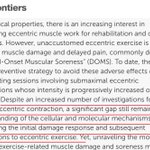
Rush posts dosing speed MD-2. Thought adaptation to eccentric exercise > 36 hours? Priming I get. And get the link between RBE and adaptation to eccentric exercise. Interesting how this review says “significant gap” w eccentric exercise adaptations.
pmc.ncbi.nlm.nih.gov/article…

Loris Bertolacci retweeted

There are few advantages to aging beyond your 20s, from a physiological POV. But if we live long enough, we CAN learn from our youthful overexuberance. I think the biggest mistakes high achievers make is undervaluing and under-exploiting the power of REST. It happens across 4 different time domains:
1. Cognitive recovery during creative and deep mental work: My 10-15 min coffee breaks have very little to do with caffeine and a whole lot to do with getting up out of my chair, interacting with colleagues, and resetting. My best writing happens between gardening and clothes-washing breaks. "Grinding" is a creativity killer.
2. Taking days off from ALL training: My take is that the benefits of the full rest day on all aspects of a busy work and family life FAR outweigh any (so far non-established) "recovery acceleration" benefits of "recovery workouts". Either train purposefully or rest purposefully (and then warm up properly the next day!)
3. Consistency YES, Monotony NO: There is a difference. Great endurance athletes train frequently and accumulate a LOT of time on task. BUT, there are rhythms to this. Yes, 80:20 seems to be a useful starting point for overall intensity distribution. On top of that, there is often a layer of "work load rhythm" such as 3 weeks up and 1 week down that can help prevent mental and physical overreaching issues before they get worse.
4. It can be tempting to roll right through the end of a season and try to get a fast training start on the next season. This jump-start mentality can be motivated by both successes and disappointments. I know elite athletes who have tried this. It rarely goes well. The old expression "The mind needs rest but the body needs work" seems to have real merit here. Besides resolving minor physical niggles, I strongly suspect there are some brain chemistry resets that are at play. Don't be afraid to enjoy your Christmas Holidays!
Loris Bertolacci retweeted

The (relative) importance of training volume and intensity: why there are no shortcuts in endurance sports?
A short thread 🧵
👇

Loris Bertolacci retweeted

A Trump supporter was seated next to an older woman on an airplane and he turned to her and said, “Do you want to talk? Flights go quicker if you strike up a conversation with your fellow passenger.”
The old woman, who had just started to read her book, replied to the total stranger:
“What would you want to talk about?”
“Oh, I don’t know,” said the man. “How about how they stole the election in 2020 and Donald Trump should be president.”
“Okay,” she said. “Those could be interesting topics but let me ask you a question first. A horse, a cow, and a deer all eat the same stuff – grass. Yet a deer excretes little pellets, while a cow turns out a flat patty, but a horse produces clumps. Why do you suppose that is?”
The man, visibly surprised by the old woman’s, thinks about it and says, “Hmmm, I have no idea.”
To which the old woman replies, “Do you really feel qualified to discuss politics, when you don’t know shit?”

Loris Bertolacci retweeted

Note 1500m runner Jye Edwards, 20cm airborne before one of >2000 multiple-bodywt plyometric footstrike forces through the Achilles in a track session. It's worth considering the risk/benefit ratio before adding plyometic stress to the Achilles in a middle-distance gym program.

Loris Bertolacci retweeted

The amount of rest you prescribe in workouts, can hugely change the type of training stimulus received.
Be deliberate with your choices.
Examples below from sprint training recommendations.

Lauren Bertolacci. Head Coach Switzerland Women’s Volleyball at Euro Volley. She is only female head coach in tournament. 97 coaches (assistants etc) in tournament. Only 11 females. In national league NUC Volleyball has dominated the National league multiple titles for 4 years.


I worked alongside Graham Turner PhD at the NTIS in 2017. Together with Tadek Rudz we published in the NSCA journal (Strength and Conditioning Coaching Practice and Positive Youth Athletic Development: Context-Specific Application of the Developmental Re…lnkd.in/gex9QQ3P
Jarrod Egan has a wealth of experience. He started with me in the AFL in 2000 at the Geelong Cats. Before that he had done a stint at AIS. He also was a very good track and field athlete. He then worked at the Kangaroos AFL as HPM. Followed by stints in c…lnkd.in/g-JWkWW6
Interesting that with many injuries stats not lower. Despite exponential increase knowledge. IMO often the "umma amma" approach to RTP & "let's see how it goes/ticks boxes" is a problem. Instead of after diagnosis/initial rehab sticking to plan & working back from planned RTP.
In 2021 after the Tokyo Olympics, the Shanghai Institute Sport asked me to write an article for a Chinese Journal on Team Pursuit Cycling. Before 2019 I could not clearly articulate what an Omnium or Madison race entailed nor knew…lnkd.in/e9XAsqBR lnkd.in/ePMvkN_t