

Logic and applications of logic from @JohnDCook
Houston, TX
Joined September 2016
- Tweets2.2K
- Following8
- Followers28.3K
- Likes8





Logic & Applications retweeted

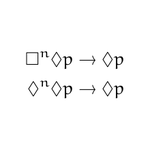
New post: Privacy Policies and Modal Logic
johndcook.com/blog/2026/10/0…

Logic & Applications retweeted

A topological model for provability logic
johndcook.com/blog/2026/10/0…
Logic & Applications retweeted
Topological models of modal logic
johndcook.com/blog/2026/10/0…
Logic & Applications retweeted

The Curry-Howard correspondence is only one of many lenses we can use to view the relationship between things and facts. Different lenses characterize different approaches to foundation:
- Propositions are basic (single-sorted logics, ZF)
- Types are basic, some types are propositions (Homotopy Type Theory)
- Propositions and types are the same (Martin-Löf’s Type Theory)
- Propositions and types are different but equally basic (Logic-enriched Type Theory)
Shulman explains how the Axiom of Choice is true some but not in others, arguing that in certain respects, the HoTT’s way is the most “natural”: golem.ph.utexas.edu/category…
Adams & Luo argue instead for the practical virtues of making propositions and types completely separate: arxiv.org/html/0809.2061v3

Logic & Applications retweeted

Two integers satisfy 1 < x < y and x + y ≤ 100.
S is given the sum x + y and P is given the product xy.
Then S and P have the following dialog.
P: “I do not know the numbers.”
S: “I knew you didn’t.”
P: “Now I know them.”
S: “Now I know them too.”
What are x and y?
Logic & Applications retweeted

Awesome!
Kevin Buzzard had a 5-year grant to formalize the proof of Fermat's Last Theorem, but now Claude has done it in 11 days!

Checking that a major mathematical proof is correct can take years. Formalization—converting the mathematical reasoning into a form computer proof assistants like Lean can verify—can help.
Last month, Claude completed the first formalized proof of Fermat’s Last Theorem, one of the most famous theorems of all time. This was a project experts thought would take many years. It is the largest Lean proof ever written.
Fermat’s Last Theorem was first proven in 1995 by Sir Andrew Wiles, more than 350 years after it was conjectured. Our proof, which totals over 13 million lines of code, provides machine verification. More importantly, it proves over 29,000 other theorems that the proof requires, across many areas of math which had never before been formalized.
We see this as a major step in the long process of firming up the core of mathematical knowledge, building on work from three centuries of mathematicians and hundreds of contributors to Lean and Mathlib. We are optimistic that AI-assisted verification of mathematical proofs will help reduce the burden of refereeing mathematics in an era where more proofs are being produced than ever before.
You can read about the process on our Science Blog: anthropic.com/research/forma…
And see the complete proof on GitHub: github.com/anthropics/fermat…


Logic & Applications retweeted

Löb's theorem asserts that for any computably axiomatizable (sufficient) theory of arithmetic T, if T proves Pr_T(φ)→φ, where Pr_T is the provability predicate, then T proves φ outright. In short, if you can deduce φ from the provability of φ, then you can deduce φ directly.
Logic & Applications retweeted

Placing all six chess pieces on a 6 by 5 board so that no piece attacks another.
Solution using Claude to generate Z3/Python.
johndcook.com/blog/2026/06/2…


Logic & Applications retweeted

I'm here to tell you a dirty secret about Gödel's incompleteness theorems, after having been asked whether we might hit a "Gödel limit" when trying to prove the correctness of computer programs.
My qualification to speak on this is that I'm a software engineer who used to be a mathematician with a strong interest in foundational logic and mathematical philosophy, and I still track the field.
Here's the skinny about Gödel limits...
Gödel's incompleteness theorems are theoretically and philosophically tremendously important, but most mathematicians don't expect the limits implied by those theorems to be important in practice - not at the proof scales accessible by humans.
We don't know for sure, but the intuitive sense of most mathematicians is that true but Gödel-inaccessible theorems are probably far away from us in very weird corners of the space of all formally possible propositions.
The reason for this intuition is that you have to do very odd contortions to construct a proposition that demonstrates Gödel-inaccessibility. Such constructions are not mathematically natural questions.
Consider the contrast with the Continuum Hypothesis or the Axiom of Choice. These arise from very simple and natural questions the answers to which turn out to be unprovable in standard set theory. They are not weird, twisted constructions made specifically to force the axiom system to rupture something.
Because all reasoning about computer programs is reasoning about finite sets, it seems highly unlikely that being able to prove the correctness of a program will ever depend on even unprovable propositions as natural as CH or AC, which are axioms about what you can do with infinite sets.
Still less likely does it seem that the proof of any program will ever depend on a proposition that is Gödel-inaccessible.
So, in practice, it is not worth worrying about Gödel-inaccessibility of program proofs. Unless you're the sort of person who worries compulsively about, oh, I dunno, being beaned by a meteorite made of solid platinum, in which case there probably isn't much I can do to ease your tension.
Of course, we could be wrong. There could be a landmine, or any number of landmines, in the regions of proof space we care about. The real worry about the Riemann hypothesis isn't whether it's true or false, but that it might turn out to be such a landmine.
Then again, the Riemann hypothesis involves claims about infinities. Even if it does turn out to be Gödel-inaccessible (and the most mathematicians don't worry that it is) it would be quite a bit more shocking if a proof on finite sets turned out to be.
Logic & Applications retweeted

A High Value Man:
—shows that logic is complete but math is not
—formalizes the Ontological Argument
—solves Einstein’s equations to allow for time travel
—finds an inconsistency in the US Constitution
—fears the refrigerator
—writes his love letters in Gabelsberger shorthand


Logic & Applications retweeted

Should I use Frege’s notation in my discrete mathematics course, just for giggles?


Logic & Applications retweeted

Saharon Shelah and number 4, a thread.
Shelah is an incredibly prolific mathematician working mostly in mathematical logic who has (co-)authored around 1500 papers so far. His other superpower is the ability to discover number 4 where it has absolutely no reason to be. 1/32

Logic & Applications retweeted
“It is a constant source of annoyance when you come up with a clever special algorithm which then gets beaten by translation to SAT.” — Chris Jefferson

