




The one dashboard a CRE brokerage actually needs is four views, not one screen.
1. Pipeline: which deals move today
2. Site demand: who needs power and land, and when
3. Market pulse: what to post, what worked
4. Verification brief: every claim checked against a primary source before it reaches the queue
AI can fill the cells. A human still owns the publish button.
What's on yours?
21
79% of site selectors now rank power as a top factor (Site Selectors Guild via CRE Daily). In 2024, workforce was #1. Over half say weak power alone gets a site cut.
Selling land or industrial? Document the power before you list.
credaily.com/briefs/power-ac…

25
The market isn't doubting data center demand. It's pricing who can get built.
Yesterday, leased AWS powered shells priced at a 7.0% cap. Today we learn a bank sold its slice of a permit-troubled campus loan in the mid-80s.
Developers: what do your lenders make you prove first?

HSBC sold roughly $300 million of debt tied to Oracle's $ORCL Project Jupiter data center at a steep discount.
The bank sold its $300 million share of the project's $18 billion construction loan for roughly $255 million, about $45 million below face value.
The 2.45 GW campus in New Mexico is part of the Stargate AI infrastructure initiative backed by Oracle, OpenAI and SoftBank. The project has faced local opposition and significant delays in securing air and pipeline permits.
The sale came shortly after Oracle issued a force majeure notice to the developer, a unit of Blue Owl Capital, seeking to delay certain payments if the project is derailed or misses its planned 2028 opening.
About 20 banks participated in the original $18 billion financing. Construction lenders typically hold these loans until projects are completed, making an early sale at such a steep discount noteworthy.
Separately, ING and Société Générale have put up to $800 million of other data center loans up for sale in recent weeks, including exposure to Oracle's Stargate initiative.
Source: Bloomberg, Financial Times.

28
Delay and higher cost, not cancellation. That's what it looks like on the ground in Missouri this week.
Springfield extended its data center pause to Feb. 24. Independence pushed its next vote to December.
Landowners: would you rather get a clear no or a rolling not yet?

AI data-centre: 100% moratorium improbable, modest slowdown likely and it will elongate the cycle (and the selloff has already priced a lot in)
Post-midterm noise has focused on local ballots, state pauses and talk of tighter rules on new data centres. Legitimate friction exists: power, water, permitting and community pushback are real constraints. However, a near-total U.S. halt is improbable as it will send the US into an immediate recession.
AI is a strategic priority; economic and geopolitical costs of freezing buildout are high. Much near-term capacity is already permitted or under construction.
Private land + evolving power solutions (gas, nuclear, efficiency) + international options provide outlets.
No federal ban has material traction; impact is more delay and higher cost than cancellation.
Base case from banks: some 2028 projects slide to 2029. This elongates the AI capex cycle rather than derailing it. Positives include:
1) Smoother supply-demand rebalancing (less boom-bust risk for the supply chain).
2) Better utilisation and pricing power for compute.
3) Improved credit outlook and more sustainable multi-year spending.
4) Hyperscalers still guiding strong near-term capex; and they will likely become FCF +ve
The aggressive selloff in AI infrastructure names (picks-and-shovels, semis, related industrials) has already discounted substantial slowdown risk. Multiples have compressed hard while order books and guidance have stayed firm. This looks more like a positioning/sentiment reset than a fundamental end of the cycle.
Quality AI infrastructure exposure still looks attractive if demand holds. Best to own companies with strong balance-sheets, high margins, FCF and real backlog. alphatarget.com
27
KCMO's new economic scorecard: population +1.0%, median household income +7.6%, asking rent +4.3%.
But housing permits are down 22.5% and commercial construction costs are up 7.6%.
Demand is growing. Supply isn't. That gap favors owners of existing buildings.

29
Amazon just told you what a powered shell is worth.
7.0% cap, 12-year triple net leaseback. The scarce part isn't the building. It's the power and the permission to build it.
Developers: is 7% where you'd sell a stabilized powered shell in the Midwest?
AMAZON IS SELLING DATA CENTERS & RENTING THEM BACK
Blackstone's new data center trust is buying a 75% stake in two $AMZN data center campuses valued at about $5 billion. The deal covers 13 newly built data center buildings with 647 megawatts of power capacity, nine in northern Indiana near Chicago and four in Mississippi.
Amazon keeps the other 25% and will lease back all 13 buildings for at least 12 years, with options that can stretch to 32. The price works out to a 7% initial yield, and the rent rises 2.75% a year.
At closing, Amazon gets a cash payout funded by $1.9 billion from Blackstone and about $2.5 billion of new mortgage loans on the buildings. Amazon said the partnership lets it keep expanding as demand grows.
Meta did a version of this last year, when funds run by Blue Owl took an 80% stake in its $27 billion Hyperion data center campus in Louisiana.
It is the first deal for Blackstone Digital Infrastructure Trust, which raised $1.75 billion in its IPO in May. It is expected to close by year-end.


57
In an 8-deal test, AI got every hard number right and about a quarter of the returns (Avi Hacker).
Let AI pull the rent roll, the T-12 and the tax bill. Rent growth and the exit cap are still judgment calls. That's the job.
avihacker.substack.com/p/cla…
1
58
Overland Park's Planning Commission voted 10-0 to recommend rezoning Corporate Woods for a $500M plan: 1,206 homes + 29K SF retail, added on surface parking. The office buildings stay. Council takes it up Dec 7. Office-first or neighborhood-first?
linkedin.com/feed/update/urn…

88
Evergy's "Path to Power" for 25 MW+ loads (MO PSC testimony): $200K study deposit, land rights, site plan, signed letter of agreement.
Then a cluster queue "if there is a space available" and an SPP study of ~90 days.
Evergy runs RFIs too. This is the queue side.
52
Data centers are fighting for permission. KC industrial is fighting for space.
Newmark Zimmer 3Q26: KC industrial vacancy 3.7%, down 100 bp year over year, lowest among the top 30 U.S. markets. Net absorption: 5.8M SF in the quarter.
Owner-users and tenants with 2027 expirations should start now.
nmrkzimmer.com/wp-content/up…
1
49
Rates won't break everyone the same way. They break thin spreads. The 10-year closed at 5.15% Friday. KC's average cap rate is 6.2% (Newmark Zimmer 3Q26), about 105 bp of room. Which property type cracks first?

38
A power delay just made a public data center company a takeover target.
Goodman and Digital Realty sought up to 9.9% of Australia's NEXTDC at A$9.50 a share after a Melbourne grid delay cut its FY27 guidance. Shares rose about 51% (CNBC).
The energization date is the asset. Acreage is just the wrapper.
60
Tenant credit is the real asset in a data center deal. Fermi lost its TensorWave lease and the AMD backstop, then got an investment-grade hyperscaler to put $200M up front for power before a lease is even signed. Who carries the risk?

Fermi Terminates $6.5 billion $AMD data center
Fermi–TensorWave: $6.5 billion agreement terminated
This is the clearest cancellation.
Fermi’s November 12 earnings disclosure confirms that its data-center lease with TensorWave was terminated, along with the associated AMD credit-support agreement.
The original agreement involved:
Approximately 222 MW of capacity.
Approximately $6.5 billion in anticipated revenue over 15 years.
An AMD credit-support arrangement.
46
A $28M Leawood, KS project that isn't really about storage.
The Foundry: luxury garage condos with a clubhouse bar, poker nights and weekly Cars + Coffee. Units from $315K.
Builds like this pop up where people want to be. Would you buy in?
linkedin.com/feed/update/urn…

21
TPG Net Lease's Gordon Whiting: "I'd rather be investing in a rising interest rate environment." A higher going-in cap rate on a 20 to 25 year lease leaves more room for compression.
CBRE's Spencer Levy says he's the first guest in 7 years to say it. Owner-users thinking about a sale-leaseback should hear this.
Clip: The Weekly Take from CBRE, Oct 26, 2026
1
69
Avison Young is tracking 124 proposed or announced U.S. manufacturing projects worth about $3.4T. Only about two dozen, roughly $500B, are actually under construction.
The gap is the story. Announcements are easy. Power, permits and site prep decide which ones get built, and the Midwest is in that race (SK Hynix's $4B chip packaging plant in West Lafayette, Indiana broke ground in August).
Every one of these plants pulls suppliers and logistics space behind it.
(Avison Young via Bisnow and CRE Daily. h/t Jake Heller's PLOT roundup)
1
59
On the data center line: Missouri already makes the biggest loads carry their own costs. Evergy's large-load rate starts at 75 MW, with long-term contracts and minimum payments, and Evergy says expected data center revenue cut its new Missouri West rate request by $61 million. The rate protection he's asking for exists here. A federal pause would hit projects that are paying in.

Senate Republicans trying to figure out what to do in the next 6 weeks? Here you go:
DEFUND Planned Parenthood
MORATORIUM on data centers
SUSPEND the gas tax
FUND rural hospitals
SAVE AMERICA ACT
56
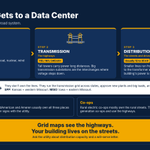
Grid maps see the highways. Your building lives on the streets.
How power gets to a data center, in road terms:
1. Generation = the factory that makes the cars. Power plants: gas, coal, nuclear, wind, solar.
2. Transmission = the highways. Tall towers, very high voltage (115/161/345 kV+), long distances. Big transmission substations are the interchanges where voltage steps down.
3. Distribution = the streets and driveway. Smaller lines, usually 12 to 35 kV, from a local substation to the transformer at your building. This is where it really gets decided.
ISOs (SPP, MISO, PJM) are the traffic controllers. They don't own the lines. They run the grid across states and approve new plants and big loads. Kansas + western Missouri = SPP. Iowa + eastern Missouri = MISO.
Utilities like Evergy, MidAmerican and Ameren usually own all three pieces here. A data center signs with the utility. Rural co-ops mostly own the rural streets.
Most online tools only see the highways. They can't see the streets or the line of big users already waiting for power.
Transmission tells you power is nearby. Distribution and a will-serve letter tell you if your building can get it.
That's what I help owners and data center buyers figure out at Midwest CRE Advisors: which buildings can actually get power.

52
Under construction is now its own asset class.
Oracle's CFO says the data centers already being built get more valuable as they near completion. My read on the land side: in KC, sites that cleared zoning before the backlash should be worth more than ones that haven't. Agree?

Oracle CFO predicts its data centers under construction will become even more valuable as they get closer to completion, noting anti-data center sentiment didn’t just arise on Election Day
David Faber: “We’ve been talking a lot since the election about the possibility of data center delays. How important is that to your ability to continue to grow and meet the specific metrics you just lined out?”
Hilary Maxson (CFO): “They get a lot of headlines. We have five large data centers under construction already in the US. One of those is nearing completion, so there’s four primarily that are under construction today. They started in our calendar year ‘26, all the way through ‘29. So it’s part of the seven gigawatts we’re bringing online, but not all. That said, it’s an important part, and we think that we have all of the scenario planning in place in order to bring those data centers online in a timing that allows us to achieve the commitments that we gave.”
David Faber: “Regardless of our political environment? Or the various referendums that said, hey, no more data centers in our backyard?”
Hilary Maxson: “These are projects that are already under construction, which generally are quite different than new data centers. So I think we feel pretty confident. It’s not like anti-data center sentiment just arose last Tuesday. Actually, this is an environment that we’ve been dealing with for at least the past eight to ten months. So I don’t think anything really changed for us on Tuesday, aside from maybe those data centers, as we get them to completion, will actually be even more valuable in future.”
$ORCL
_______
Source: CNBC
40
Meta has $355.73B in leases it has signed but not yet started, per its Q3 10-Q.
Data centers, energy infrastructure, colocation and network. Start dates run from late 2026 through 2036, with terms up to 30 years.
That demand is already on paper. What's scarce is powered land that can actually deliver on schedule, and more of that conversation is happening in the Midwest.
h/t Jake Heller's PLOT roundup
sec.gov/Archives/edgar/data/…
37