

Official account of Prof. Julian Knight's lab at @NDMOxford @OxfordMedSci and @HumanGeneticsOx Using functional genomics to understand the human immune system
Oxford, England
Joined February 2016
- Tweets257
- Following352
- Followers565
- Likes133






Our new study shows a genetic variant fine-tunes MTOR and immune crosstalk, improving survival in pneumonia-associated #sepsis - toward personalised treatments.
Congrats to @pingzhangneho and everyone involved! @HumanGeneticsOx @CAMS_COI_Ox @NatureComms
nature.com/articles/s41467-0…

Knight Genetics retweeted

Glad to share our study showing how a common genetic variant impacts immune cell-cell communication and patient survival in pneumonia-associated sepsis, providing a framework for stratified therapy. Thanks to our funders and everyone involved.
nature.com/articles/s41467-0…

Knight Genetics retweeted

Comprehensive epigenomic profiling reveals the extent of disease-specific chromatin states and informs target discovery in ankylosing spondylitis dlvr.it/Sn0DBD

Our research on the chromatin landscape of ankylosing spondylitis (AS) has just been published in @CellGenomics. An important step towards future drug discovery.
Congratulations to @DrCarlaCohen, @HumanGeneticsOx, and and everyone involved!

Really excited to present our research on epigenomics of #AnkylosingSpondylitis, a spinal arthritis.
Published this week in @CellGenomics: doi.org/10.1016/j.xgen.2023.…
1st authors: Andrew Brown, Ola Mielczarek, Gabriele Migliorini and @DrCarlaCohen
A 🧵

We are excited to share our recent work mapping the host response to sepsis at single-cell resolution. The study, led by @andrewjkwok and published in @NatImmunol, identifies a subset of immature neutrophils which is increased in severe sepsis.
Big thanks to everyone involved!

Julian Knight and colleagues find that altered granulopoiesis and increases in immature immunosuppressive neutrophil subsets are associated with poor outcomes in some patients with sepsis. Read it here: rdcu.be/daDeU
nature.com/articles/s41590-0…
Knight Genetics retweeted

Congratulations to @KnightGenetics @andrewjkwok @eddiecg and team for their work on immune subsets in sepsis
Julian Knight and colleagues find that altered granulopoiesis and increases in immature immunosuppressive neutrophil subsets are associated with poor outcomes in some patients with sepsis. Read it here: rdcu.be/daDeU
nature.com/articles/s41590-0…
Knight Genetics retweeted
Our study on AS epigenomics has been covered by @GenomeWeb
Watch this space for link to paper and 🧵

Ankylosing Spondylitis Genomics Study Points to Genes, Pathways for Drug Discovery. Researchers analyzed transcriptomic and epigenomic features in immune cells from cases and controls alongside genetic risk data. ow.ly/Mxen104EMMw
A big thank you to the patients, families, clinicians, and research nurses involved in our sepsis studies, without whom this wouldn't have been possible.
Congratulations to @eddiecg @ee_davenport @HumanGeneticsOx @sangerinstitute and everyone else involved!
For more information, you can refer to our full publication and the associated R package:
R package: bit.ly/3zIRqxs
Publication: bit.ly/3FKyhij
(14/15)

In summary, we derived a transcriptional measure of risk (SRSq) which captures information on a patient's overall immune function.
SRSq can be predicted using SepstratifieR and is associated with illness severity in adult and paediatric sepsis, influenza, and COVID-19. (13/15)

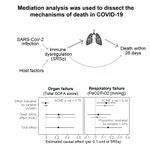
In contrast to our observations in sepsis, mediation analysis revealed that in COVID-19 SRSq likely increases risk of death mostly via alterations to lung function.
Thus, single-organ dysfunction is a much more important mediator of death in COVID-19 than in sepsis. (12/15)

SRSq was also predictive of severity in a cohort of COVID-19 patients (COMBAT study).
SRSq estimates correlated not only with patient groupings proposed by the WHO, but also with neutrophil counts, clinical measures of severity (e.g. SOFA and P/F ratio), and mortality. (11/15)

To assess its applicability, we tested SepstratifieR in patients who would not fulfil conventional sepsis criteria.
SRSq was detectable in patients hospitalised with H1N1 influenza (MOSAIC study). Moreover, SRSq correlated with the degree of oxygen supplementation (10/15).

We confirmed that SepstratifieR is applicable in both adult and paediatric sepsis.
In paediatric patients, higher SRSq scores were associated with higher illness severity. Moreover, the gene expression program captured by SRSq was present in both patient populations. (9/15)

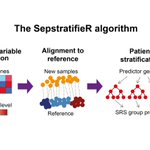
We created an algorithm to predict SRS and SRSq in new cohorts: SepstratifieR.
We trained random forest models for prediction and borrowed a method for batch alignment developed for single-cell omics.
SepstratifieR is publicly available: bit.ly/3zIRqxs
(8/15)

We then asked which clinical alterations explain the observed increase in mortality.
We used mediation analysis, which revealed that SRSq likely results in increased alterations in arterial pressure, coagulation, and renal function, which in turn increase mortality risk. (7/15)

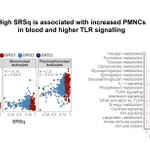
From an immunology perspective, high SRSq was associated with increased frequency of polymorphonuclear cells in blood (including neutrophils) and higher TLR signalling.
This was accompanied by a proportional decrease in lymphocytes and reduced activity of T cell pathways. (6/15)

There was a significant association between SRSq and mortality. An SRSq increase of 0.1 units was associated with a decrease in survival comparable to a patient being 10 years older.
However, if SRSq decreases over time, then a patient's risk of death decreases too. (5/15)

We found that gene expression profiles from sepsis patients and healthy volunteers form a continuum.
We leveraged this fact to derive a quantitative measure of risk: the sepsis response signature score (SRSq).
SRSq ranges from 0 to 1. A higher SRSq reflects higher risk. (4/15)

