
Trying to make it in trading.
Joined March 2020
- Tweets510
- Following701
- Followers88
- Likes463



Keanu retweeted

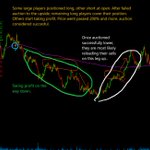
You were taught auction theory wrong.
Fair Value and Point of Control aren't where everyone agrees on what's fair. Quite the opposite.
It's where the most buyers think the price is too low, and the most sellers think it's too high. It's not consensus. It's not fair. It's disagreement.
You don't buy or sell because you think current price is fair - you buy or sell because you belive current price is UNFAIR! Gamechanger, connect the dots :P
Shocker, I know.
(random profiles for attention)


Keanu retweeted

perry's lecture series is reasonable and accessible
sites.bu.edu/perry/lectures/…

Keanu retweeted

TRUE STORY:
When Recognition Becomes a Trap: A True Story from the Inside
In 2012, I was honored to be featured in the book Traders at Work: How the World’s Most Successful Traders Make Their Living in the Market.
It was humbling to be alongside legendary names like @PeterLBrandt @LindaRaschke @AnneMarieTrades
and @ToddFGordon - 16 traders in total, all with verified performance.
The chapter on me focused on my trading style—anchored VWAP, volume profile, and multi-timeframe analysis. The interview captured my thinking, my process, and at the time, my results.
But here's what most people don’t know:
Shortly after the book was published, I hit one of the deepest drawdowns of my career.
The irony wasn’t lost on me. A book about success… followed by a season of struggle.
That season taught me four things I didn’t fully understand until I lived them:
Pride sneaks in quietly. Recognition can puff the ego, and ego distorts clarity. Humility is a superpower—not just personally, but as an edge. It’s what keeps you listening to the market, not just yourself.
Public recognition creates pressure—to maintain, to outperform, to “prove” you belong.
That pressure subtly hijacks decision-making. My risk management suffered. Position sizing, in particular, became more aggressive. Not because the setup warranted it—but because the ego did.
The real lesson?
The market doesn’t care what books you’re in. It will always reward presence over pride… humility over hubris… and process over persona.
And for any trader navigating visibility: don’t confuse being seen with being centered. #tradermindset #tradingpsychology #tradingperformanceWhen
Keanu retweeted

"THE MARKET IS BROKEN": WHY STOCKS MOVE
We are in a stage of markets where it is fashionable to look at the massive moves in $NVDA (+90% YTD) and $SMCI (+242% YTD) and conclude that the market is broken and price discovery is dominated by quants, pods & retail momentum traders. And to make the argument that "fundamentals don't matter."
While I have my opinions on how some of the AI-levered stocks will play out (which I won't share here), I do have very strong views on the "fundamentals don't matter" debate.
I'm here to assert: fundamentals are all that matter**
(**with an investment horizon longer than 3 months).
Sure, not in a given day, week, month or quarter. Shorter movements in stock prices are certainly influenced by positioning, sentiment & flows. Price discovery in the order book is a function of supply/demand and people buy stocks in a given day for all sorts of reasons (mostly non-fundamental). Trading has always been about identifying the catalyst & the incremental buyer and being ahead of the wall of flows. Some are good at that (I never was).
But extend the horizon even a few months (let alone a few years) and one thing hasn't changed in markets over the last two decades, and won't change in the next two decades: fundamentals are deterministic to stock prices. The analysis I will present below is a ~3 month analysis of why stocks move.
There are two very common proxies for "fundamentals" when looking at a stock, 1) revisions, i.e. how consensus estimates are changing and 2) consensus expected growth, i.e. consensus expectations for revenue growth and margin expansion, which the market in its extrapolative fervor is apt to accept as baseline for the future growth algorithm.
To try to make this point, I did an analysis of the top & bottom 25 stocks in the S&P 500 this year. I applied a very typical "why did the stock move" decomposition analysis of revisions, P/E and growth algorithm shift to try to isolate why these stocks move.
Let's start with revisions
Of the top 25 stocks in the S&P 500 as measured by price performance YTD, 25/25 have seen either positive EPS or revenue revisions to 2024 consensus estimates this year.
Of the bottom 25, 24/25 have seen negative revisions.
A very common framework for short/intermediate term traders is the view that "stocks follow numbers". That has been very true this year.
The trajectory of fundamentals that is captured in shifting consensus estimates has been deterministic to winners/losers this year (as it is almost every year)
Next, let's consider starting valuation
Neither the group of winners or losers was meaningfully above the average S&P 500 company.
The same hedge funds who tell you "stocks follow numbers" will also tell you "valuation isn't a thesis", and they are generally correct.
The group of winners has seen P/E expansion this year by ~4x and losers compression by ~3x. Notable, but not dramatic.
Is this P/E re-rating fair? Fundamentals look ahead
One might look at the winners and say "well this is a valuation driven bubble, those valuations have to de-rate". That certainly seems likely in a few select cases.
But in aggregate, the winners have expanded from 23x to 27x P/E but the fundamentals look quite strong on a go-forward basis using street consensus as a proxy. Nearly 20% revenue growth this year and 10%+ expected in 2025 with ~300bps of OM expansion this year. High 20x P/E for double digit revenue growth & operating margin expansion is arguably very reasonable.
In the group of winners, the accelerating fundamentals as captured by positive revisions to revenue & EPS and solid look ahead expected fundamental growth is supporting the twin stock propulsion of higher numbers & higher valuation. In modern markets, this is how stocks win. Cheap stocks don't magically get expensive... there is, almost always, a fundamental outcome that is influencing valuation. That was true in 25/25 of the top winners this year.
The losers are the inverse. -3.4% average revenue revisions, a group that consensus expected to grow ~7% at the start of the year and now expect to only grow 3.5%. That compression of expected growth has led to de-rating of the P/E. P/E's are a "point of view" on the FCF stream, and it makes sense that slower expected growth (with tepid margin expansion) has flowed through to compressed P/Es.
In conclusion
By no means am I saying that fundamental equity investing is easy. I'm showing you an ex-post analysis. Monday morning quarterback. The hard part is using process & judgment to identify these dynamics ex-ante.
What I'm telling you is fundamentals still matter. Don't fall into the trap that fundamentals don't matter. They
have this year, and they always will. If, heading into the year, my process could identify positive & negative revisions that I felt would support P/E expansion/contraction, these moves were identifiable.
I hope this was helpful, if you want to see the underlying excel analysis my team is putting this into a Google Drive. Check back on my X timeline in a couple hours and we will distribute that way.
Brett
APPENDIX: S&P YTD WINNERS & LOSERS


Keanu retweeted

5/ So if you're making money as a trader, I claim you MUST be providing the world a service. But what's that service?
@therobotjames has already told you the answer a zillion times:
You're bearing risk that others don't want to bear.


Keanu retweeted

Just hung up with a long-time, highly successful founder of a 'medium size' hedge fund. "Fear is essential." Do not bother trying to not be afraid! INSTEAD, seek to know and categorize your degrees of fear as stemming from the price action, your desire to make or not lose money, your desire to make the maximum amount of money, the evidence that you are smart (or not). Is the fear integral or incidental? --(to quote Lerner of Harvard)


Keanu retweeted

Key tenets of wisdom on Risk and Return - #investing
1. Creating a long term portfolio is not all about maximising returns but should also include managing risk and material drawdowns.
Remember (1+x)*(1-x)= 1-x^2
Your portfolio returns are driven by what you loose!

Keanu retweeted
My experience is this topic puts people's head in a blender. 🍌🥤
I tried to make easier.
You can decide how it went.
New Post:
notion.moontowermeta.com/und…

Keanu retweeted
23/ “Lock in a profit when you can.”
I think this is kind of a hack to address a persistent human cognitive bias called loss aversion, but that’s kind of outside scope. It’s a bad hack w/ bad consequences.
The world doesn’t care what your Pnl is.
Keanu retweeted

With the launch of The Mental Game of Trading, I wrote a blog about the big differences between this book and The Mental Game of Poker. Cliffs:
*The system is more systemized
*You'll feel more like a client reading it
*80% more content and no filler
https://xitter.cf/t.co/wvWzUstilx


