

Likes startups, politics, sports, rock music, and math problems.
Joined June 2009
- Tweets1.7K
- Following1.1K
- Followers553
- Likes2K







I spent 11 years as a CFO, then founded a fintech called Glean.
A few years in, a bigger company started using the same name.
I had to learn trademark law in a hurry.
The questions I needed answered were simple ones. How close are these two marks, really? Has anything changed on that filing? Who else is using something like this?
Every answer was already public, sitting in USPTO records. Getting to any of it was miserable because the government's website is clunky and very hard to use.
I started GleanMark to fix that, and today we're announcing our public launch. A few things about GleanMark:
Clearance you can back-test.
I took a mark that had already drawn a refusal and ran it through our clearance analysis. It flagged five registrations as high risk. Those were the exact five the examiner had cited — same marks, same owners. That is the whole product thesis: the answer was sitting in the record the entire time.
An office action drafter that asks before it writes.
Most AI drafting tools take the refusal and hand back prose. Ours starts by asking you the strategy questions: which cure are we pursuing, do we have client authorization for it, what facts can you supply that aren't in the record. It only offers cures actually available for that refusal, and it tells you whether its recommendation comes from the record or is an inference.
Then it brings the receipts — third-party registrations, coexisting pairs, crowded-field evidence — all researched and assembled into the draft.
Don't like where it went? Redirect it — argue, amend, pursue consent — and it drafts again.
An AI that has actually read the register.
Ask Markus, our trademark research associate AI, about a company's TTAB enforcement history and it comes back with the proceedings — which were substantive, which were extensions, and who they went after. Ask it about upcoming deadlines in your portfolio, strategies for responding to office actions, etc. It's like ChatGPT with direct access to the entire USPTO corpus.
Onboarding that is already done when you arrive.
Sign up with your work email and your clients, your registered marks and your deadlines are already populated — because all of it is public record and we matched it for you. No data entry, no implementation call. That one still surprises people more than anything else we built.
We are only doing trademarks on file at the USPTO. Not patents, not other IP jurisdictions. One register, understood properly.
Free to search, no account needed. Plans from $99/month, published, no sales call.
On July 26, John Oliver closed Last Week Tonight by daring Buc-ee's to sue him. He put "Buc-Off" merchandise on sale to bait the lawsuit, and made a specific accusation along the way: that Buc-ee's goes after businesses whose logos feature cartoon animals, even when they look very little like its own grinning beaver.
Two days later, Buc-ee's sued a convenience store in Beavercreek, Ohio called Beaver's Mini Mart.
Oliver's claim was a comedian's assertion. We wanted to know whether the filings backed it up, so we downloaded every trademark challenge Buc-ee's has brought at the Trademark Trial and Appeal Board, all 33 of them, and read the pleadings. The portfolio and the TTAB record are both public:
gleanmark.com/owner/buceeslt…
gleanmark.com/owner/buceeslt…
They back it up, in Buc-ee's own words, more literally than Oliver probably knew. What these filings assert is usually not "this business is using our name." In most of them the business is not using anything close to the name. What Buc-ee's claims, over and over, in language its lawyers rewrite to fit each defendant, is something much larger: a smiling cartoon animal on a round background.
Two definitions first, because they carry the story.
An opposition is a formal objection you file inside the USPTO when someone applies to register a trademark. A board at the agency decides it, not a court. It is cheaper and faster than a federal lawsuit, it never makes the news, and it is where most trademark enforcement actually happens. A cancellation is the same idea aimed at a trademark that already registered.
And a word mark protects a name. A design mark protects a picture. They are separate registrations, they are enforced separately, and which one a company reaches for tells you what it actually believes it owns.
Two honesty notes before any number, because they change the numbers.
Buc-ee's has also filed 33 extensions of time to oppose, and we excluded every one. An extension only reserves the right to object later, and often nothing follows. Counting them would double the apparent volume without reflecting a single actual challenge. Every figure below is oppositions and cancellations only.
And 27 of the 33 have come since 2023, tracking the chain's expansion out of Texas, but 2023 is busier on paper than in life. Six of that year's eight filings went in on the same day, against one applicant, over six related applications. That is one dispute counted six times.
Here is what the 33 show.
1. Buc-ee's is not enforcing its name.
It owns BEAVER'S as a registered word mark, two registrations for it:
gleanmark.com/trademark/uspt…
gleanmark.com/trademark/uspt…
Given a defendant literally called Beaver's Mini Mart, you would assume those are the workhorses of the whole program. They are not. Across the 33 proceedings, the BEAVER'S word marks appear in 4. That is twelve percent.
The three most-asserted registrations in the entire set are design-only marks with no word element at all. In the USPTO's own records their text field reads "no mark text provided." They are pictures of a beaver. They appear in 20, 19 and 17 of the 33 notices respectively:
Reg. 4,007,064 gleanmark.com/trademark/uspt…
Reg. 4,316,461 gleanmark.com/trademark/uspt…
Reg. 3,246,893 gleanmark.com/trademark/uspt…
In total, 21 of the 33 notices assert a beaver design, while 13 assert any Buc-ee's word mark.
The picture is the engine. The name is a passenger.
2. In the filings, "beaver" becomes "cartoon animal."
Buc-ee's frequently stops describing its logo as a beaver and describes it as a cartoon animal instead. The adjectives then change from filing to filing to match whatever the defendant happens to have drawn. Same law firm, same paragraph, same sentence structure. All verbatim, all describing Buc-ee's own logo:
• Against The Squirrelly Bavarian Nut Co.: "a cartoon animal with big eyes, smiling and wearing headwear with ears sticking out, overlaying a round background" gleanmark.com/ttab/proceedin…
• Against Nut Huggers: "a brown and white cartoon animal with buckteeth and big eyes, overlaying a round background" gleanmark.com/ttab/proceedin…
• Against Mickey Mart: "a cartoon animal smiling and facing the right, overlaying a round background" gleanmark.com/ttab/proceedin…
• Against Par Hawaii: "a cartoon animal with wide eyes and a smile, overlaying a round background" gleanmark.com/ttab/proceedin…
Thirteen of the 33 then run the same line: "Like the Buc-ee's Logo, Applicant's Mark incorporates a cartoon animal…"
Read those again and notice what has gone missing. Not the beaver. The species. A squirrel in a hat. A brown-and-white animal with buckteeth. An animal facing right. Buc-ee's logo is described at whatever level of abstraction makes it resemble the target.
3. The registration says beaver. Every single one of them.
This is the part that turns an impression into a documented fact.
When you register a design mark you file a written description of the mark with the USPTO. It goes on the public record, it is sworn, and along with the drawing it is how the registration says what it covers. Buc-ee's has filed one for every beaver logo it owns.
All eight say beaver. Not one says animal.
The most-asserted registration in the entire docket, Reg. 4,007,064, which appears in 20 of the 33 notices, is described on the register like this: "The mark consists of the head of a brown and white beaver with a red tongue, black nose, white teeth, and black eyes wearing a red baseball cap with a brown, black, and white ear showing through the side of it. The beaver design is within a yellow circle that is outlined in black."
gleanmark.com/trademark/uspt…
Now set that beside how Buc-ee's described the same logo to the Board when the defendant was Nut Huggers, an Oklahoma apparel company: "a brown and white cartoon animal with buckteeth and big eyes, overlaying a round background."
gleanmark.com/ttab/proceedin…
Same logo, same company. Line the terms up. Beaver becomes cartoon animal. Red baseball cap becomes hat, or headwear. Yellow circle becomes round background. Every specific term is swapped for a general one.
And this is not a quirk of one filing. Five of the other registrations share a shorter description, "a cartoon image of a beaver head wearing a hat with a circle around it," and that one says beaver too. Reg. 3,246,893, the registration carrying the 1982 first use, says "a brown and white beaver head wearing a red baseball cap within a yellow circle all outlined in black."
gleanmark.com/trademark/uspt…
So the description was never vague and it was never missing. Buc-ee's told the government exactly what its mark is, and the register has said beaver since 2007. When the target is a squirrel, a mouse, or a store with no animal resemblance at all, that word disappears from Buc-ee's own account of its own logo.
To be fair about it: a design mark is defined by the drawing as much as by the words, and describing a mark at a general level in a pleading is not automatically improper. Lawyers argue resemblance, and resemblance requires some abstraction. But it is worth seeing plainly where the abstraction enters. It is not in the registration. It arrives in the enforcement.
The clearest illustration is the opposition against Teddy's Market, a Georgia grocery, where Buc-ee's spells out what it says makes its logo distinctive: "the red hat, expressive eyes with white specular highlights, solid black nose with a single white specular highlight, smiling expression displaying a red tongue, lighter coloration around the character's mouth, contrasting geometric shape encasing, and thick outlining."
gleanmark.com/ttab/proceedin…
A specular highlight is the little white dot cartoonists put on an eye to make it look wet. It has been standard practice since Disney. The argument is that the combination is distinctive, which is a real legal theory. But the elements being claimed are the basic vocabulary of drawing a friendly animal.
4. The color argument is about a color nobody used.
Buc-ee's uses red heavily, and red is part of its case. But against Mickey Mart, an Ohio convenience chain, it does not allege Mickey Mart uses red. It argues that because Mickey Mart's registrations do not claim a specific color, they theoretically cover every color, "including the color scheme shown in the Buc-ee's Logo." gleanmark.com/ttab/proceedin…
That is technically accurate about how registrations work. A mark registered with no color claim does cover all colors. But as a basis for taking someone's registration away, it means the conflict exists only in a version of their logo they have never used. Mickey Mart's marks registered in 2020 and 2024. Buc-ee's moved to cancel in 2025.
5. Sixteen of the 33 defendants never answered.
Eight were straight defaults, with no response at all, and the opposition was sustained on that basis. Four more gave up without contesting: an application withdrawn 28 days after the challenge landed, two registrations voluntarily surrendered, one application amended. The other four are simply too new or are suspended, which matters, because leaving that out would overstate the default rate.
Sometimes the defense is one person typing it themselves. Bucktooth Bucky, with no lawyer, wrote: "The applicant's mark doesn't resemble Buc-ees' mark in any way, shape or form. People or consumers of products would be able to distinguish a squirrel from a beaver, and Buc-ees from Bucktooth Bucky." The opposition was sustained.
6. The filings are close to identical.
One passage, from an article calling Buc-ee's "the rare brand ... that inspires loyalty that goes well beyond rational consumer calculations," appears word for word in 26 of the 33. A CBS segment comparing the logo's renown to Mickey Mouse appears in 18.
The same two press clippings, from 2019 and 2022, are attached as exhibits against a Chinese yoga-equipment exporter, an Oklahoma apparel brand, an Arizona nut roaster, an Ohio convenience chain, a Hawaii fuel distributor, and an individual filing from an apartment. Only the animal adjectives change.
One more thing those filings do not say: that the mark is legally famous. Trademark law has a specific claim for genuinely famous brands, called dilution, and it is powerful, but it requires proving fame to a high standard. Buc-ee's pleads it in exactly one of the 33, filed back in 2016 by different counsel. The word "famous" does not appear in any of the 24 notices filed since 2021. They call the brand iconic and widely known in nearly every filing. They just do not make the claim that would require them to prove it.
Now the other side, because a piece like this is worthless without it.
The mascot genuinely is famous. People do drive out of their way for these stores, and a cartoon beaver on a convenience store in a state Buc-ee's is expanding into is not an absurd thing to worry about. Trademark law also expects owners to police their marks; a company that ignores lookalikes can find its rights narrowed later. Filing consistently is, in that sense, the system working as designed. And several of the targets are not sympathetic small-town shops at all. They include companies in Canada, France and China.
The question this record raises is not whether Buc-ee's may enforce. It is how wide the claim has become, from a specific beaver, to a cartoon animal, to the drawing conventions used to make one look friendly.
On the Ohio lawsuit specifically: everything in it is an allegation. No answer has been filed, the summons only issued on July 29, and the store's side of the story does not exist in the record yet. We are not predicting an outcome. The case may well turn on a date nobody has published, which is when that store started calling itself Beaver's. The complaint does not say. It pleads only, "upon information and belief," that the store's use came later, which is the language lawyers use when they do not yet know.
Two things a founder should take from this.
Check the design marks, not just the name. If you had searched "Beaver's" you would have found the word registrations and concluded you had a name problem. The pressure in this docket comes from picture registrations that a name search never surfaces.
And look at who is enforcing, not just what is registered. A mark owned by a company that has filed 33 challenges carries a different practical risk than an identical mark owned by someone who has never filed one. That history is public, and almost nobody checks it.
An honest limit on our own data, since we sell it: the USPTO register only shows registered and pending marks. It cannot see a business operating under an unregistered name. A search would not have found Beaver's Mini Mart, because Beaver's Mini Mart was never in the register. Any tool that claims otherwise is overselling.
Full breakdown, with all 33 proceedings, the verbatim quotes, and how we counted:
[BLOG URL: gleanmark.com/insights/, paste the live URL once the post publishes]

The agency that examines everyone else's trademarks filed two of its own — through a door it had never used before — then withdrew them before any examiner looked.
The USPTO owns seven registered trademarks in its own name. Every one of them entered through ordinary electronic filing. Not one has a petition event anywhere in its record.
Then two applications for BOARD OF PEACE showed up. Paper filings, entered by Petition to the Director, granted the same day each application formally entered the system. No examining attorney was ever assigned.
Both were expressly abandoned July 2-3. Each file contains exactly two documents: the withdrawal and the notice of it.
Six days later, a New York nonprofit's applications for the same phrase reached examination — and the conflict search came back clean.
There's a third oddity. All seven registered marks name the owner as "United States Patent and Trademark Office, U.S. Department of Commerce." The two BOARD OF PEACE filings drop the department and say only "United States Patent and Trademark Office (USPTO)." On the register they resolve as two different owners.
The record shows the sequence. It does not show the intent.
Full file history: gleanmark.com/insights/uspto…
What Coca-Cola's "Spricy" trademark actually tells you
Coca-Cola filed to trademark "Spricy" on July 9, and the coverage read it as a spicy-sweet soda on the way. We pulled Coca-Cola's full USPTO filing history. The record tells a more interesting story — and mostly the opposite of the headlines.
The filing itself signals almost nothing.
"Spricy" was filed intent-to-use, which requires only a good-faith intention to use the name someday. No product, recipe, or launch date has to exist — and there's no first-use date in the file because nothing is in market. Intent-to-use is also how Coca-Cola files nearly everything: of its 108 applications since January 2021, 95 (about 88%) were intent-to-use. So the filing basis is not a tell. What it does tell you is narrower — the name cleared internal legal screening and someone thought it was worth locking down. That's a green light for the name, not evidence of a product.
What kills these names isn't the trademark office — it's the product pipeline.
Look at the 144 intent-to-use marks Coca-Cola filed from 2018 through 2023, old enough to have mostly resolved: 62 registered, 72 abandoned, 10 still pending. But almost none of the 72 died on legal grounds — 60 of them died for a single reason: Coca-Cola never filed a statement of use, the sworn proof it was actually selling the product. The examiner didn't refuse the name; the product never showed up. An abandoned trademark, in other words, is usually a commercial verdict, not a legal one.
The runway.
Among Coca-Cola's registered intent-to-use marks from that cohort, the median run from filing to registration was about 490 days — roughly 16 months. When Coca-Cola registers a mark for something it's already selling, the median is about 186 days — six months. The gap is the product pipeline: the year-plus a name waits for a real drink to exist. Mapped onto Spricy, filed July 9: if it's headed for shelves on the typical path, expect evidence of a real product between mid-2027 and early 2028. If not, expect a quiet abandonment — the way Coca-Cola Spiced (discontinued) and Sprite Limelight (filed 2022, abandoned) went.
The detail that suggests this one is real — and it isn't the filing basis.
Coca-Cola Spiced never had its own trademark; zero applications containing "Spiced" were ever filed by the company. It ran under the house Coca-Cola mark. Giving "Spricy" a dedicated, standalone filing is itself the signal: it suggests Coca-Cola sees independent brand equity in the name that it never claimed for Spiced. The broader portfolio fits a company leaning into flavor extensions — more than 250 live registrations, 36 pending, 13 filed just in 2026, with an unusually active Sprite program right now.
And the smart part: "Spricy," not "swicy."
The trend term is a pileup — among live marks containing "swicy," one registration and fifteen pending applications across six owners; Frito-Lay even abandoned the bare word. "Spricy" has never been filed by anyone. Clean coinage, empty lane. The one risk to watch: "Spricy" is one letter off "spicy," and there are 16 live "spicy" marks in Class 32, so a descriptiveness question is at least conceivable.
The lesson for anyone building a brand: a trademark filing is a shortlist, not a launch — and when a name dies in the register, look at the product, not the lawyer.
Full write-up: gleanmark.com/insights/coca-…
Taylor Swift is being sued over the name of her album, "The Life of a Showgirl." Her lawyers call the claim "absurd" and "meritless."
Here's the fact almost every write-up skips: months before the lawsuit, the U.S. Patent and Trademark Office had already looked at Swift's application to register "The Life of a Showgirl" as a trademark — and refused it, citing the plaintiff's existing registration by name and number.
That refusal isn't a plaintiff's talking point. It's in the public file. I pulled it.
And the case turns on a doctrine most people have never heard of: reverse confusion.
Ordinary trademark confusion is the story you know — a small company free-rides on a famous brand, and consumers think the knockoff is the real thing. Reverse confusion is the mirror image: a large, LATER user floods the market with a similar mark and drowns out a small, EARLIER one, until consumers assume the original is the imitation. It's the whole reason a working performer can sue the biggest pop star on earth and not get laughed out of court.
Strip away the celebrity and look at the register:
• The plaintiff, Maren Wade, owns CONFESSIONS OF A SHOWGIRL — used since 2014 (it started as a Las Vegas Weekly column and grew into a live show, a book, and a podcast), federally registered in 2015, now incontestable. A genuine senior right.
• Swift's THE LIFE OF A SHOWGIRL was filed by her company in 2025, across FOURTEEN classes of goods. Its status in the register today: suspended — because, per the complaint, the USPTO issued a November 2025 Office Action refusing it as confusingly similar to Wade's mark.
Swift will argue "showgirl" is a common, weak word nobody can own. The register only half-cooperates: just 18 live registrations use it (13 in the entertainment class), and those 13 belong to only 7 owners — one strip-club chain holds 7 of them. It's a used term, not a saturated one. And a telling detail: across the entire register, "showgirl" has never once been disclaimed as descriptive (when a word really is generic filler, the USPTO makes you disclaim it). So that defense is thinner than it looks. And Wade isn't claiming the word anyway; she's claiming the construction — "___ OF A SHOWGIRL," same structure, same dominant phrase, same meaning.
And "everyone knows it's Taylor Swift" doesn't rescue her either. That defeats forward confusion — people mistaking Wade's work for Swift's — which isn't the claim. In reverse confusion, Swift's fame is the engine of the harm: the bigger her rollout, the more it swamps Wade's mark. Courts flip the usual "famous mark = strong" rule in these cases precisely so a household name can't argue "I'm too big to infringe."
There's an irony in Swift's own file: she runs one of the biggest trademark operations in music (300+ filings) and has gone to federal court to seize bootleg merch herself. She knows exactly what a clearance search turns up.
But Swift has a real defense, and it's where this gets decided. Album titles are expressive works with strong First Amendment protection (Rogers v. Grimaldi), and trademark law usually can't touch them. The 2023 twist: the Supreme Court's Jack Daniel's ruling says that shield drops when you use the term as an actual trademark, not just expressively — and Swift's team filed to register the name across fourteen classes of merchandise (candles, shoelaces, napkins). The plaintiff's line: "One does not register expression. One registers a trademark."
So the real question isn't "can you trademark a song title." It's whether Swift used the phrase as an expressive title (protected) or as a brand on products (not immunized). This is not a sure thing for either side — reverse confusion is hard to prove, and no one thinks a Vegas cabaret performer released a Taylor Swift album.
The lesson has nothing to do with these two: a USPTO refusal is a signal, not a speed bump. Fame doesn't clear a name. And being small and first still counts — that's exactly what reverse confusion protects.
The whole story was in the public record — the registration, the refusal, the crowded field — months before it made the news.
Full breakdown with the data and the legal fight:
gleanmark.com/insights/taylo…

Saturday was 7-Eleven Day 🥤 — free Slurpee day, for those of us who partake.
Fitting timing, because 7-Eleven spent the run-up to it suing Nike.
On July 1, 7-Eleven filed a federal trademark suit alleging that Nike's Air Max 95 "Sport Green / Safety Orange" (Big Bubble) sneaker infringes its trademark rights — using a color scheme and overall presentation that consumers associate with 7-Eleven. Nike had the shoe set to release on… July 11.
The reaction was predictable: can a convenience store really own orange, green, and red?
Wrong question. This is a trade dress case — and the USPTO record tells a sharper story than the headlines.
Trade dress protects the overall look and feel of something when consumers tie that look to a single source — the Coca-Cola contour bottle, the Tiffany blue box, the Louboutin red sole. Nobody "owns a color." The question is whether a specific presentation has become source-identifying.
So I pulled the register:
• 113 live registrations, owned by 95 different companies, claim only orange, green, and red (with or without white). The palette alone isn't unusual.
• Narrow to registrations that describe the mark as stripes, bars, rectangles, or lines — the actual trade dress at issue — and the field collapses to about a dozen across the entire register.
• 7-Eleven owns four of them. In Class 35, every match is 7-Eleven. In Class 25 — apparel and footwear — there are none.
• And the three Class 35 striped registrations the search surfaces are the exact ones 7-Eleven cites in its complaint. Run the register the way trademark law actually looks at it, and it points straight to the marks this case is built on.
The context makes it more serious. The shoe was set to drop on 7/11, in a sneaker market full of licensed collabs — and 7-Eleven already does footwear collabs (Crocs, Sunday Golf, DGK). Sneaker media were calling it "7-Eleven-inspired" before it even launched. Nobody thinks Nike IS 7-Eleven. The question is whether consumers think 7-Eleven approved it.
There's even an irony in the record: Nike is one of the most aggressive trademark enforcers in the country — 157 oppositions and 16 cancellations since 2020 — and in its own pleadings it has asserted its famous Swoosh well beyond footwear. Nike, of all companies, knows trademark law protects far more than words.
The lesson has nothing to do with these two brands: trademark risk isn't just a wordmark problem. It's a marketplace-perception problem — color, timing, layout, media reaction, prior licensing. Most teams clear a name and never check the trade dress. That's how a design that felt clever internally ends up looking like someone else's brand in the market.
Read the record before the internet writes the story for you. Full breakdown, with the data and Nike's own TTAB pleadings:
gleanmark.com/insights/7-ele…

Abnormal's CEO says he learned Anthropic was suing them "from a reporter, not our partner."
I pulled the public USPTO/TTAB record. It tells a longer story — and both sides' tellings leave out the best parts.
1. The dispute was ~11 months old before the lawsuit. Per the complaint: warnings from August 2025, a 60-day letter, a formal demand in November. Then Anthropic filed a TTAB opposition — which Abnormal ANSWERED on March 23, 2026, with three affirmative defenses. You don't answer an opposition you didn't know about.
2. Anthropic isn't even the only opposer. Absolute Software filed a second opposition against the same Abnormal application, on its own senior marks. One rebrand, two unrelated senior brand owners, within months of each other.
3. The gridlock is mutual. Abnormal filed its "A" first (March 2025) — and the USPTO suspended ALL FOUR of Anthropic's later "A\" applications in June 2026, citing Abnormal's earlier filing. Anthropic's opposition blocks Abnormal right back. Nobody's mark registers until this ends.
4. The quiet tell: Abnormal filed intent-to-use in March 2025 — a statement it wasn't yet using the mark — while publicly saying the logo "was designed in April 2021." Anthropic's filings are use-based, claiming first use back to May 2021. Priority fights turn on details like this.
5. The part nobody's covering: on the letterform, NOBODY in this fight owns a US registration — except Absolute, whose registered design is a 2023 Madrid filing, likely junior to Anthropic's claimed 2021 use. On the merits this is a common-law "who actually used it first" fight. And Abnormal's answer goes further: it argues Anthropic's "A\" really reads as "AI" — generic for the industry itself — and even pleads unclean hands.
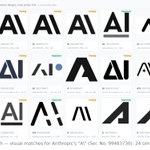
6. And the crossbar-less "A"? A crowded field. A visual-similarity search surfaces about two dozen comparable A/AI letterforms already on the register, several in the same class (screenshot below).
Every one of these facts was public — most of them months before the news broke. The companies watching their dockets saw it live. The ones who weren't found out from a reporter.
If you own a brand: watch your docket, not the headlines. GleanMark monitoring is free — status & TTAB alerts, a register-wide watch for new lookalikes, and visual Design Search.
Full breakdown with serial numbers and the docket detail in the first reply. 👇


.@AnthropicAI has filed a lawsuit against @Abnormal
claiming we copied their brand to mislead security customers, and they are asking for “all revenues, earnings and profits”
This is obviously not true. They don’t own every A/slash design in AI cybersecurity, and they don’t get to turn a logo dispute into a claim on Abnormal’s entire business.
It would be easier to concede quietly. But Abnormal was built on trust, innovation, and intellectual honesty.
Values are what you do when tested (especially when inconvenient) Our behavioral security platform and our AI models are ours.
Everything meaningful about Abnormal was built the hard way: the technology, the customer relationships, and the trust. We earned that trust by protecting customers, and we will defend it.
My blog post about it (link below):


Full analysis — the priority table, both oppositions, all four suspensions, and the design-search data: gleanmark.com/insights/anthr…

LandHopeDreams retweeted

Television pioneer Fred Rogers, gone 23 years ago today.
His acceptance speech for the Lifetime Achievement Emmy Award is always worth a watch.
#RIP 💔

LandHopeDreams retweeted

it's crazy that the secret to prompting AI better than 99.999% of people is just asking AI how to prompt AI

This is what the election came down to. The more likely a news source was to have an editorial filter, the more likely that voter would vote for Harris (and vice versa).

Most election post-mortems neglect a key factor in how people vote: where they get their news.
politi.co/3UKLXjU


Can I disable my “For You” feed on X? I never want to see it, but it somehow reverts to it as a default. And it’s too easy to swipe there accidentally when vertically scrolling.


