





Knowledge to Policy Center - AUB retweeted

📢 Excitement is building for HSR2026!
Speaker confirmations are currently underway, with announcements coming soon. Make sure you're following HSG so you don't miss the latest program updates, speaker reveals and symposium news.
Read more: healthsystemsglobal.org/news…
#HSR2026 #HealthSystemsGlobal #GlobalHealth #HealthSystemsResearch

ALT Sunset view over a city skyline with sailboats on a shimmering river, promoting HSR2026 speaker announcements.
K2P Center’s Program Manager, Clara Abou Samra (@klara_as), participated as a panelist in a #conference discussion on hospital #foodwaste at the Lebanese American University of Beirut (@lebamericanuni), highlighting the importance of addressing food waste as a public health and health systems priority in #Lebanon.
Drawing on her expertise in health systems, policy, and hospital accreditation, Clara Abou Samra emphasized three key priorities:
𝐄𝐟𝐟𝐢𝐜𝐢𝐞𝐧𝐭 𝐚𝐧𝐝 𝐞𝐪𝐮𝐢𝐭𝐚𝐛𝐥𝐞 𝐫𝐞𝐬𝐨𝐮𝐫𝐜𝐞 𝐮𝐬𝐞: Reducing avoidable hospital food waste goes beyond environmental concerns, contributing to more efficient resource utilization, equitable allocation of limited resources, and improved patient care.
𝐈𝐧𝐭𝐞𝐠𝐫𝐚𝐭𝐢𝐨𝐧 𝐢𝐧𝐭𝐨 𝐡𝐨𝐬𝐩𝐢𝐭𝐚𝐥 𝐚𝐜𝐜𝐫𝐞𝐝𝐢𝐭𝐚𝐭𝐢𝐨𝐧: Embedding food-waste management into hospital accreditation standards, institutional policies, and continuous quality improvement processes can strengthen accountability and improve hospital performance.
𝐍𝐚𝐭𝐢𝐨𝐧𝐚𝐥 𝐩𝐨𝐥𝐢𝐜𝐢𝐞𝐬 𝐚𝐧𝐝 𝐬𝐭𝐚𝐧𝐝𝐚𝐫𝐝𝐬: Developing national policies, standardized protocols, and measurable indicators is essential to coordinate food-waste prevention and management across Lebanon’s healthcare institutions.
The conference was held under the patronage and in the presence of Dr. Weam K. Abou Hamdan, Director General of the @mophleb - Lebanon. It was organized by the Department of Nutrition and Food Science at the LAU School of Arts and Sciences (LAU Nutrition), in collaboration with the Faculty of Public Health at the Lebanese University, and with the endorsement of the Lebanese Order Of Dietitians.

10 October was #WorldMentalHealthDay, a reminder that mental health is health and must be a public health priority.
In #Lebanon, the need remains urgent. 110 𝐩𝐞𝐨𝐩𝐥𝐞 𝐥𝐨𝐬𝐭 𝐭𝐡𝐞𝐢𝐫 𝐥𝐢𝐯𝐞𝐬 𝐭𝐨 𝐬𝐮𝐢𝐜𝐢𝐝𝐞 in the first eight months of 2026, and 13.5% 𝐨𝐟 𝐬𝐮𝐫𝐯𝐞𝐲𝐞𝐝 𝐋𝐞𝐛𝐚𝐧𝐞𝐬𝐞 𝐚𝐝𝐨𝐥𝐞𝐬𝐜𝐞𝐧𝐭𝐬 𝐫𝐞𝐩𝐨𝐫𝐭𝐞𝐝 𝐡𝐚𝐯𝐢𝐧𝐠 considered suicide at least once. Yet 𝐨𝐧𝐥𝐲 5% 𝐨𝐟 𝐭𝐡𝐨𝐬𝐞 𝐰𝐡𝐨 𝐬𝐜𝐫𝐞𝐞𝐧𝐞𝐝 𝐩𝐨𝐬𝐢𝐭𝐢𝐯𝐞 𝐟𝐨𝐫 𝐚 𝐩𝐬𝐲𝐜𝐡𝐢𝐚𝐭𝐫𝐢𝐜 𝐝𝐢𝐬𝐨𝐫𝐝𝐞𝐫 𝐬𝐨𝐮𝐠𝐡𝐭 𝐦𝐞𝐧𝐭𝐚𝐥 𝐡𝐞𝐚𝐥𝐭𝐡 𝐬𝐮𝐩𝐩𝐨𝐫𝐭.
These figures highlight the importance of making mental health support more accessible and strengthening the place of mental health in Lebanon’s health system.
Addressing these challenges requires sustained policy action.
In 2013, the Knowledge to Policy (K2P) Center of the American University of Beirut identified mental health as a top policy priority through a priority-setting exercise with the @mophleb - Lebanon. In 2014, K2P published 𝐋𝐞𝐛𝐚𝐧𝐨𝐧’𝐬 𝐟𝐢𝐫𝐬𝐭 𝐦𝐞𝐧𝐭𝐚𝐥 𝐡𝐞𝐚𝐥𝐭𝐡 𝐩𝐨𝐥𝐢𝐜𝐲 𝐛𝐫𝐢𝐞𝐟 and convened the country’s 𝐟𝐢𝐫𝐬𝐭 𝐧𝐚𝐭𝐢𝐨𝐧𝐚𝐥 𝐩𝐨𝐥𝐢𝐜𝐲 𝐝𝐢𝐚𝐥𝐨𝐠𝐮𝐞 𝐨𝐧 𝐦𝐞𝐧𝐭𝐚𝐥 𝐡𝐞𝐚𝐥𝐭𝐡. Within six months, stakeholders established a national MHPSS task force, rolled out WHO mhGAP training in 45 primary health care centers, updated the national essential drug list to include psychiatric medications, and integrated mental health indicators into the MOPH Health Information System.
𝐅𝐫𝐨𝐦 𝐞𝐯𝐢𝐝𝐞𝐧𝐜𝐞 𝐭𝐨 𝐚𝐜𝐭𝐢𝐨𝐧, 𝐦𝐞𝐧𝐭𝐚𝐥 𝐡𝐞𝐚𝐥𝐭𝐡 𝐦𝐮𝐬𝐭 𝐫𝐞𝐦𝐚𝐢𝐧 𝐚 𝐩𝐫𝐢𝐨𝐫𝐢𝐭𝐲.
@AUB_Lebanon
@FHS_AUB
#MentalHealth #PublicHealth #HealthPolicy #EvidenceToPolicy #KnowledgeTranslation #PrimaryHealthCare #SuicidePrevention


Are we ready for the next #pandemic?
On 25 September, world leaders gathered at the UN General Assembly to discuss pandemic prevention, preparedness and response (#PPPR).
The meeting highlighted the importance of health-system resilience, sustainable financing and One Health, while equity and access and pathogen sharing remain important challenges.
However, the Political Declaration on PPPR was not adopted by consensus and is expected to be considered through a vote at a later stage.
The next step matters. For pandemic preparedness to become meaningful, the commitments that follow this process must be translated into evidence, policy, and action.
Since 2015, the Knowledge to Policy (K2P) Center at the American University of Beirut has contributed to this effort through 27 policy products on pandemic prevention, preparedness, and response, including rapid response products, rapid evidence syntheses, peer-reviewed studies, and road maps.
@UN
@WHO
@WHOLebanon
@mophleb
@FHS_AUB
@AUB_Lebanon


The Knowledge to Policy (K2P) Center of @AUB_Lebanon joined researchers, policymakers, academics, and practitioners at the Advancing Research for a Sustainable Future Conference (#ARSFC2026) at the @BeirutArabUni, bringing together discussions on 𝐫𝐞𝐬𝐞𝐚𝐫𝐜𝐡-𝐝𝐫𝐢𝐯𝐞𝐧 𝐬𝐮𝐬𝐭𝐚𝐢𝐧𝐚𝐛𝐢𝐥𝐢𝐭𝐲, 𝐩𝐨𝐥𝐢𝐜𝐲, 𝐢𝐧𝐧𝐨𝐯𝐚𝐭𝐢𝐨𝐧, and 𝐬𝐨𝐜𝐢𝐚𝐥 𝐢𝐦𝐩𝐚𝐜𝐭.
𝐓𝐡𝐫𝐞𝐞 𝐤𝐞𝐲 𝐫𝐞𝐟𝐥𝐞𝐜𝐭𝐢𝐨𝐧𝐬 𝐬𝐭𝐨𝐨𝐝 𝐨𝐮𝐭:
1️⃣ #Sustainability 𝐫𝐞𝐪𝐮𝐢𝐫𝐞𝐬 𝐜𝐨𝐧𝐭𝐢𝐧𝐮𝐢𝐭𝐲 𝐚𝐧𝐝 𝐜𝐚𝐩𝐚𝐜𝐢𝐭𝐲
Sustainability cannot depend on starting over with every change in leadership, introducing new technologies without building the capacity to use and maintain them, or enacting policies and laws without mechanisms for implementation and enforcement.
2️⃣ #Research 𝐬𝐡𝐨𝐮𝐥𝐝 𝐫𝐞𝐬𝐩𝐨𝐧𝐝 𝐭𝐨 𝐧𝐞𝐞𝐝𝐬 𝐚𝐧𝐝 𝐢𝐧𝐟𝐨𝐫𝐦 𝐚𝐜𝐭𝐢𝐨𝐧
Research should respond to the actual needs of communities and policymakers, not only the priorities of funders. Universities, governments, and other stakeholders need to work together to ensure this. Moreover, evidence must reach decision-makers in a timely, accessible, and actionable way to translate research into policy and practice and shape a sustainable future.
3️⃣ 𝐒𝐮𝐬𝐭𝐚𝐢𝐧𝐚𝐛𝐥𝐞 𝐝𝐞𝐯𝐞𝐥𝐨𝐩𝐦𝐞𝐧𝐭 𝐫𝐞𝐪𝐮𝐢𝐫𝐞𝐬 𝐦𝐞𝐚𝐧𝐢𝐧𝐠𝐟𝐮𝐥 𝐩𝐚𝐫𝐭𝐢𝐜𝐢𝐩𝐚𝐭𝐢𝐨𝐧
Social integration means enabling people to shape development and participate in it. Research should therefore look beyond measuring access to asking how people are meaningfully integrated into systems and decisions.
𝐔𝐥𝐭𝐢𝐦𝐚𝐭𝐞𝐥𝐲, 𝐚 𝐬𝐮𝐬𝐭𝐚𝐢𝐧𝐚𝐛𝐥𝐞 𝐟𝐮𝐭𝐮𝐫𝐞 𝐝𝐞𝐩𝐞𝐧𝐝𝐬 𝐨𝐧 𝐡𝐨𝐰 𝐰𝐞𝐥𝐥 𝐰𝐞 𝐜𝐨𝐧𝐧𝐞𝐜𝐭 𝐞𝐯𝐢𝐝𝐞𝐧𝐜𝐞, 𝐢𝐧𝐬𝐭𝐢𝐭𝐮𝐭𝐢𝐨𝐧𝐬, 𝐚𝐧𝐝 𝐩𝐞𝐨𝐩𝐥𝐞 𝐭𝐨 𝐭𝐮𝐫𝐧 𝐢𝐝𝐞𝐚𝐬 𝐢𝐧𝐭𝐨 𝐥𝐚𝐬𝐭𝐢𝐧𝐠 𝐜𝐡𝐚𝐧𝐠𝐞.
@HFLebanon
@CNRSL
@AUB_Lebanon
@AUB_Research
@FHS_AUB


Knowledge to Policy Center - AUB retweeted
Honoring a lifetime of impact in Health Policy and Systems Research
Nominations are now open for the HPSR Lifetime Service Award to the field of health policy & systems research. This award recognizes individuals who have made a major contribution to the field through research and scholarship, leadership, education, mentoring, or the development of future generations of HPSR professionals.
Help us celebrate those whose work has shaped & strengthened the field over many years.
Submit a nomination by 21 October 2026, at 11.59pm (BST)
healthsystemsglobal.org/soci…
#HPSR #HealthSystemsResearch #HSR2026
@AllianceHPSR

ALT Blue and teal graphic announcing the HPSR Societal Awards 2026 and Lifetime Service Award by Health Systems Global and Alliance for Health Policy.
Knowledge to Policy Center - AUB retweeted
⏰ Reminder for #HSR2026 session organizers and speakers
We're still awaiting speaker information from a number of accepted sessions. To help us finalize the Symposium program, please complete the speaker information form and share the registration, visa and travel information with all speakers in your session .
Please refer to the email recently sent by the HSG Secretariat and complete any outstanding actions at your earliest convenience.
We appreciate your support as preparations continue for HSR2026. 🌍
#HealthSystems #HPSR #GlobalHealth

ALT Reminder for HSR2026 organizers and speakers to submit info, register, check visa needs, and share travel details.
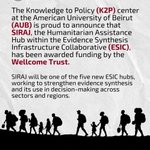
The Knowledge to Policy (K2P) Center at the @AUB_Lebanon is proud to announce that SIRAJ has been awarded funding by the @wellcometrust!
SIRAJ (Synthesis Infrastructure for Research, Analysis & Joint Action) is one of the five new hubs within the Evidence Synthesis Infrastructure Collaborative (ESIC). Led by Dr. Fadi El-Jardali, founder and director of the Knowledge to Policy (K2P) Center at the @AUB_Lebanon, it will build demand-driven, AI-enabled living evidence synthesis infrastructure. The goal is to get the best available evidence to decision-makers in humanitarian settings faster, more inclusively, and in multiple languages.
Over the next few years, SIRAJ will:
1- Synthesize the best available evidence on priority humanitarian issues, including mental health, gender-based violence, and economic wellbeing and resilience
2- Make evidence more accessible, inclusive, and relevant for decision-makers in fragile settings
3- Strengthen capacity and promote equitable partnerships across the Global South and beyond
This work brings together a global partnership:
Knowledge to Policy (K2P) Center, AUB – led by @feljardali
@RESCUEorg (IRC) – Sheree Kullenberg
@UdeA (UNED) – Ivan Florez and Daniel Patiño-Lugo
@ACRES_RRS – Ismael Kawooya and Rhona Mijumbi Deve
@Bigd_BracU – Munshi Sulaiman
@UNICEF – Amber Peterman
Together, SIRAJ aims to make sure humanitarian policies and programmes are informed by the best evidence and deliver greater impact for the people and communities most in need.
Read the full announcement: evidencesic.org/about-us/new…


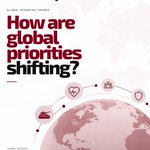
How are global spending priorities shifting?
Between 2024 and 2025, global spending moved in two very different directions: military expenditure increased by $169 billion, while development assistance for health (DAH) decreased by $10.5 billion.
This shift raises an important question: what are we prioritizing, and what might we be putting at risk?
#Health is not separate from #security.
Healthier populations are more resilient, and resilient societies are better prepared to withstand shocks. When health financing declines, the ability to prevent, respond to, and recover from crises can also be affected.
With #resources limited, how we allocate them today helps shape the health and security of tomorrow.
At #K2P, we call for renewed commitment to sustainable health financing and keeping health at the centre of the global agenda.
References: Apeagyei AE, et al., Tracking development assistance for health, 1990-2030: historical trends, recent cuts, and outlook. Lancet. 2025 & Liang, X., et al., Trends in World Military Expenditure, 2025. Stockholm International Peace Research Institute (SIPRI), 2026.
@WHO
@UNICEF
@wellcometrust
@IDRC_CRDI
@NIHRresearch
@UN
@WorldBankGroup
@gavi
@gatesfoundation
@FHS_AUB
@AUB_Lebanon


This week marks Climate Week NYC 2026, a global gathering bringing together leaders from business, government, finance, and civil society to advance climate action and solutions.
For Lebanon, this moment matters. The country's annual mean PM2.5 concentration is 24 µg/m³, nearly 5 times the WHO-recommended level of 5µg/m³, driven by diesel generators, road transport, and power plants and industries.
The health toll is real: air pollution, particularly exposure to particulate matter, is a recognized carcinogenic exposure. Lebanon now ranks #2 in lung cancer incidence among women in the MENA region. Clean air isn't just an environmental issue; it's a public health and cancer prevention issue.
In response, K2P is developing a policy memo on cancer prevention and control, with air pollution as a key pillar, exploring evidence-based, context-specific
policy options like emission controls for generators, improved public transport, and stronger industry emissions standards.
This work will be presented as a poster at HSR2026, where K2P is proud to co-host the symposium at AUC, Cairo, Egypt.
🔗Registration is now open; join us:
hsr2026.healthsystemsresearc…
References: Lakkis, N. A., etal., (2023). Lung cancer and risk factors in Lebanon: Epidemiology,temporal trends, and comparison to countries from different regions in the world. Cancer Control & World Health Organization (2023). Health and environment scorecard: Lebanon.
On 18 September 2026, the #SDGMoment brought leaders together to accelerate action on the 17 SDGs.
What can parliamentary action tell us about Lebanon's progress?
Through its #K2Parliament program, #K2P assessed 1,108 legislative actions, including law proposals, oversight questions, and approved laws. Of these, 778 addressed the #SDGs, with the greatest attention going to #SDG16 (Peace, Justice & Strong Institutions), #SDG3 (Good Health & Well-being), and #SDG10 (Reduced Inequalities).
Yet most of these actions were law proposals, and only about 10% of proposed laws assessed were approved by the General Committee. This points to a gap between parliamentary proposals and their translation into enacted laws. Strengthening follow-up across the legislative process could help turn SDG-related proposals into action and support progress towards a stronger, more equitable, and sustainable tomorrow.
@UN
@UN_SDG
@UNDP
@UNDP_Lebanon
@WHO
@GCNLebanon
@AUB_Lebanon
@FHS_AUB
@feljardali
@Lama_boukarroum
Knowledge to Policy Center - AUB retweeted

We are pleased to announce the Call for Expressions of Interest (EOIs) for the MENA Hub for Action Research on Climate Change & Health (MARCH)!
We invite eligible academic organizations and research institutes to apply before October 9, 2026.
Apply now: shorturl.at/sQrtT

Knowledge to Policy Center - AUB retweeted
📢 Just one week to go until the extended early bird registration deadline for #HSR2026!
Secure your discounted rate by 14 September and join health systems researchers, policymakers and practitioners from around the world in Cairo, Egypt (7-9 December 2026).
Theme: Future-Focused Health Systems in a Changing World
Don't miss your chance to connect, collaborate and help shape the future of health systems research.
Learn more: hsr2026.healthsystemsresearc…
#HealthSystems #GlobalHealth #HPSR #HSR2026

ALT Aerial view of a city by the water promoting early bird registration for the 9th Global Symposium on Health Systems Research 2026.
We are pleased to share our new publication in SSM – Health Systems:
📘 “Strengthening empowered people and communities as a core component of the primary health care approach: A scoping review of WHO policy and operational guidance (2018–2024)”
Developed through a collaboration between K2P, the World Health Organization’s Department of Performance, Financing and Delivery—Dr. Faraz Khalid and Ms. Erica Barbazza—and the University of Toronto, this review examines how empowering people and communities (EPC) is reflected across WHO guidance.
Despite differences in terminology and framing, we found considerable alignment in how EPC is operationalized, particularly in emergencies, communicable diseases, and mental health. This common ground can support a clearer and more coherent approach to EPC through a primary health care lens while respecting programme-specific needs.
We hope this work supports efforts toward more responsive, participatory, and people-centred health systems.
Our sincere appreciation to all co-authors and collaborators.
🔗 Read the publication: sciencedirect.com/science/ar…
#PrimaryHealthCare #CommunityEmpowerment #HealthPolicy #HealthSystems #WHO

Accepted to speak at #HSR2026? Congratulations! 🎉
Acceptance notifications have now been sent!
And we have more good news: early bird registration has been extended to 7 September 2026.
📍 Cairo, Egypt
📅7–9 December 2026
Register: hsr2026.healthsystemsresearc…
#HealthSystems #HPSR
@H_S_Global
@MBRSG

How ready are countries to implement #OneHealth?
Our study presents KOHSRA-a practical framework to assess national One Health system readiness & inform priority actions. Piloted in Croatia, Ghana & Nigeria, it identified common strengths, gaps &priorities
@feljardali
@Rasha_Fadlallah
@AUB_Lebanon
@FHS_AUB
@WHO
@Loeffler_News
sciencedirect.com/science/ar…

Six months. One shared vision. Meaningful impact.
The #K2PMentorshipProgram empowered Ministry of Health professionals in #Oman to translate evidence into action. The achievements below reflect the continuation of a journey toward institutionalizing evidence-informed policymaking. 👇

The 3-day culminating event of #K2PMentorshipProgram in #Oman concluded with a Leadership Roundtable on institutionalizing evidence-informed policymaking, followed by a joint MoH–K2P graduation ceremony. Congratulations to the 40+ @OmaniMOH professionals who completed the program!


Participants in the #K2PMentorshipProgram reflected on the outputs, achievements, and early signs of change emerging from their work to advance evidence-informed policymaking within the Ministry of Health in #Oman.


A key milestone of the #K2PMentorshipProgram in #Oman was a national #PolicyDialogue on strengthening primary health care to address #NCDs. On 8 July 2026, 16 senior leaders, policymakers & researchers framed the policy problem, refined 3 policy options & agreed on implementation pathways.

